
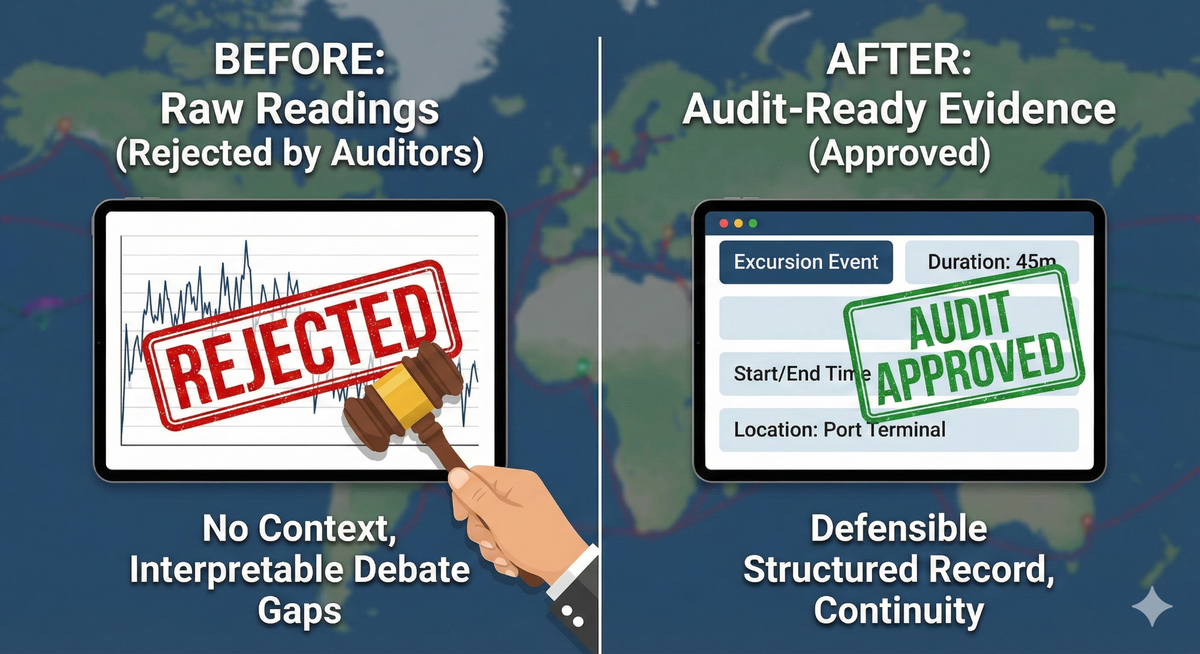
Cold chain operations often start with a simple goal: measure temperature. But the moment a shipment faces an excursion — or a customer escalation, QA review, or insurance claim — the goal changes. Teams are asked to prove what happened with defensible, time-consistent records.
That is where many cold chain programs struggle: not because sensors are unavailable, but because data is not structured as evidence.
This article outlines an engineering and compliance to transform telemetry into an evidence trail for overseas freezer and reefer routes. It is based on practices we describe in the GPT29 Cold Chain White Paper (download here)
1. Why cold chain "visibility" fails in audits
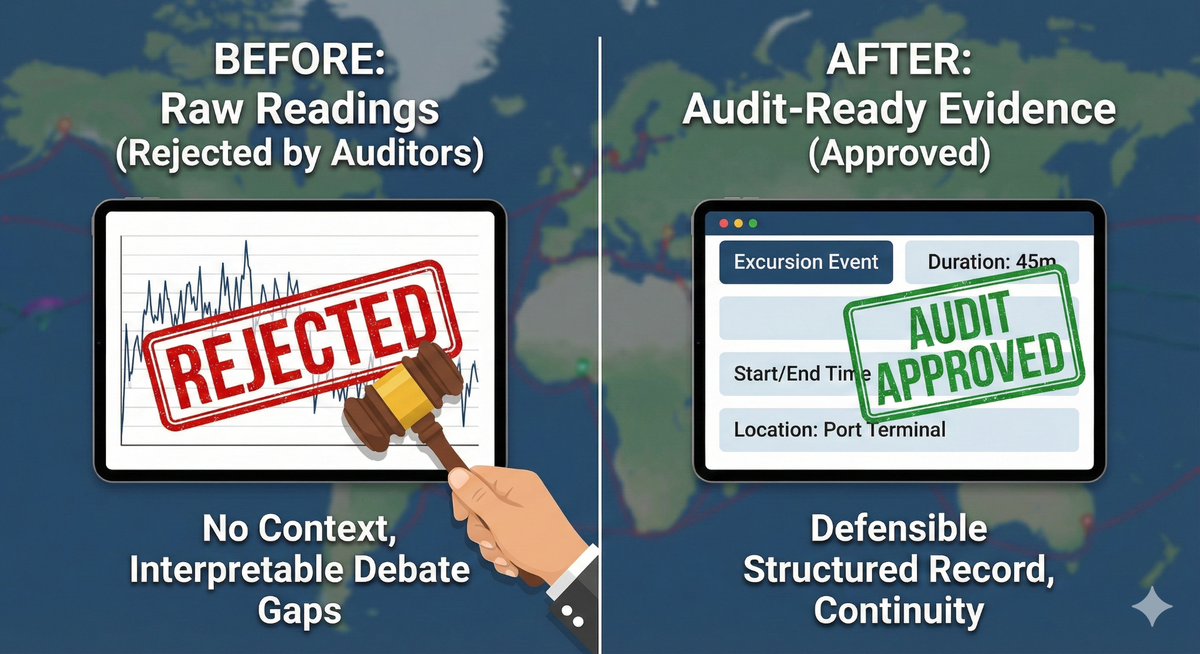
When an incident occurs, auditors and stakeholders rarely accept a single chart screenshot. They ask questions that require event logic and context:
- When did the excursion start, and when did it end?
- How long was the shipment out of bounds?
- Where did it happen — in transit, at a terminal, during customs hold?
- Are there correlated signals suggesting exposure (door-open proxy) or handling issues?
- Is there evidence continuity, or are there gaps at critical moments?
- If your system only stores periodic raw readings, you will end up debating interpretations rather than presenting a clear record.
2. Define the "excursion" as a formal event
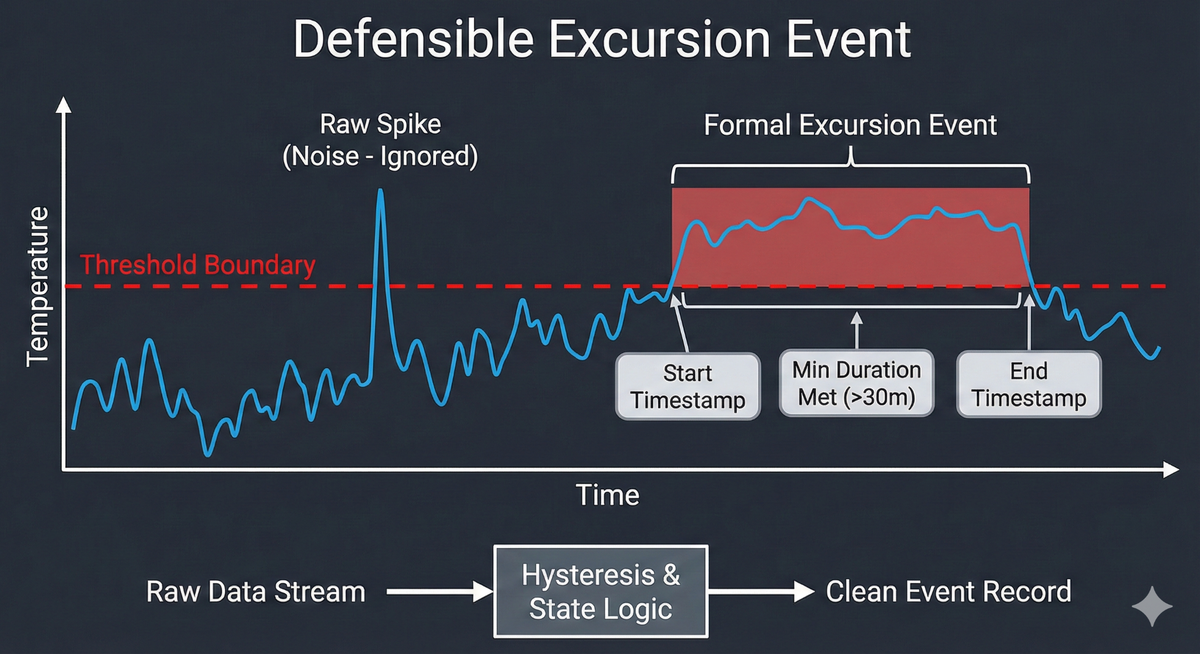
Not every spike above a setpoint constitutes a reportable deviation. To transform noisy readings into evidence:
- Establish a temperature threshold boundary for your product.
- Require a minimum duration above that threshold (e.g., more than 30 minutes) to filter out transient spikes.
- Record start and end timestamps once the minimum duration is met.
- Implement hysteresis and state logic so the event is continuous until the temperature returns below the threshold.
By defining excursions this way, you convert raw data into clear, defensible event records.
3. Preserve evidence continuity on global routes
Cross-border journeys span countries and oceans. A simple cloud chart will be incomplete if your tracker stops sending data every time a ship leaves shore or the container goes through a tunnel. To ensure that audits have a continuous record:
- Transit across countries and continents means variable cellular coverage and long sea voyages with no network; your tracker must store data locally during these gaps.
- Use buffering and store‑and‑forward: devices should buffer readings and forward them once they regain connectivity to ensure a continuous evidence trail.
- Support accountable handoffs: record each transfer between carriers or custodians (e.g., port terminals, customs brokers) as a formal event to maintain chain‑of‑custody.
Without continuity, investigators will question what happened during those missing segments.
4. Correlate condition data with exposure & handling signals
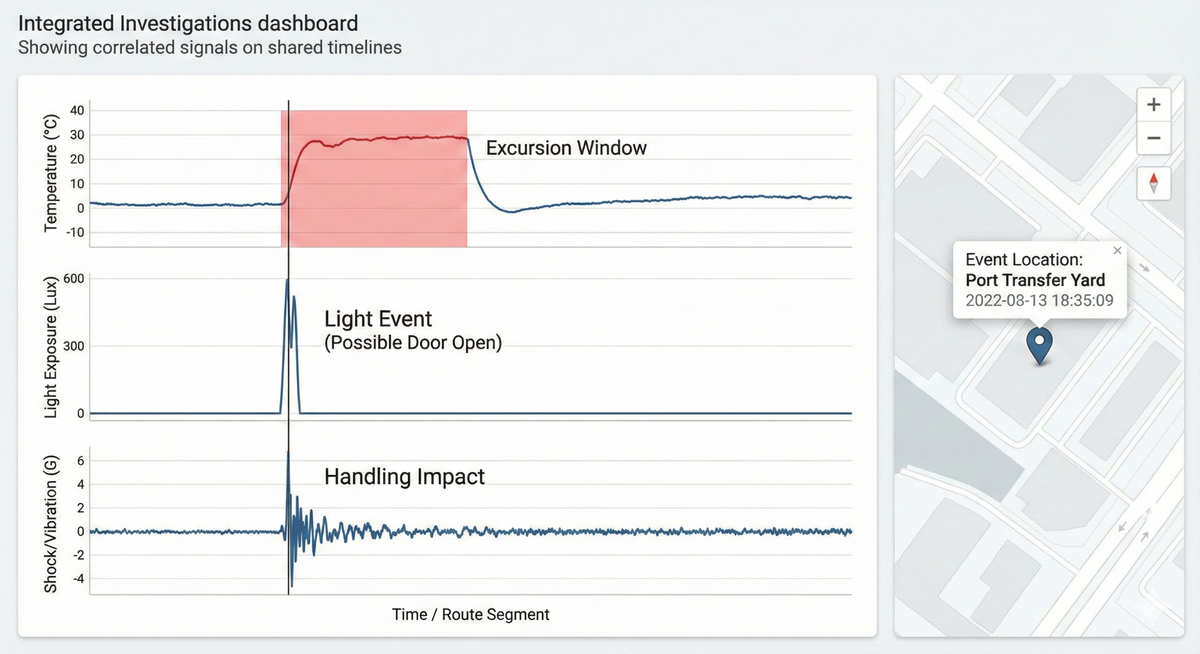
Temperature charts alone can't tell the whole story. Investigators must understand the context around an excursion:
- Light exposure events: a sudden burst of light often means a door was opened, letting ambient air in or cooling out.
- Shock and vibration: large G‑force spikes reveal drops or rough handling that may coincide with a temperature excursion.
- Location: linking the event to a port terminal or handover yard pinpoints who had custody when the incident occurred.
Aligning these signals on a shared timeline provides a complete narrative from cause to effect and strengthens your evidence trail.
5. Installation is a compliance variable
Even the best sensor won't produce defensible evidence if it's installed incorrectly or dislodged in transit:
- Placement: mount the tracker away from refrigerator doors, vents or fans, inside the packaging at the product level.
- Secure attachment: use tamperproof brackets, adhesives or zip ties so the device stays put for the entire route.
- Orientation and packaging: pack the unit upright and protect it from condensation or ice; test that it's still within the payload environment, not outside.
Treat installation as part of your compliance process rather than an afterthought
6. Integration-first deployments
Sensors and data platforms should work with your existing systems, not create another silo:
- Choose devices and platforms that offer open APIs, webhooks and data export so you can ingest events into your WMS, ERP or quality systems.
- Use a single repository to unify temperature, location and exposure data from different tracker models and carriers.
- Configure simple, automated reports and alerts, rather than manually logging in to check charts.
By integrating telemetry into your existing workflows, you reduce training overhead and ensure that audits are aligned with your operational reality.
7. Pilot with measurable acceptance criteria
Before rolling out across your entire fleet, run a focused pilot and define what success looks like:
- Select a few representative routes and cargo types to evaluate performance under real-world conditions.
- Define acceptance criteria for battery life, evidence continuity, excursion detection accuracy and integration ease.
- Review the results with operations, QA and compliance teams and iterate on placement, thresholds and workflows.
A structured pilot exposes issues early and gives everyone confidence before scaling up.
By following these practices, you can transform raw telematics into defensible, audit-ready evidence for your cold chain. For a deeper dive into the underlying technology and data structures, download the GPT29 Cold Chain White Paper here or get the PDF directly here.