
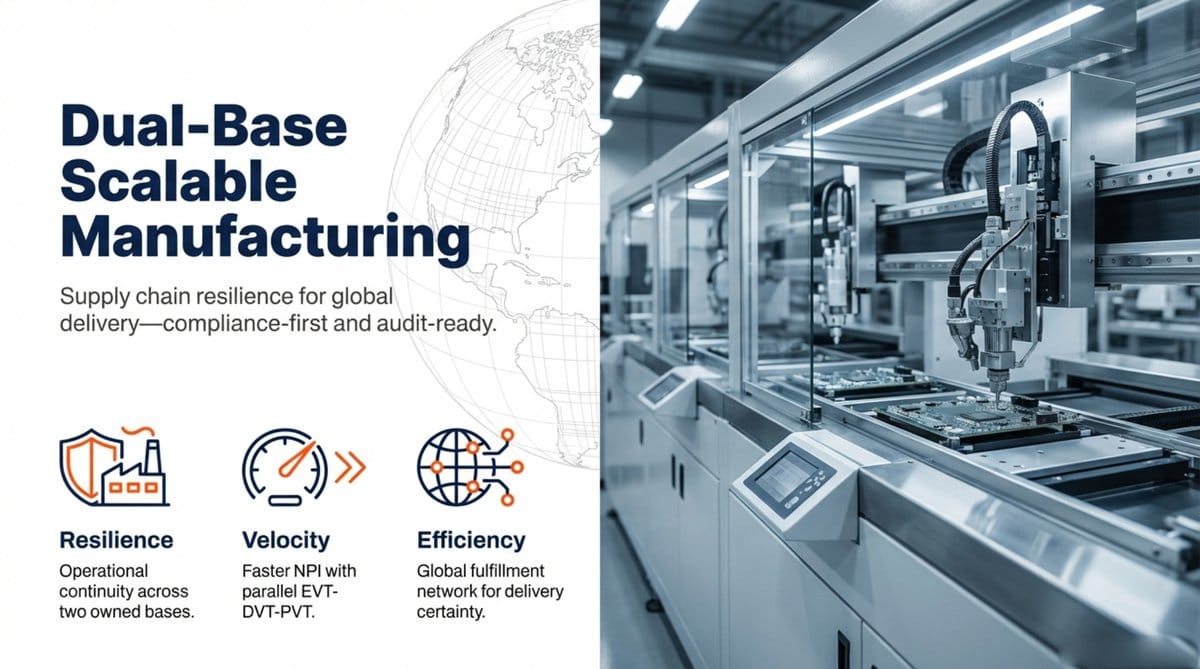
Building Supply Chain Resilience: Operationalizing Dual‑Base Manufacturing, Parallel NPI and Fulfillment Networks
Meta Information
Meta description: This article explores how dual‑base manufacturing, parallel EVT→DVT→PVT validation, and fulfillment network playbooks make supply chains resilient and audit‑ready. It provides actionable insights on operational resilience, compliance‑first manufacturing and logistics, and offers FAQs to help readers implement these principles.
Keywords: supply chain resilience, dual‑base manufacturing, parallel NPI, EVT DVT PVT, fulfillment network, compliance‑first, audit‑ready, global delivery, operational resilience
Introduction: From Buzzwords to Operable Capability
Supply chains rarely have the luxury of smooth seas. Volatile demand, geopolitical events, natural disasters and public health crises have made disruption the norm rather than the exception. In the face of these realities, the concept of resilience is often reduced to a marketing slogan—a slide in a presentation promising “no downtime” or “risk‑free operations.” Yet anyone who has shepherded a hardware program from concept to global delivery knows that resilience only matters when it is operable. It must be built into the fabric of your manufacturing and logistics processes, tested regularly, and ready for auditors’ scrutiny. In other words, resilience is a capability, not a checkbox.
This article looks at three pillars that transform resilience from concept to reality:
- Dual‑base manufacturing that lets teams rebalance capacity across two geographically distinct factories.
- Parallel NPI (New Product Introduction) using EVT→DVT→PVT phases that reduce time to market without compromising quality.
- Fulfillment network playbooks that align production with destination markets, optimize routing and consolidation, and keep documentation ready for audits.
Throughout this discussion, we maintain a compliance‑first, audit‑ready posture. Every process, metric and playbook discussed here is grounded in actual production and respects applicable laws and regulations. These practices will not eliminate uncertainty, but they do make disruptions manageable and delivery more predictable—essentials for any modern hardware program.
The Dual‑Base Ecosystem: Designing Continuity
Why two bases matter
The core idea behind dual‑base manufacturing is deceptively simple: instead of concentrating all production in a single location, split it across two owned sites with standardized processes. When disruption hits one site—be it a regional lockdown, a labor shortage or a power outage—you can rebalance capacity to the other. This is not an ad‑hoc transfer but a controlled shift supported by standard work instructions, synchronized documentation and pre‑validated tooling.
Much of the recent discourse around relocating manufacturing has been driven by tariff considerations. In contrast, a dual‑base strategy focuses on continuity and repeatability. Each base mirrors the other in process controls, quality management, and test coverage. Operators, engineers and line supervisors train to identical procedures. Tooling and fixtures are built in pairs and validated in parallel. In addition, a buffer capacity—often 40 % or more of normal output—is maintained to accommodate priority builds, demand spikes or recovery scenarios. That spare capacity is not idle; it is continuously rotated through “ready” status via pilot runs and engineering builds.
Synchronization and transfer readiness
Synchronization happens on multiple levels. Process documentation lives in a centralized repository accessible from both bases and version‑controlled so that updates propagate instantly. Production databases (e.g., MES and traceability systems) are integrated, allowing engineering teams to see output metrics and quality alerts in real time, regardless of location. Even seemingly mundane items like maintenance schedules and calibration certificates are aligned so that a tool transferred from Yibin to northern Vietnam (or vice versa) plugs into a familiar environment.
When recovery is needed, there is no time to hunt for paperwork. Transfer‑ready documentation ensures that the receiving site knows exactly which processes to run, which test limits to apply and which inspectors to deploy. Lines can switch over in as little as 72 hours—a dramatic improvement over the weeks‑long transitions common in conventional relocation scenarios. The typical ramp‑down/ramp‑up plan includes pre‑staged materials at both locations, with logistics arranged through accredited brokers who can navigate import/export requirements without improvisation.
Illustration: Continuity by design
The figure below (adapted for web) illustrates the dual‑base concept. Two bases—Yibin in China and a northern site in Vietnam—are connected by standardized processes and transfer‑ready documentation. A maintained buffer of more than 40 % capacity allows the network to absorb shocks, whether they stem from demand surges or supply interruptions. Footnotes emphasize that these metrics represent typical ranges and may vary by program conditions. The key is not the exact number but the presence of a deliberately managed buffer and repeatable processes.
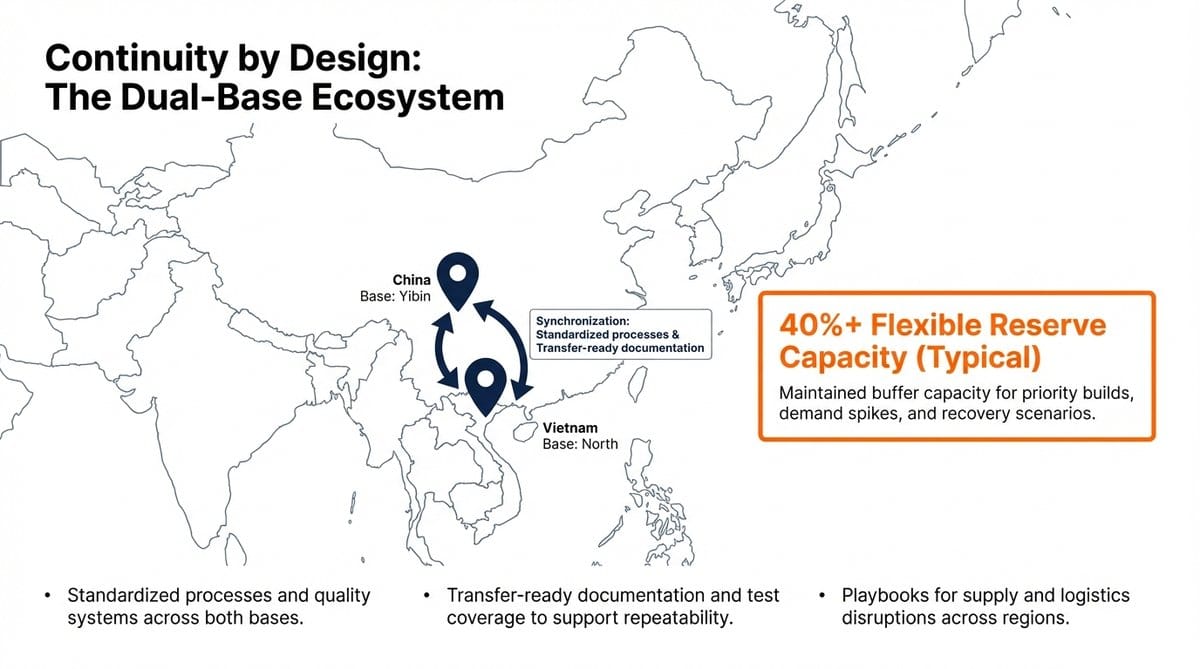
Alt text: Dual‑base ecosystem map illustrating two bases in Yibin, China and northern Vietnam connected by synchronized processes and transfer‑ready documentation. Highlighted text notes a typical flexible reserve capacity above 40 %.
By designing continuity into the manufacturing topology, organizations create more than redundancy. They build an operational environment in which every build is a training exercise for a possible transfer. This reduces the stress and error rate when an actual disruption occurs. Moreover, the discipline of documenting and synchronizing every step provides a strong foundation for compliance audits, which increasingly require proof of control across the entire supply chain.
Internal anchor: The case for dual manufacturing in China and Vietnam
To dive deeper into the rationale behind selecting China and Vietnam as complementary bases—including considerations like supply ecosystems, labor availability, and geopolitical diversification—see our in‑depth article “Building Resilient Supply Chains: The Case for Dual Manufacturing in China and Vietnam”. This companion piece examines cost, reliability and capacity allocation across the two locations.
Accelerating Time to Market: Parallel EVT→DVT→PVT Validation
Understanding EVT, DVT and PVT
Hardware development typically flows through three validation phases:
- EVT (Engineering Validation Test): Focused on verifying the core functionality of a design. Teams build prototypes to test mechanical fit, electrical performance, firmware behaviour and thermal characteristics. The goal is to prove that the product concept works as intended.
- DVT (Design Verification Test): Shifts the emphasis to compliance with specifications and manufacturability. Here, teams validate that the product meets regulatory standards (e.g., FCC, CE), reliability targets (thermal cycling, vibration, drop tests) and that the design can be mass‑produced without quality escapes. Tooling and fixtures are often finalized in this phase.
- PVT (Production Validation Test): Involves running a pilot build on the actual production line using final materials and processes. It serves as a rehearsal for mass production, allowing teams to iron out any remaining issues in yield, throughput or supply logistics.
Traditionally, these phases are executed sequentially. Each phase must complete before the next begins, leading to long development cycles. If DVT reveals a major flaw that should have been caught in EVT, the schedule slips dramatically.
Parallelization: reducing the critical path without skipping checks
Parallel NPI aims to overlap certain EVT, DVT and PVT tasks under controlled conditions. For example:
- Concurrent mechanical and electrical EVT: Mechanical prototypes may be built using production‑grade materials while electrical tests run on breadboards. If mechanical EVT reveals a housing interference issue, the electrical team does not have to wait; they can still debug firmware and signal integrity concurrently.
- Early reliability testing: Instead of waiting until DVT to run thermal and vibration tests, teams can start stress testing EVT units. Early failures inform design changes before expensive tooling is cut.
- Phased tooling build: Tooling for high‑risk parts (like RF shields or enclosures) can be built and verified during DVT, while lower‑risk parts proceed into PVT preparation. This staggers the risk and allows partial pilot builds while remaining tools are refined.
The result is a 20–35 % reduction in the prototype‑to‑pilot timeline for typical IoT hardware. Importantly, parallelization does not equate to skipping checks. Each validation gate still requires documented test results, sign‑offs and risk assessments. What changes is the timing and overlap. Cross‑functional teams coordinate to ensure that dependent tasks only overlap when risks are understood and mitigation plans are in place.
Visualizing parallel validation
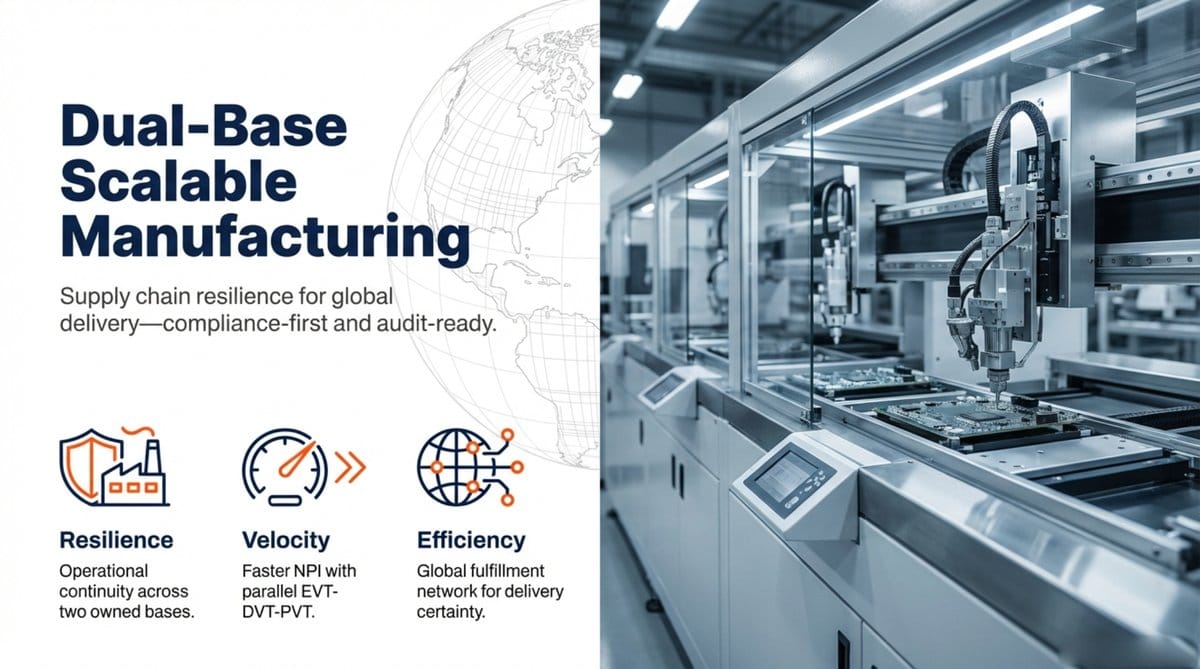
Alt text: Slide showing dual‑base scalable manufacturing with icons for resilience, velocity and efficiency, and an automated production line representing high‑precision manufacturing. The text notes that operational continuity across two bases improves resilience, parallel EVT‑DVT‑PVT accelerates NPI, and global fulfillment network enhances delivery certainty.
The image above captures three benefits of this approach—resilience, velocity and efficiency—and pairs them with a high‑precision manufacturing line. The visual reinforces that speed gains are achieved through better process design, not corner‑cutting. By pairing parallel NPI with dual‑base operations, teams ensure that improvements in time to market do not compromise continuity or quality.
Training the organisation for parallel NPI
Achieving these gains requires more than scheduling changes. It demands a culture where mechanical, electrical, firmware, RF and manufacturing engineers collaborate from day one. Documentation flows seamlessly between teams, and change control processes accommodate multiple “branches” of a design. Managers must allocate budgets for extra prototypes, early tooling and additional reliability tests—investments that pay off through shorter ramp‑ups and fewer field failures.
The combination of parallel NPI and dual‑base manufacturing also influences supply chain planning. Materials must be sourced for multiple builds in overlapping timelines. Quality teams must validate parts from vendors at both bases concurrently. And procurement must anticipate demand spikes when multiple builds run in parallel. Taken together, these factors underscore the need for strong coordination and clear internal communication.
Fulfillment Network Playbooks: Designing for Delivery Certainty
Beyond freight: the strategic role of logistics
Many discussions of supply chain resilience focus on manufacturing capacity. However, logistics and fulfillment are equally critical. Producing units on time means little if they languish in a warehouse waiting for a vessel or if customs paperwork delays entry into the destination market. Delivery certainty requires thinking of the production base, intermediate staging locations and final customer destinations as a single network.
Fulfillment network playbooks provide pre‑defined routing options, consolidation rules and contingency plans. They align manufacturing sites with markets based on transit time, duty classifications, available carriers and service‑level agreements. For instance, high‑volume orders bound for a regional distribution center may go directly from the primary base, while smaller, high‑mix orders destined for multiple countries may route through a staging hub where they are consolidated and labeled. The playbooks specify when to use air freight versus ocean, which forwarders are approved, and what documentation must accompany each shipment.
Routing & consolidation choices
The photo below depicts a warehouse coordinator reviewing a routing plan on a tablet while cartons designated for “consolidated” and “direct ship” shipments await processing. The distinction matters. Consolidation reduces per‑unit logistics costs by combining multiple small orders into a single shipment, but it requires holding inventory until enough orders accumulate. Direct ship, by contrast, speeds delivery but may increase cost. A well‑designed playbook helps teams decide when each method is appropriate based on demand patterns, service‑level commitments and inventory carrying costs.
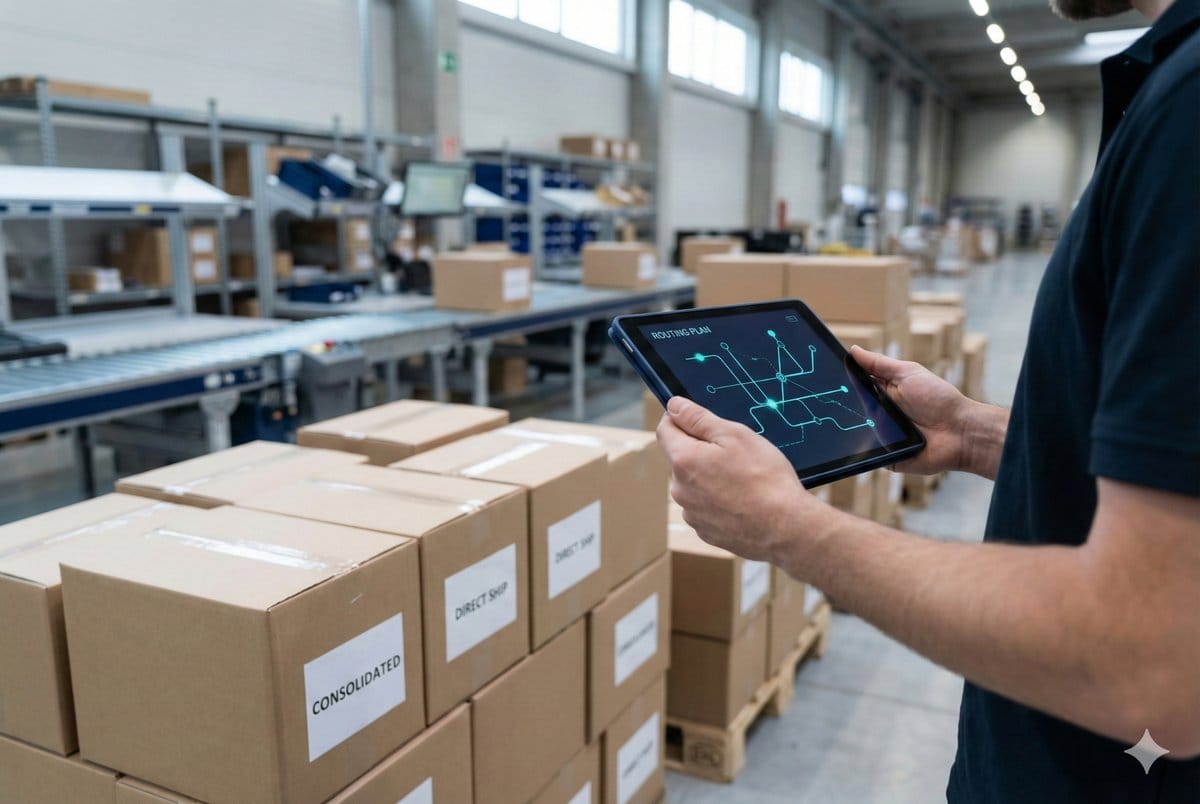
Alt text: Warehouse worker holding a tablet showing a digital routing plan while standing next to pallets of packages labeled “consolidated” and “direct ship”; the image conveys routing and consolidation decisions in a fulfillment network.
Combining these routing and consolidation playbooks with dual‑base manufacturing unlocks further resilience. If a disruption hampers the primary base’s ability to serve a nearby market, the secondary base can step in, drawing on the same logistics rules. Similarly, if a carrier experiences delays or a port is congested, alternate routes and forwarders are pre‑approved, minimizing downtime. Because the documentation and shipping labels are standardized, switching from one route to another does not introduce compliance or traceability risks.
Aligning fulfillment with regulatory requirements
Delivery certainty is not just about timeliness. It also encompasses compliance with customs regulations, trade agreements and origin declarations. A playbook must detail the documentation required for each market (commercial invoices, packing lists, certificates of origin, and product test reports) and ensure that the information flows from the manufacturing execution system to the logistics provider without manual intervention. Modern systems generate export paperwork automatically based on the bill of materials and manufacturing data stored in the MES, reducing the risk of errors and ensuring that origin claims reflect actual production.
In addition, many countries operate under preferential trade agreements that depend on specific regional value content (RVC) thresholds. Fulfillment playbooks integrate these rules so that shipments automatically qualify for applicable tariff reductions when they meet the criteria. Importantly, this process is compliance‑first; it does not create false origin claims. When shipments do not meet preferential thresholds, the system generates the appropriate non‑preferential certificate of origin. Transparency and auditability are essential.
Metrics and typical ranges
Logistics teams often track metrics such as lead time, on‑time delivery, cost per unit delivered and inventory turnover. When dual‑base operations and fulfillment playbooks are executed well, many programs see:
- Lead time reductions of 7–10 days, particularly when shipments originate closer to the destination market.
- Landed cost efficiencies of 5–12 %, driven by optimised consolidation, route selection and duty qualification.
These figures are typical ranges, not guaranteed outcomes. Actual results depend on product mix, order volume, destination, regulatory environment and logistics contracts. The important point is that supply chain managers should monitor these metrics regularly and adjust playbooks as conditions change.
Compliance‑First and Audit‑Ready: An Operating Model, Not an Afterthought
Building compliance into processes
Throughout this article we have assumed a compliance‑first approach. This goes beyond preparing for an occasional audit; it requires designing processes so that compliance is a natural by‑product of normal operations. Key elements include:
- Traceability from component to shipment: Every unit carries a unique identifier (via barcodes or QR codes) that links back to its bill of materials, manufacturing base, test results and shipping route. Quality incidents can be traced to specific production lots and corrective actions implemented quickly.
- Document control: Process documentation, test plans, drawing revisions and supplier certifications are maintained in a controlled repository with version history. Auditors can see not only the current procedure but how and why it evolved.
- Origin determination: Origin declarations reflect actual production activities. If an assembly is completed in Vietnam using subassemblies made in China, the certificate of origin states this. Systems calculate regional value content automatically and generate the correct certificate type.
- Training and drills: Personnel are trained not only on how to run machines but on how to maintain records, prepare for transfers and respond to disruptions. Regular drills simulate transfer of production, record retrieval and shipping under alternative routes.
Why compliance matters for resilience
Some organizations see compliance as a box‑checking exercise. However, compliance and resilience are deeply connected. Without accurate records and auditable processes, it is impossible to know whether your backup plan will work. Regulators, customers and insurance providers increasingly ask for proof of operational controls. A supply chain that can produce such proof quickly is more likely to secure permits, qualify for preferential trade programs and receive favourable terms from carriers and suppliers.
By embedding compliance into everyday work, companies also reduce the cognitive load on their teams. Operators do not have to scramble to prepare reports when a regulator calls. Instead, the system continuously collects the data, organizes it and makes it available on demand. This lowers stress, improves morale and reduces the risk of errors.
Putting It All Together: The Anatomy of Delivery Certainty
Combining dual‑base manufacturing, parallel NPI and fulfillment playbooks creates a resilient and nimble supply chain capable of delivering products globally with high confidence. The pillars reinforce each other:
- Dual bases provide capacity flexibility and geographic diversification, ensuring that a disruption at one site does not halt production.
- Parallel NPI accelerates time to market, enabling firms to respond to market opportunities or regulatory changes faster than competitors while maintaining quality.
- Fulfillment networks ensure that products reach customers reliably, using pre‑approved routes and consolidation strategies that balance cost and service levels.
When layered over a compliance‑first foundation, these capabilities produce more than operational benefits. They enhance credibility with customers and partners, demonstrate adherence to evolving trade regulations and increase investor confidence. They also create a culture of continuous improvement. Metrics gathered from both manufacturing and logistics feed back into design and planning, allowing teams to refine processes and playbooks over time.
The human factor
While technology and process design are central to resilience, people remain at the heart of these systems. Operators who understand why a process is designed a certain way are more likely to follow it. Engineers who see traceability not as bureaucracy but as a tool for problem solving become champions of compliance. Supply chain managers who collaborate across functions—manufacturing, quality, logistics, legal—create an environment where risk is discussed openly and mitigated proactively. Building this culture takes time and leadership commitment, but it is ultimately what sustains the systems described here.
Looking ahead
As supply chains continue to evolve, resilience will remain a moving target. New technologies such as digital twins, advanced analytics and AI‑driven scheduling will enable even finer control over capacity and routing decisions. Regulatory requirements will also change, demanding greater transparency and environmental accountability. Organizations that have embraced the principles outlined here—decentralization, parallelism, documented playbooks and compliance‑by‑design—will be better positioned to adapt. They will treat each new challenge not as a crisis but as an opportunity to validate and strengthen their operating model.
Frequently Asked Questions (FAQ)
What is dual‑base manufacturing and why does it matter?
Dual‑base manufacturing refers to operating two owned production sites with synchronized processes, tools and documentation. Each base can produce the same products to the same standards. This matters because it provides capacity flexibility and geographic diversification, reducing the risk that a local disruption will stop production. When combined with buffer capacity, dual bases allow teams to rebalance output quickly without re‑qualifying processes.
How does parallel EVT→DVT→PVT reduce development time without skipping checks?
Parallel validation overlaps certain tasks from the engineering, design and production phases. Mechanical and electrical tests may run concurrently, reliability testing begins earlier, and tooling for high‑risk parts is built in phases. Teams coordinate closely to ensure that overlapping tasks do not hide critical issues. Because each phase still requires formal sign‑offs and documentation, quality gates remain intact. Typical results include a 20–35 % reduction in the time from prototype to pilot build.
Why is a compliance‑first approach critical for supply chain resilience?
Compliance‑first means that processes are designed to meet regulatory, legal and customer requirements by default rather than being retrofitted later. This is critical for resilience because it provides traceability, documentation and control. When disruptions occur or auditors request information, teams can produce records quickly and confidently. Compliance‑first operations also qualify for preferential trade programs and instill trust among customers and partners.
How can companies start implementing these practices?
Begin by documenting existing processes and identifying critical dependencies. Establish cross‑functional teams to develop standard work instructions, test plans and transfer protocols. Pilot dual‑base operations with a limited product line to learn how capacity can be rebalanced. Introduce parallel validation in areas with clear dependencies and low risk, and refine as you gain experience. Develop logistics playbooks that outline routing and consolidation choices, and integrate documentation requirements into your execution systems. Finally, invest in training and create a culture where compliance and continuous improvement are valued.
How does this relate to the company’s product portfolio?
Although this article focuses on operational strategy, resilience and compliance ultimately support product innovations. For an overview of Apple Ko’s flagship product offerings in asset tracking and monitoring, visit our flagship product innovations page. Ensuring that new devices can be produced and delivered reliably is as important as the features they offer.
Conclusion
Resilience is not an abstract ideal; it is an operating model built on dual‑base manufacturing, parallel validation and robust fulfillment playbooks. These practices provide a repeatable framework for delivering hardware products to global markets even amid disruption. By maintaining a compliance‑first posture and investing in documentation, training and cross‑functional collaboration, organizations transform resilience from a marketing term into a measurable capability. As supply chains face new challenges—be they geopolitical, environmental or technological—the ability to rebalance production, accelerate development and ensure delivery certainty will separate the leaders from the followers. The journey begins with recognizing that resilience is not a backup plan; it is the way we operate every day.