
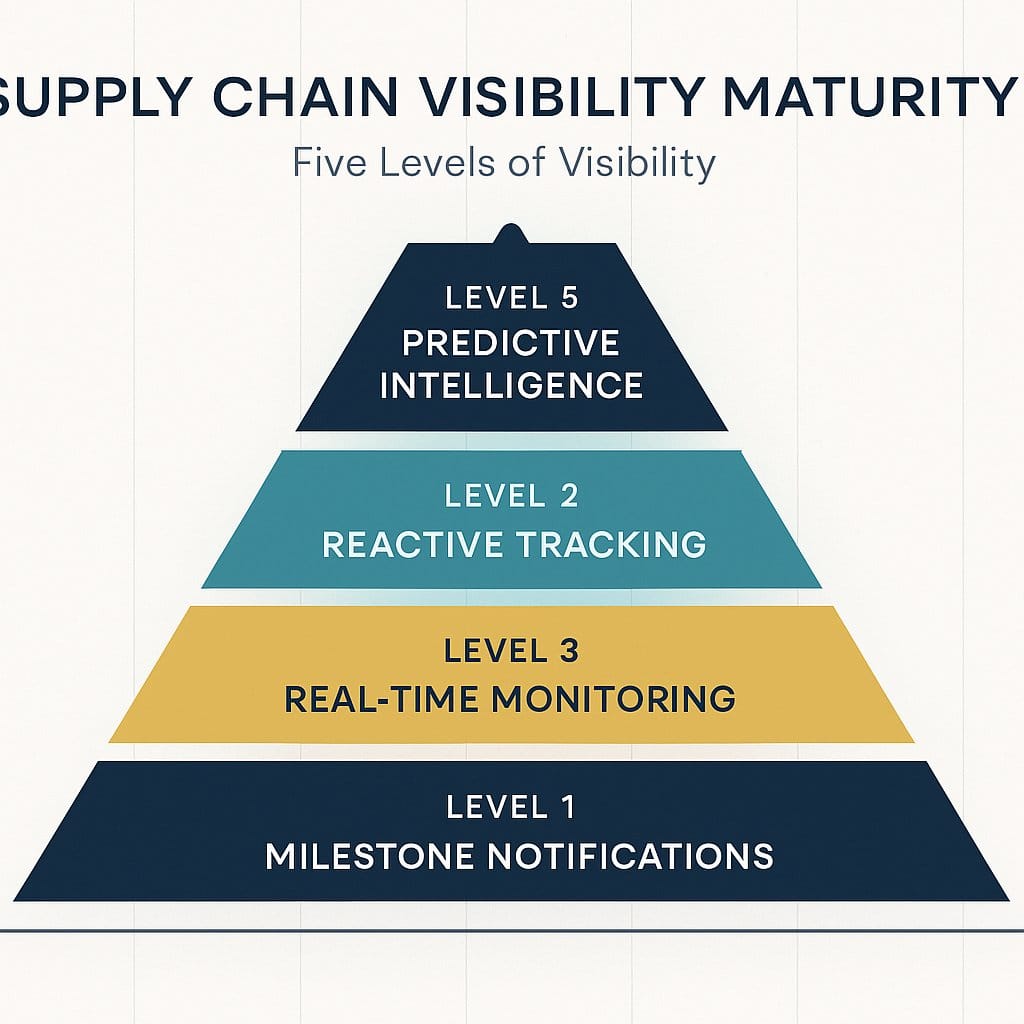
When a logistics director asks "Can we see where our shipments are?", what they almost always mean is something far more ambitious: can we see what's happening to our shipments, predict what will happen next, and act before a customer notices? Those are five different questions, not one. Most companies, including ones that have spent real money on tracking, are sitting on rung two of that ladder, convinced they're higher. This article lays out the framework I use when scoping visibility projects, and explains why Level 2 is the rung where progress quietly stalls.
What Is Supply Chain Visibility Maturity?
Supply chain visibility maturity is a framework that classifies an organization's ability to observe, monitor, and act on what is happening to its goods in transit. It progresses from passive milestone notifications to predictive intelligence systems that detect anomalies and trigger autonomous responses. Each level adds capability (and engineering complexity) over the one below. The model maps cleanly onto the underlying logistics technology stack: tracker hardware, connectivity, data pipeline, and the operations capability required to act on the resulting telemetry.
The model echoes what Gartner has formalized as a five-stage logistics maturity model, and it tracks how broader analytics frameworks describe progressive sophistication in any industrial discipline. Across two decades of designing IoT hardware and working with logistics, fleet, and cold chain customers in more than one hundred countries, I have seen the pattern hold consistently: most operators self-assess one or two levels higher than the engineering reality of their deployment supports.
What Are the Five Levels of Supply Chain Visibility?
The framework below distills how I evaluate an operation's visibility maturity in a discovery conversation. It is closely aligned with the 5-level visibility framework Eelink uses for hardware specification, where each level corresponds to a different class of tracking device and data pipeline.
| Level | Capability | Data Source | Decision Mode |
|---|---|---|---|
| Level 1 Milestone Notifications |
"Picked up", "in transit", "delivered" — discrete carrier-driven events | Carrier APIs, EDI, manual scans | Post-event reporting |
| Level 2 Reactive Tracking |
Periodic GPS pings, basic last-known-location dashboard | Single-mode tracker, vehicle telematics | Investigate after a complaint |
| Level 3 Real-Time Monitoring |
Continuous position, dynamic ETA, geofence and exception alerts | LTE-M / NB-IoT trackers, integrated TMS | Manage by exception |
| Level 4 Conditional Visibility |
Location plus temperature, humidity, shock, light, door events, calibrated and timestamped | Multi-sensor tracker, audit-grade telemetry pipeline | Compliance evidence and intervention |
| Level 5 Predictive Intelligence |
Anomaly detection, predicted disruptions, automated rerouting and notifications | All of the above plus ML models, partner-network data, weather and traffic feeds | Autonomous or assisted response |
Why Are Most Companies Stuck at Level 2?
The headline statistics about visibility tend to mislead. Survey after survey reports that two-thirds or more of supply chain executives say they have "moderate to high" visibility into their network. That's the self-report. The engineering reality, when you walk a deployment, is different. McKinsey, in research with senior global supply chain executives, found that only about half could describe the location and essential risks of their tier-one suppliers, and only two percent had any meaningful visibility beyond tier two.
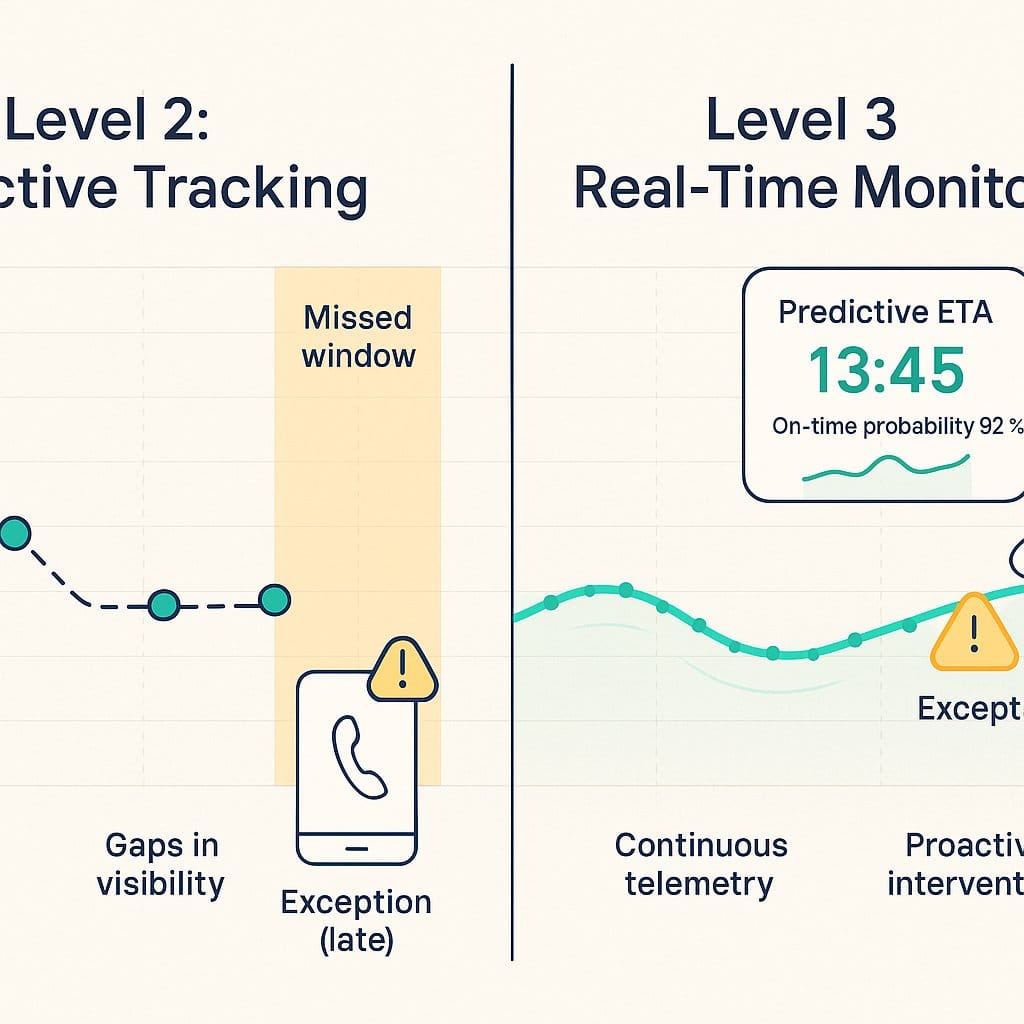
That McKinsey number is brutal. It says that for the overwhelming majority of operations, the data stops at the first handoff. Within a single shipment, the picture is similar. Many operators rely on one of three patterns that all live at Level 2:
- Vehicle telematics only. The truck has a GPS unit; the cargo does not. Once the cargo leaves the truck (at a cross-dock, an intermodal yard, an airline pallet), visibility ends.
- Hourly position pings. Battery-saving asset trackers configured to report every 60 or 120 minutes. Between pings, you have nothing. Geofence alerts can fire late, and ETAs are stale by the time anyone reads them.
- Carrier portal aggregation. A nice dashboard that pulls from carrier APIs and re-displays milestones. This is Level 1 dressed up in a Level 3 user interface, and it is the most common form of visibility theater I see.
None of these are wrong. They are appropriate for low-stakes goods, predictable lanes, and operations where exception costs are low. The problem starts when the same setup is applied to high-stakes cargo such as pharmaceuticals, fresh food, high-value electronics, or security-sensitive goods, and the operations team believes the dashboard reflects reality.
Level 2 is the rung where confidence and capability diverge most dramatically. The dashboard looks like Level 3 or 4, but the underlying telemetry is sparse enough that you only learn about an excursion after the fact — usually from a customer.
What Does the L2-to-L3 Transition Actually Require?
Climbing from Level 2 to Level 3 is rarely framed accurately to budget owners. It is presented as "buy a real-time tracking platform," when in practice it is a hardware, connectivity, and operations redesign with three components running in parallel:
- Per-asset instrumentation, not per-vehicle. The tracker has to ride with the cargo, not the truck. That means battery-powered devices that survive multi-leg journeys without a charge cycle. In practice this is where LTE-M and NB-IoT modules earn their place, paired with multi-GNSS receivers and aggressive eDRX/PSM power profiles.
- A telemetry payload schema you can defend. Continuous monitoring is not "ping more often." It is a payload design that captures position, signal context, and event triggers with stable semantics, time-synchronized to a trustworthy clock. If a customer or auditor questions the data later, the schema is your evidence.
- An operations team trained to manage by exception. Real-time data is worse than periodic data if no one is watching for the alerts. Most Level 2 operations have nobody whose job is to act on a temperature excursion within an hour.
Modern cellular IoT chipsets such as the Nordic nRF9160 family, paired with multi-mode LTE-M / NB-IoT and disciplined power management, make multi-year battery lifetimes practical at Level 3 for the first time. We've covered that hardware-software stack in more depth in a previous piece on building resilient global supply chains with IoT.
What Does Level 4 Visibility Add for Cold Chain?
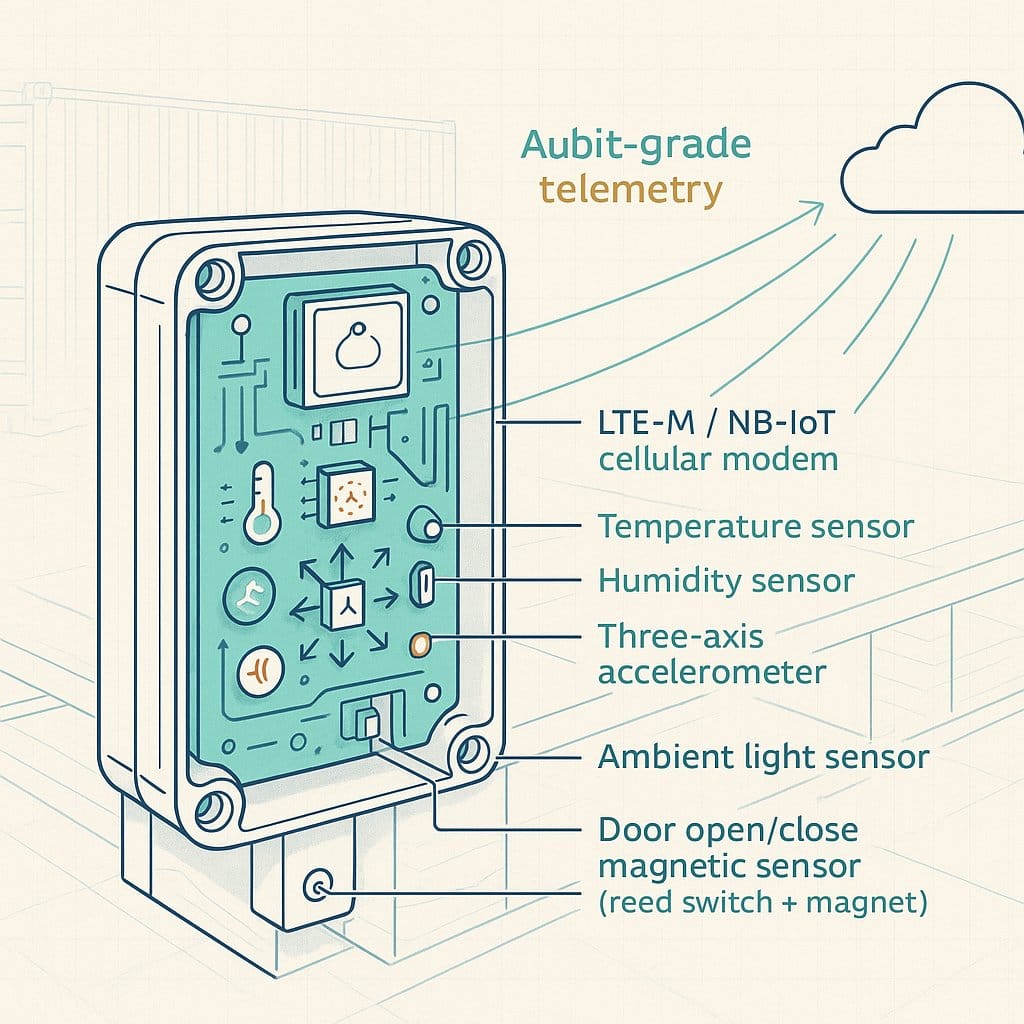
Level 4 introduces the question what is happening to my cargo?, and the only honest answer is one a regulator can sign off on. The instrumentation requirement steps up sharply:
- Calibrated environmental sensors. Temperature accuracy of ±0.5 °C or better for pharmaceutical work, with traceable calibration records. The device's spec sheet has to survive an audit, not just a sales meeting.
- Stable event semantics. A door-open event recorded at 14:02:07 on tracker A has to mean the same thing on tracker B three weeks later, on a different lane. Without that, you do not have evidence — you have anecdotes.
- Industrial-grade ruggedness. Air, sea, road, vibration, rain, temperature swings. Rugged design is the difference between data that exists and data that doesn't.
- Audit-grade data integrity. Signed firmware, configuration digests, raw evidence windows around exceptions. Data you cannot prove came from your device is data a regulator will discount.
Cold chain pharmaceuticals, biotech shipments, fresh-food exports, and high-value electronics live at Level 4 by regulatory necessity, not aspiration. FSMA 204 in the United States and the EU GDP guidelines for medicinal products have moved continuous, defensible environmental telemetry from a competitive advantage to table stakes for the categories they cover.
What Does Level 5 Predictive Intelligence Deliver?
Level 5 is where supply chain visibility stops being a tracking problem and starts being a data and decision problem. The hardware contribution is incremental — same multi-sensor instrumentation as Level 4, with denser sampling on critical events. The new work happens above the tracker:
- Anomaly detection models trained on historical lane behavior, capable of flagging a drift before it crosses a hard threshold.
- Predicted ETAs that incorporate weather, port congestion, and partner-network data — not just the tracker's current position.
- Exception-management workflows that route the right alert to the right human (or automated action) in a window short enough to matter.
- Governance for the AI components: which decisions can the system make autonomously, which require human approval, and where the audit trail lives.
Very few operations run at Level 5 across their full network. Those that do are usually focused on one critical lane or one critical product family. The right strategy for everyone else is to get to Level 3 reliably, then add Level 4 instrumentation where the cargo demands it, then add the predictive layer where volume justifies the data investment.
How Should You Sequence a Visibility Project?
The biggest mistake in visibility projects is trying to instrument the entire network at once. Pick the highest-risk or highest-value asset class. Deploy Level 3 tracking against it. Validate the data pipeline. Train the operations team to act on real-time information. Only then expand — to more lanes, or to Level 4 sensors on the same lane.
The reason this sequencing works is that the operations cost of real-time data is paid once. Once your team is good at managing by exception on lane A, adding lane B is incremental. Instrument all lanes simultaneously without that capability and you have built an expensive Level 2 deployment with extra alerts that nobody acts on.
What Are the Most Common Questions About Visibility Levels?
The questions below summarize what comes up most often when teams scope a visibility upgrade. They cluster around the L2-to-L3 transition (the rung where most stalls happen), and around the practical sequencing decisions a project owner has to make in the first quarter of work.
What is the difference between Level 2 and Level 3 supply chain visibility?
Level 2 reports a vehicle's or asset's last-known location on a periodic basis, typically with hour-scale ping intervals and a dashboard that updates after the fact. Level 3 delivers continuous position, dynamic ETAs, and exception alerts within a window short enough to act on — usually minutes, not hours. The hardware difference is per-asset cellular trackers with disciplined power management; the operational difference is a team that manages by exception in real time.
Why isn't a carrier-portal dashboard considered real-time visibility?
Carrier portals re-display milestone events the carrier reports through EDI or its own API. Those events are typically discrete and lagging — a "departed origin" event might appear hours after the truck actually left. A polished dashboard does not change the underlying data quality. If the input is Level 1 milestones, the output is Level 1 visibility regardless of how the user interface looks.
Do I need Level 4 visibility for general logistics, or only for cold chain?
Level 4 multi-sensor visibility is justified whenever the cargo's value or compliance exposure is significant relative to the per-shipment cost of instrumentation. Cold chain pharmaceuticals and biologics are the canonical case because the regulations make it mandatory, but high-value electronics, hazardous materials, and security-sensitive goods routinely justify Level 4 instrumentation outside cold chain.
How long does it take to move from Level 2 to Level 3?
Hardware deployment for a single asset class typically runs eight to sixteen weeks once devices are selected and the data pipeline is connected. The operational change (training a team to manage by exception, building the alert-routing rules, and defining success metrics) usually takes longer than the hardware rollout. Plan for two quarters before the new capability is genuinely embedded, not just live.
Is Level 5 predictive visibility realistic for mid-sized operators?
Yes for specific lanes, no for full networks. A mid-sized operator can build effective predictive visibility on their two or three highest-value lanes by combining Level 4 instrumentation with off-the-shelf anomaly detection and a focused exception-management workflow. Trying to deploy network-wide predictive visibility before mastering Level 3 across the network is the failure pattern that drives most disappointing pilot outcomes.
What Should You Take Away?
The five-level visibility maturity ladder is most useful as a diagnostic tool, not a roadmap. The point is not to climb to Level 5 across every lane. The point is to honestly assess where each lane sits today, decide which lanes deserve to climb based on cargo value and compliance exposure, and accept that the L2-to-L3 transition is where most of the engineering work and most of the operational change happens.
- Most companies sit at Level 2 — periodic position data on a dashboard that looks more capable than it is.
- The L2-to-L3 transition is a hardware, connectivity, and operations redesign in parallel, not a platform purchase.
- Level 4 multi-sensor instrumentation is mandatory for regulated cold chain and high-value cargo, set by auditors not dashboards.
- Level 5 predictive intelligence is a per-lane achievement before it becomes a network-wide capability.
If you're scoping a visibility upgrade and trying to figure out which level fits your operation, and which hardware and connectivity choices match it, let's discuss your requirements.