

With the arrival of 3GPP Release 17, a Reduced‑Capability (RedCap) profile – sometimes called NR‑Light – joined the 5G New Radio family. RedCap fills the performance gap between low‑power wide‑area technologies such as LTE‑M and Cat‑1 and the gigabit‑class 5G used by smartphones. By trimming features like carrier aggregation and multiple receive antennas, RedCap lowers cost and power consumption while still offering tens of megabits of throughput and millisecond‑level latency. This article discusses when RedCap is the right choice for industrial IoT (IIoT) hardware, when legacy technologies remain better, and what new design challenges arise.
When RedCap shines: moderate speed and low latency
Industrial automation and smart manufacturing – IIoT devices are evolving from slow telemetry toward real‑time control and video inspection. Traditional Cat‑4 offers about 150 Mbps downlink with 30–50 ms latency. RedCap typically delivers 10‑100 Mbps and reduces latency to 5‑20 ms. This is plenty for machine vision, predictive maintenance and edge AI without paying for full‑blown eMBB.
Video surveillance and mobile maintenance – Surveillance cameras, mobile robots and remote inspection tools need stable uplink capacity to stream HD video or edge‑processed data. Operating on a 5G standalone (SA) network with features like slicing, RedCap can guarantee bandwidth and low latency.
Wearables and health monitoring – Smart watches, XR glasses and medical monitors are constrained in size and battery life yet require higher uplink rates and QoS. RedCap supports flexible antenna configurations including single‑antenna SISO, reducing footprint and power.
Smart city infrastructure – Intelligent streetlights, traffic controllers and grid equipment need more bandwidth than LTE‑M to support video analytics, edge computing and secure updates. RedCap offers tens of Mbps uplink and takes advantage of 5G SA slicing.
The common thread across these applications is the need for moderate data rate and low latency without the complexity of full 5G. BBy dropping features like carrier aggregation and high‑order MIMO, RedCap reduces device cost and energy consumption
When RedCap is not ideal
- Low-duty sensors – Remote meters and environmental sensors transmit tiny amounts of data and operate for years on coin cells. LTE M and NB IoT deliver enough throughput and deeper coverage at a fraction of the cost and energy. Deploying RedCap here wastes battery and increases device cost without benefit.
- Regions with limited 5G SA coverage – RedCap works only on 5G standalone networks. In 2026 only select cities and private industrial sites support SA; global roaming and fallback are minimal. Deploying RedCap prematurely can lead to unreliable connectivity until networks upgrade.
- Cost‑sensitive applications – Early RedCap modules cost roughly three times more than LTE M and require more complex RF design. Certification is stricter and modules are scarce. For large fleets of trackers and sensors, Cat 1 or LTE M remain more economical until eRedCap appears and SA coverage matures
Comparison with LTE-M and Cat 1
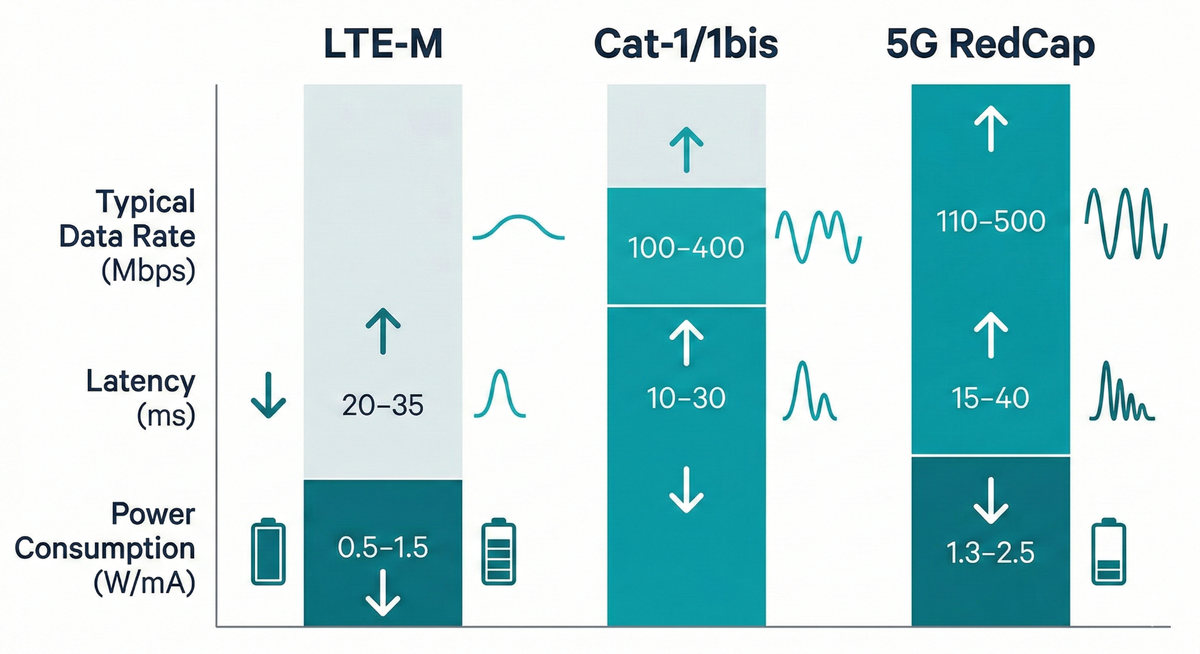
Below is a simplified comparison of key metrics across LPWA (LTE-M/NB-IoT), Cat 1/1bis and 5G RedCap:
| Technology | Typical data rate | Latency | Energy use | Availability |
|---|---|---|---|---|
| LTE M / NB IoT | Kbps‑level (0.5–2 Mbps for LTE M) | 20‑35 ms | Excellent battery life | Widely deployed worldwide |
| Cat 1 / 1bis | 3‑4 Mbps (Cat 1bis up to 10 Mbps) | 10‑30 ms | Good | Available on existing LTE networks |
| 5G RedCap | 10‑500 Mbps depending on configuration | 5‑40 ms | Very good but higher than LTE M | Limited to early 5G SA networks |
Cat 1/1bis sits between LTE M and RedCap in terms of bandwidth and complexity. LTE M is ideal for small sensor data with ultra‑low power budgets and ubiquitous coverage. RedCap offers much higher throughput and lower latency but requires 5G SA coverage and costs more. Cat 1 remains a safe choice today, while RedCap becomes attractive when mid‑range bandwidth and low latency are necessary, such as high‑resolution cameras or edge‑computing
IoT devices.
Hardware design challenges
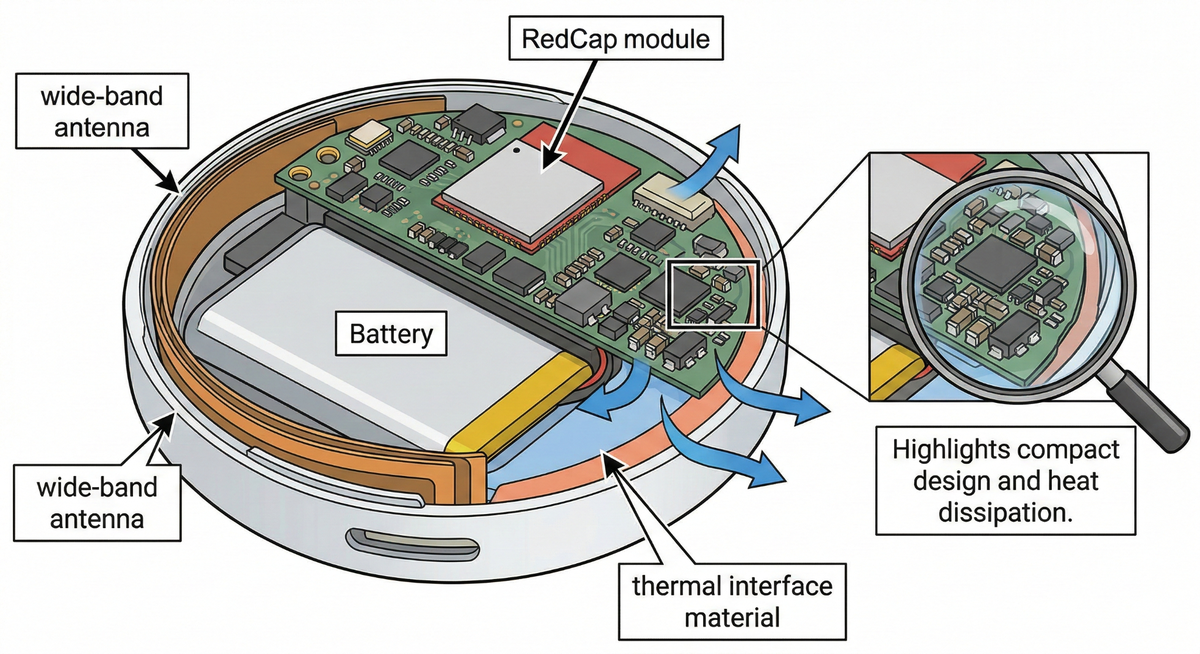
- Antenna design – RedCap devices must cover multiple frequency bands from sub‑1 GHz to mid‑band FR1. Although simplified to single or dual antennas, the wide bandwidth and SA support require careful tuning and clearance. Compact wearables and industrial sensors often lack space for full‑size antennas, and poor ground plane design leads to efficiency losses.
- Power and energy management – RedCap reduces power compared with full 5G by using single receive chains, lower modulation orders and extended DRX cycles. Yet its baseline consumption is still higher than LTE‑M/NB‑IoT. Designers need larger batteries or energy‑efficient power supplies, and should implement deep sleep modes, PSM and eDRX to extend operational life.
- Thermal design – 5G chipsets and PA stages generate more heat than 4G due to higher peak data rates and new modulation schemes. Even stripped‑down RedCap modems can create hot spots in small enclosures. Use thermal interface materials, heat spreaders and careful PCB layout to dissipate heat and prevent performance throttling.
- Mechanical and certification challenges – Integrating 5G SA components (modem, RF front‑end, antennas) into small enclosures is difficult. Enclosures must allow adequate clearance for antennas, ensure ground isolation and meet radiated spurious emission limits. Certification for 5G SA adds cost and complexity, including SA network testing and VoNR if voice is needed. Manufacturers may design modular PCB footprints to swap Cat‑1/LTE‑M and RedCap modules as needed.
Judgement and recommendations
- Short term (next 1–2 years) – For IIoT applications needing moderate speed and low latency, trial RedCap in campuses or cities with 5G SA. Use antennas that cover 600–6000 MHz and design proper thermal paths.
- Long‑term planning – 3GPP Release 18 will introduce eRedCap with peak rates around 10 Mbps to replace Cat‑1. Design modular hardware platforms that currently support Cat‑1/LTE‑M but can be upgraded to RedCap modules.
- Carefully evaluate cost and coverage – RedCap modules are still expensive and 5G SA coverage is limited with incomplete roaming. Devices with very small data budgets or extreme battery‑life demands should stay on NB‑IoT or LTE‑M.
Conclusion
RedCap is not a one‑size‑fits‑all solution. It provides a sweet spot between performance and power, but introduces new challenges in antenna design, thermal management and cost. Industrial hardware engineers should understand bandwidth and latency requirements, verify 5G SA coverage, and design modular products for future upgrades. Only when applied in the right scenarios can RedCap unlock the promise of 5G for IoT.