There's a conversation happening in boardrooms and engineering teams right now that goes something like this:
"We've been collecting IoT data for three years. Let's connect it to an AI agent and automate our operations."
Then someone pulls up the data. And the room goes quiet.
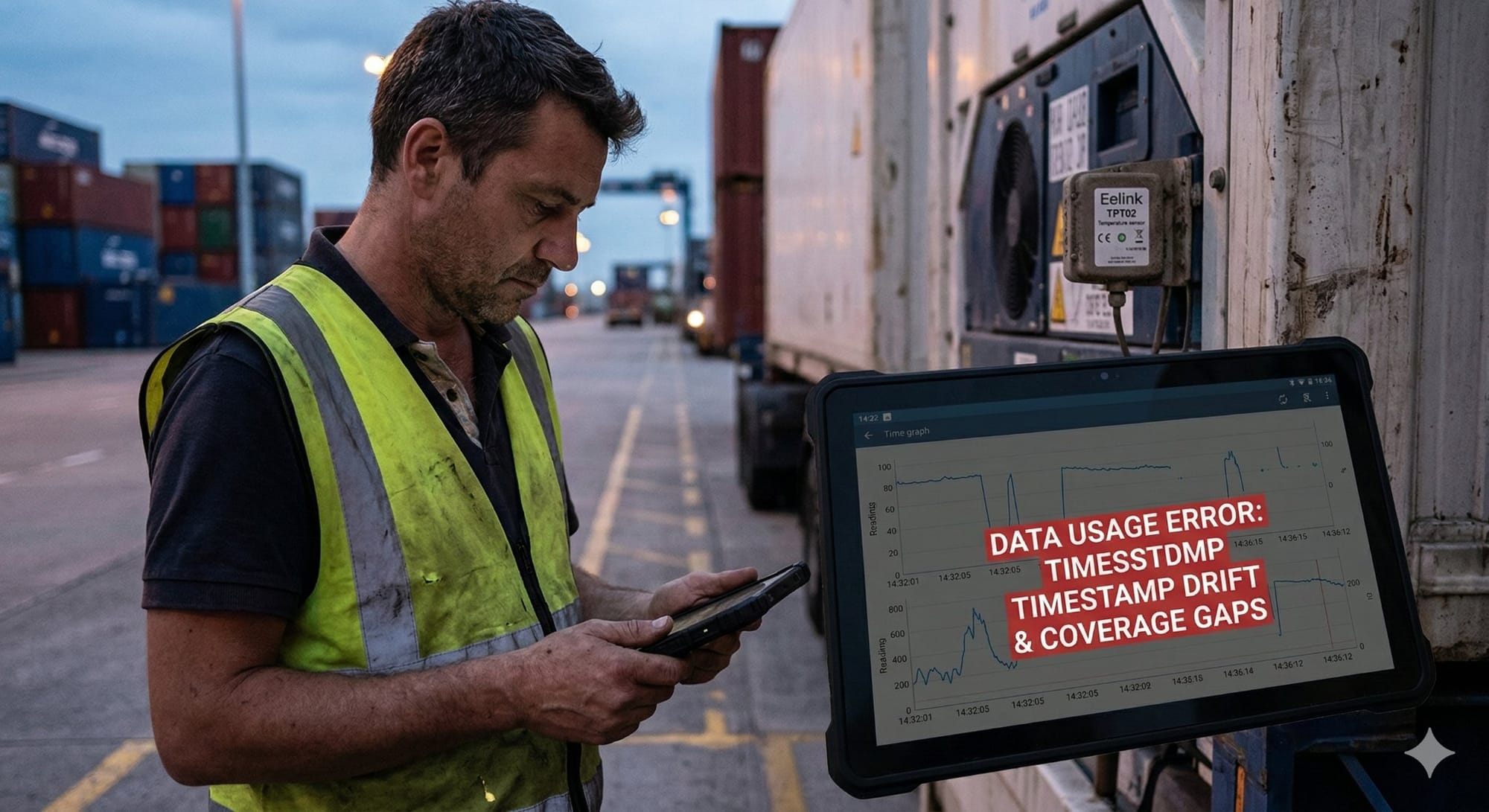
Timestamps that drift by hours. Sensors that ping once every four minutes in a system that needs sub-minute resolution. Readings that drop out entirely whenever a truck passes through a rural corridor. Values that look plausible but are consistently 2.3°C higher than reality because nobody recalibrated the sensor after the firmware update eighteen months ago.
The data exists. It's just not usable.
And this — not model capability, not API integration, not workflow design — is the actual bottleneck holding back agentic IoT in the real world.
The AI Agent Assumption Nobody Talks About
When people discuss AI agents and IoT, the conversation almost always focuses on the intelligence layer: which model to use, how to structure the prompt, what tools to give the agent, how to handle multi-step reasoning.
These are real engineering questions. But they all share a silent assumption: that the data coming in from the physical world is accurate, timely, and complete.
In practice, that assumption fails constantly.
An AI agent instructed to "monitor cold chain integrity and take action if a deviation is detected" is only as good as the temperature readings it receives. If those readings are delayed, drift-prone, or sporadically missing, the agent isn't managing cold chain integrity. It's managing a noisy, unreliable approximation of cold chain integrity — and making autonomous decisions accordingly.
That's not a marginal problem. In cold chain logistics, pharmaceutical distribution, or high-value asset tracking, it's the difference between a functional system and a liability.
Four Ways Sensor Data Fails AI
After working with IoT deployments across more than sixty countries, I've watched the same failure patterns appear regardless of industry, geography, or hardware vendor. They fall into four categories.
1. Temporal drift and inconsistent sampling
AI reasoning about physical events depends on knowing when something happened relative to other events. A temperature excursion detected at 14:32 means something very different depending on whether the shipment departed at 13:00 or 16:00.
Many deployments treat timestamps as approximate. The device's internal clock drifts. The cellular connection drops, and when it reconnects, the device uploads a batch of readings with locally-generated timestamps rather than server-synchronized ones. The data looks complete. The timeline is fiction.
For an AI agent trying to construct a causal chain of events — "the temperature rose because the door was opened, which happened because the vehicle stopped, which happened because the route deviated" — inconsistent timestamps turn that causal reasoning into guesswork.
2. Coverage gaps in the data pipeline
Connectivity is not uniform. A refrigerated truck on a highway in Germany has excellent LTE coverage. The same truck on a rural road in southern Spain, passing through a mountain corridor in Peru, or unloading in a warehouse basement in Jakarta does not.
Traditional alert-based IoT systems could tolerate these gaps. The gap itself became the alert: "No signal for 45 minutes — investigate."
AI agents cannot work this way. They need a continuous stream of structured data to reason about. A 45-minute gap isn't an alert for an agent — it's a blindspot. The agent has no basis for inference, and any decision it makes during or after that gap is made without the information it needed.
3
. Systematic sensor bias
This is the most insidious failure mode because it doesn't look like failure. The sensor reports readings. The readings fall within expected ranges. The charts look normal.
But the readings are consistently wrong.
Thermal sensors drift over time, particularly in harsh environments. A temperature probe that was accurate to ±0.2°C when installed will be accurate to ±1.8°C two years later if nobody has recalibrated it. The device doesn't report an error. It just reports temperatures that are wrong.
For a human analyst reviewing a dashboard, this bias might go unnoticed indefinitely. For an AI agent making autonomous threshold decisions, it means the excursion protocol triggers late — or doesn't trigger at all — because the "real" temperature is always a degree warmer than
what the agent sees.
4. Semantic ambiguity — data without context
A raw sensor reading is just a number. 23.7 means nothing without knowing the unit, the asset it's attached to, the normal operating range for that asset in that context, and what other readings it should be interpreted alongside.
Many IoT deployments treat data collection and data meaning as separate problems to be solved later. The result is data lakes full of readings that nobody can confidently interpret: Is 23.7°C a problem for this shipment? Depends on what's in it. Is a door sensor showing "open" for 12 minutes an anomaly? Depends on whether the vehicle is at a loading dock or on the highway.
An AI agent given semantically ambiguous data will either refuse to act (too uncertain) or act incorrectly (wrong context). Neither is useful.
The Standard That Makes Agentic IoT Possible
None of this is inevitable. These are engineering problems with known solutions. But solving them requires treating data quality as a first-class design requirement — not an afterthought.
The standard I've arrived at, working across dozens of deployments, has five components.
Synchronized, server-stamped time. Device clocks should synchronize against a reliable time source at every connection, and readings should be timestamped server-side on receipt, not client-side on generation. The gap between device time and server time should be logged and monitored as a data quality metric.
Redundant connectivity with predictable fallback. For high-stakes applications, a single cellular connection is not sufficient. LTE-M as primary with NB-IoT fallback, or dual-SIM configurations, ensure that coverage gaps are minimized and that when disconnection does occur, the agent knows a gap has happened and for how long.
Regular calibration cycles. For precision sensors, calibration should be a scheduled operational event — not a response to detected failure. The calibration date and drift delta should be stored as metadata alongside the readings. An agent that knows a sensor was last calibrated 400 days ago can weight its readings differently than one calibrated last week.
Contextual metadata at the point of collection. Every reading should carry context: asset ID, asset type, cargo type where applicable, expected operating range, and the specific protocol version the reading should be interpreted under. This metadata doesn't change the reading — it makes the reading interpretable.
Anomaly detection at the edge. Before data reaches an AI agent, it should pas
s through a layer that flags readings that violate basic physical plausibility — temperatures that change faster than thermodynamics allows, GPS coordinates that teleport, accelerometer readings that spike beyond sensor range. These readings should be quarantined and replaced with explicit uncertainty markers rather than passed downstream as if they were valid.
What This Means If You're Building Now
If you're deploying IoT infrastructure today with the intention of connecting it to AI agents in the next twelve to eighteen months, the most important investment you can make right now has nothing to do with AI.
It's data infrastructure.
Audit your current sensor data against the five components above. Identify your systematic biases. Map your coverage gaps. Establish calibration schedules. Build metadata standards before you have ten thousand assets in the field and retrofitting becomes a project in itself.
The AI capability layer will continue improving rapidly — model quality, agent frameworks, reasoning reliability are all on steep improvement curves. The hardware and data pipeline layer will improve, but more slowly, and most of the improvement will happen at design time, not deployment time.
The companies that will win in agentic IoT over the next decade are not necessarily the ones with the most sophisticated AI. They're the ones with the cleanest, most reliable, most consistently structured physical-world data.
The intelligence is becoming a commodity. The data is the moat.
A Note on Hardware Selection
One practical implication: hardware selection criteria need to change.
The traditional procurement question is "Does this device meet our connectivity and battery requirements at an acceptable price point?"
The AI-era question is "Does this device produce data that an AI agent can reason about reliably — and can we verify that at scale?"
That means looking beyond spec sheets at real-world accuracy in harsh conditions, actual connectivity performance in low-coverage environments, calibration drift rates over time, and the maturity of the device's data pipeline — not just its radio module.
These are harder questions to answer than comparing spec sheets. But they're the right questions for the infrastructure layer that AI agents will depend on.
Apple Ko is an IoT solutions architect working at the intersection of physical-world sensing and AI-driven automation for international B2B markets. He writes about what it actually takes to make autonomous systems work reliably in the real world.