

Asset tracking used to look like a single connectivity decision. A team would define the enclosure, choose a modem, tune the antenna, and try to force every use case through the same network stack.
That logic is breaking down in 2026.
The reason is simple: the asset-tracking market is now large enough, mature enough, and operationally diverse enough that one radio category no longer fits everything. The needs of a battery-powered pallet tracker, a trailer tracker that reports more frequently, and a richer telematics device are no longer close enough to justify the same connectivity layer.
What we are seeing instead is a three-tier structure:
- LPWA for battery-first, low-payload, low-maintenance tracking
- Cat 1 bis for the middle layer that needs more throughput without jumping to full 5G complexity
- RedCap for the upper layer where higher refresh rates, richer payloads, and 5G roadmaps matter
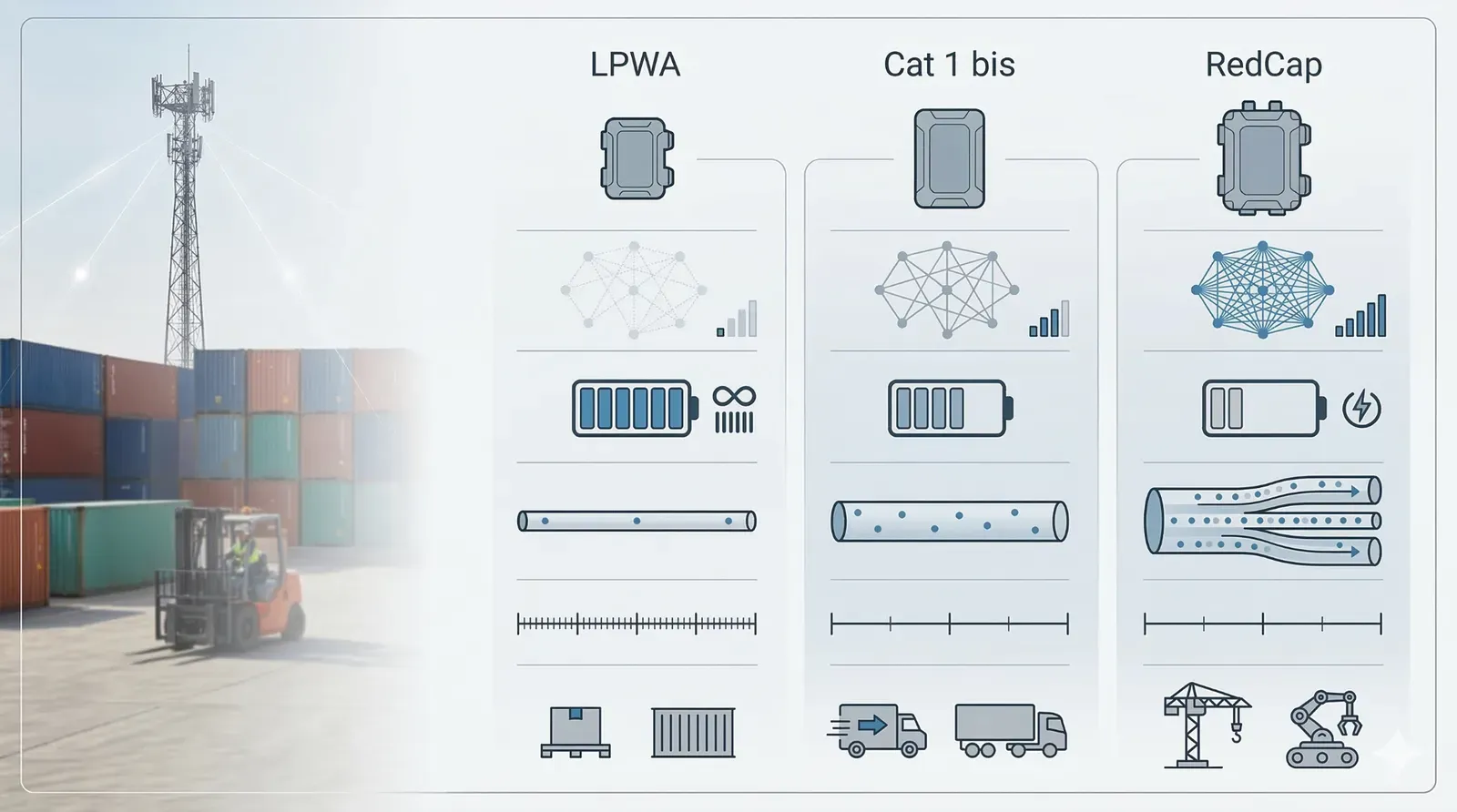
This is not just a telecom story. It is a product architecture story, a cost story, and increasingly a portfolio strategy story.
Why the market is fragmenting now
Three forces are pushing the split.
First, LPWA has become real infrastructure rather than a niche promise. LTE-M and NB-IoT now have enough deployment scale and enough design maturity that they are the obvious answer for long-life, battery-powered trackers. When the reporting profile is sparse, the payloads are small, and the device may sit on an unpowered asset for years, LPWA remains hard to beat.
Second, the middle of the market needs something LPWA cannot always provide gracefully. Many teams want more frequent reporting, faster firmware updates, denser sensor payloads, or a smoother migration path away from legacy 2G and 3G footprints. Cat 1 bis sits in that zone. It is not as power-thrifty as LPWA, but it is simpler and lighter than building everything around a broader 5G stack.
Third, RedCap has moved from roadmap language into real product planning. It is still early, and it is not the default answer for long-life trackers, but it now gives hardware teams a credible upper tier for use cases that want 5G alignment and materially more throughput than LPWA or Cat 1 bis can offer.
The result is a segmentation pattern that feels familiar in hindsight. As the market matures, architectures stop converging and start specializing.
Tier one: LPWA is still the default for battery-first tracking
LPWA remains the strongest fit when the real business requirement is not speed, but service life.
This is the domain of returnable assets, pallets, containers, rental equipment, and fixed industrial assets that have no external power and are expensive to touch in the field. These deployments care about two things above all else: long unattended runtime and acceptable visibility at a very low energy cost.
In this tier, the best product is usually not the one that can send the most data. It is the one that can stay asleep the longest, wake with purpose, and survive poor signal conditions without wasting its battery budget.
That is why LPWA is still so relevant. It aligns with small payloads, scheduled reporting, exception alerts, event-driven wakes, and a design philosophy built around sleep states, PSM, eDRX, and ruthless energy budgeting.
Product teams sometimes underestimate how important that fit is. A tracker that lives on an unpowered asset for three to five years is not merely a smaller version of a powered telematics box. It is a different class of machine with a different success metric.
Tier two: Cat 1 bis is becoming the middle layer
Cat 1 bis is not the glamorous layer, but it may be the most commercially important layer in the next wave of deployments.
It exists for buyers who need more than LPWA can comfortably deliver but do not want the cost, complexity, or network dependencies that come with pushing too quickly toward 5G-first hardware.
This is where you often find:
- more frequent uplinks
- denser payloads from multiple sensors
- faster firmware delivery expectations
- use cases that benefit from broader data headroom
- powered or rechargeable trackers that can tolerate a higher energy budget
In practical terms, Cat 1 bis often works well for the middle of a tracking portfolio: assets that move regularly, need more conversational connectivity, and are expected to behave more like connected equipment than dormant tags.
It is also a useful migration layer. As older network generations continue to retire, Cat 1 bis gives many IoT teams a cleaner path than trying to stretch LPWA into every scenario.
The mistake is to treat Cat 1 bis as a universal upgrade. It is not. It is a middle layer. It works best when the product really benefits from the extra data headroom and can afford the higher energy footprint.
Tier three: RedCap opens the upper tier, but not the default tier
RedCap matters because it gives product planners a 5G-era option that is more realistic for IoT than trying to force full-blown smartphone-class 5G into industrial trackers.
But that does not mean it should replace LPWA or Cat 1 bis.
In 2026, RedCap is better understood as the upper tier of the tracking market. It is relevant when the business case supports richer data, faster links, tighter integration with 5G roadmaps, or broader telematics ambitions. Think of devices that may blend tracking with denser sensing, more frequent reporting, or adjacent edge workloads.
That said, RedCap is still early in commercial deployment compared with LPWA. Coverage maturity, module economics, and power expectations still matter. If the job to be done is a multi-year primary-battery tracker on a low reporting cadence, RedCap is usually solving the wrong problem.
This is the key strategic mistake to avoid in 2026: confusing the newest tier with the default tier.
The best architecture is not the one with the freshest acronym. It is the one whose energy model, network model, and cost model match the operating reality of the asset.
The real decision framework is operational, not promotional
When teams ask which tier they should choose, the answer rarely starts with the radio standard itself. It starts with five operational questions.
1. How often does the device need to wake? If the tracker reports once or twice a day plus a few exception alerts, LPWA is often the strongest fit. If the device needs a much denser reporting profile, Cat 1 bis starts to make more sense.
2. How much data does each wake produce? A small location and status payload is one thing. Frequent richer payloads, larger diagnostics, or faster FOTA needs push you toward a middle or upper tier.
3. Is the asset powered, rechargeable, or fully battery dependent? This is often the deciding factor. A powered asset can justify a very different connectivity layer than a sealed tracker expected to survive unattended.
4. How expensive is a maintenance visit? The more expensive it is to touch the asset, the more valuable LPWA-style endurance becomes.
5. Is the goal visibility, responsiveness, or platform headroom? Visibility at low cost points one direction. Higher responsiveness or broader platform capability points another.
These are not merely engineering questions. They determine hardware cost, enclosure size, service intervals, battery strategy, and the sales story.
What this means for portfolio design
The most important shift is this: many vendors should stop asking which connectivity standard will win, and start asking how many tiers their portfolio actually needs.
In 2026, a serious tracking business will often benefit from a three-layer product map:
- LPWA line: multi-year, low-touch, low-payload trackers for unpowered assets
- Cat 1 bis line: more interactive, mid-tier trackers for richer reporting and broader migration needs
- RedCap line: selectively deployed, higher-value products for advanced telematics or 5G-aligned programs
That structure does three useful things at once.
It clarifies product management by preventing one SKU from being stretched beyond its physics.
It clarifies sales by giving buyers a more honest way to choose based on use case instead of marketing generalities.
It clarifies operations by aligning battery, modem, GNSS, and enclosure choices with actual service economics.
The bottom line
Asset tracking in 2026 is splitting into LPWA, Cat 1 bis, and RedCap because the market has moved past one-size-fits-all connectivity.
The winning design question is no longer, "Which network is best?" It is, "Which tier matches the way this asset behaves, the way this device wakes, and the way this deployment makes money?"
Teams that answer that question early can build cleaner portfolios, make better modem choices, and avoid expensive architectural mismatches later.
Teams that do not usually end up with the same outcome: a tracker that is too power-hungry for battery-first deployments, too limited for richer deployments, and too compromised to be truly excellent in either.
In a mature market, clarity is a competitive advantage. Connectivity tiering is now part of that clarity.
FAQ
Is RedCap going to replace LTE-M and NB-IoT for asset tracking?
Not in the near term. RedCap is becoming a credible upper tier, but LPWA remains the best fit for multi-year battery-powered trackers with sparse payloads and low maintenance requirements.
When should I choose Cat 1 bis over LPWA?
Choose Cat 1 bis when you need more frequent uplinks, richer payloads, faster firmware delivery, or a cleaner migration path from legacy networks, and your product can tolerate a higher power budget.
Do most tracking companies need all three tiers?
Not always, but many do. A single hardware line rarely serves unpowered low-touch assets, mid-tier telematics, and higher-throughput 5G-ready use cases equally well.
What is the fastest way to choose the right tier?
Start with wake cadence, payload size, power source, maintenance cost, and deployment environment. Those five variables usually make the right tier obvious.
Need help mapping a 2026 tracking portfolio?
Start with the asset behavior, not the modem acronym. Segment your devices by wake cadence, payload size, power source, and service cost, then build the right LPWA, Cat 1 bis, and RedCap roadmap from there.