
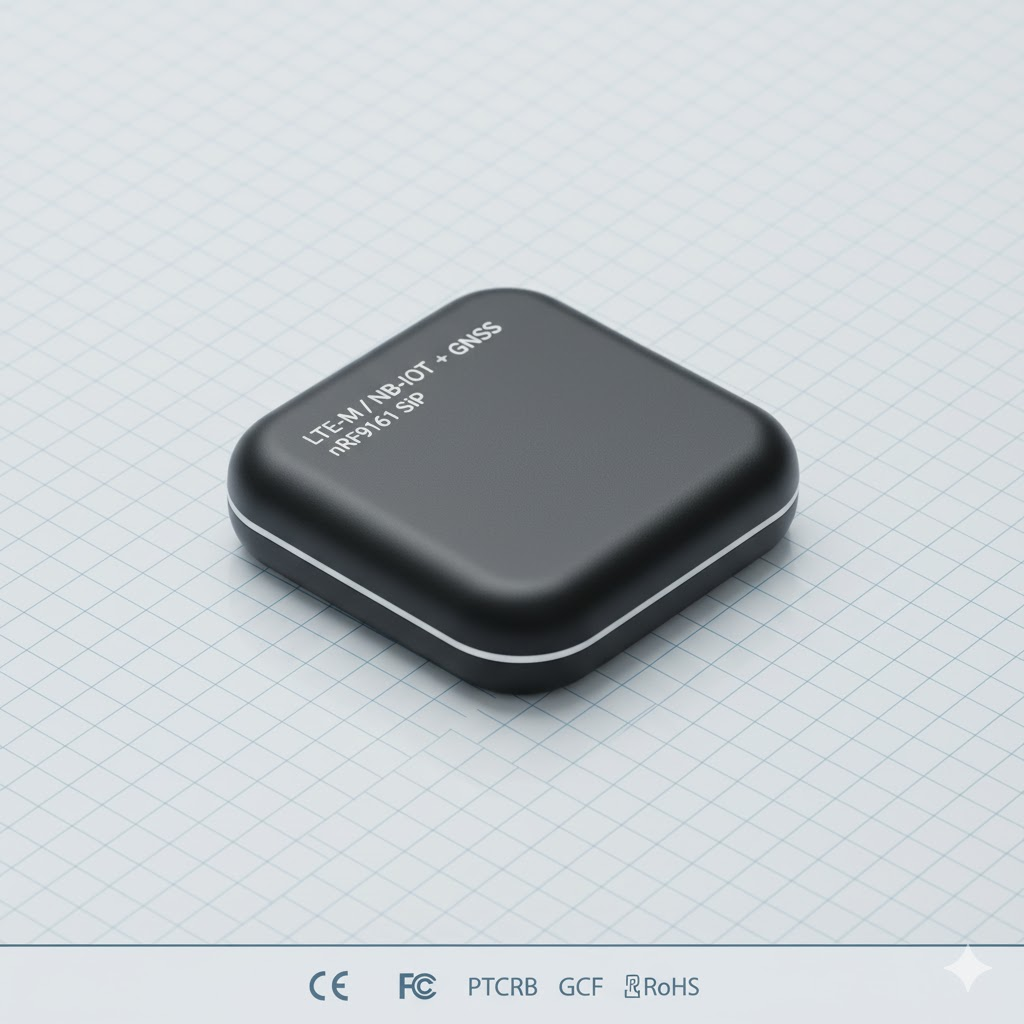
When the brief for a tracking device starts with "35 × 35 mm, runs for years and survives rain", you know you're in for a tightrope walk between physics and practicality. This essay walks through the decisions that went into the GPT12‑X Ultra, a system built around Nordic's nRF9161 SiP that combines LTE‑M/NB‑IoT and GNSS in a compact industrial tracker. It is not a product pitch; it is a set of design notes and failure modes that we think are useful for anyone building similar hardware.
1. Constraints to respect
We began by writing down the invariants. Mechanically, the PCB, battery and plastic stack had to fit within about 35 × 35 × 12 mm and withstand IP67 ingress without adhesives that creep under heat. Radio requirements were explicit: cover the common LTE Cat‑M1/NB‑IoT bands (1/2/3/4/5/8/12/13/14/17/18/19/20/25/26/28/66) and support multi‑constellation GNSS on the L1 band. Energy budget was pinned to a 5000 mAh primary lithium cell; the firmware had to support power saving modes (PSM/eDRX) and event‑driven bursts triggered by an accelerometer, light sensor, tamper switch or SMS. Finally, the thermal path had to prevent the modem's power amplifier from throttling during periods of poor coverage or frequent reporting.
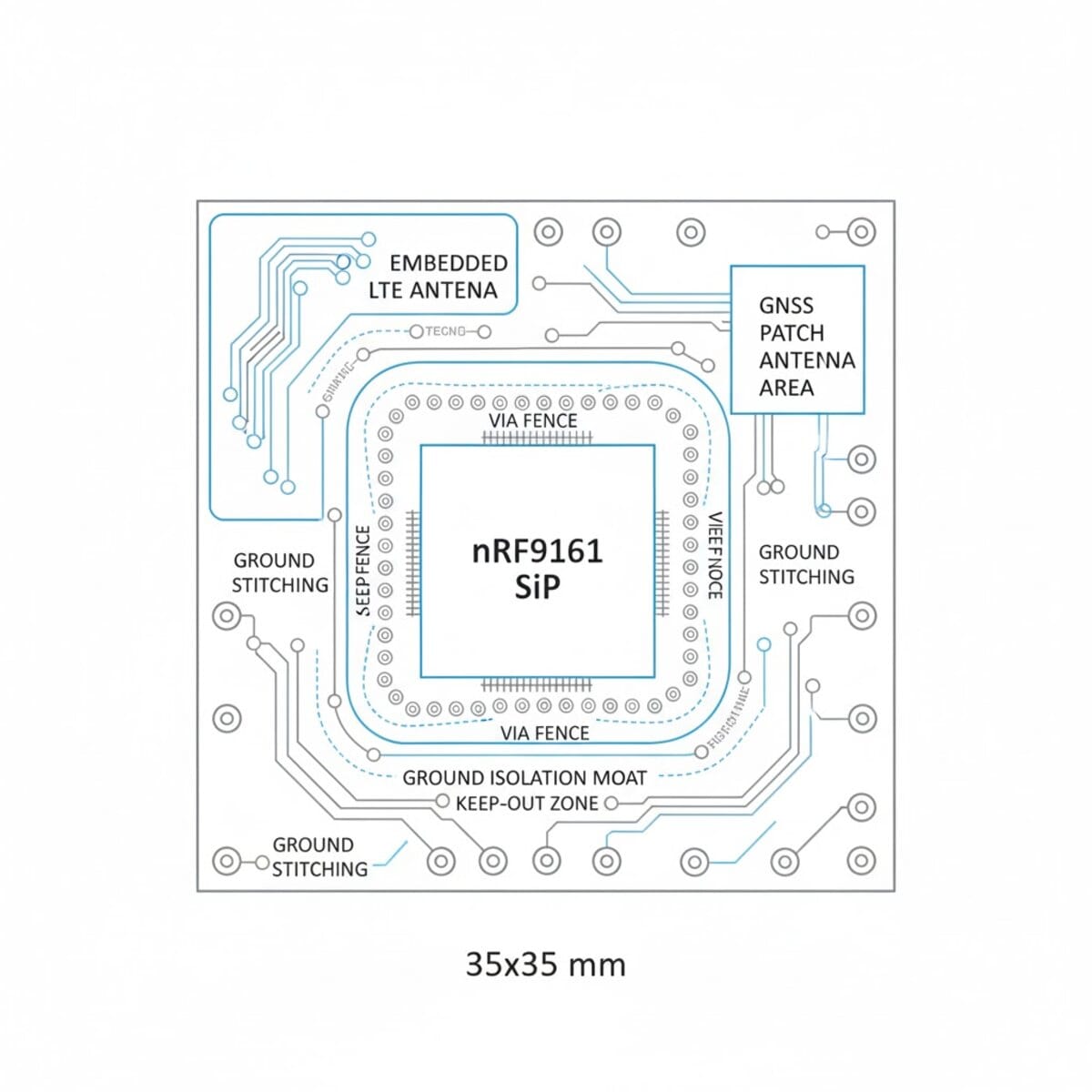
2. RF and antenna topology in tight spaces
The nRF9161 SiP is wonderfully integrated, but it does not remove the need for careful RF design. In a 35 mm square you cannot make the antennas an afterthought. We chose an embedded LTE antenna tuned for our bands and a patch‑style GNSS element. Between them we cut a ground isolation moat and stitched vias to stop the LTE feed coupling into the GNSS trace. We also used a small discrete LNA and SAW filter on the GNSS front end; this is not strictly required by the SiP but it gives margin when plastic or adhesive detune the patch or when the modem's harmonics are high during attach.
Isolation and desense were verified with three tools: S‑parameter measurements on a network analyser gave us at least 25 dB of isolation; OTA chamber tests provided total radiated power and sensitivity; and long open‑sky runs with a GNSS simulator gave real fix times. These acceptance numbers justify policies in the firmware—for example, suppressing LTE bursts during the first few seconds of a GNSS cold start to keep noise down
3. Thermal path: small area, short bursts
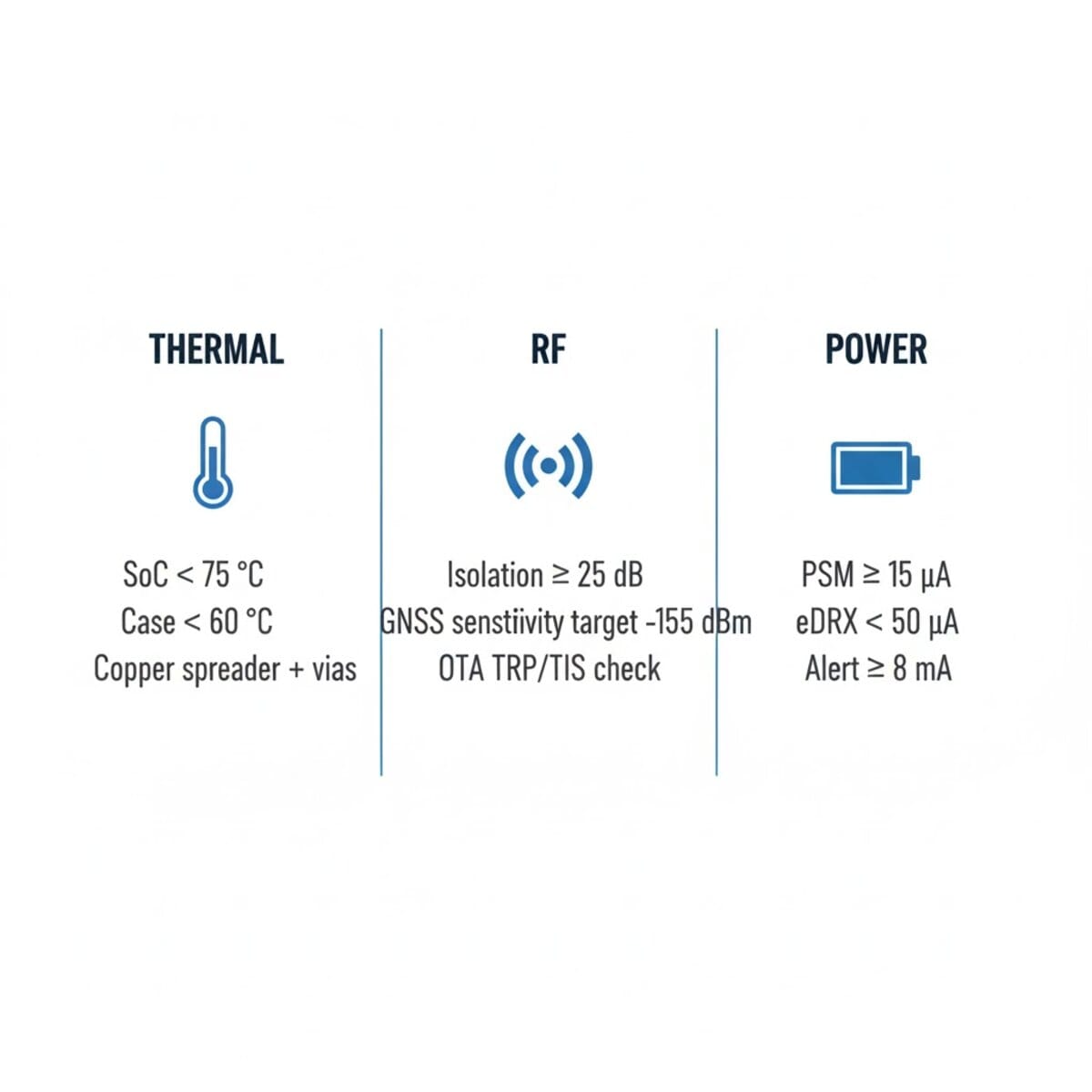
Even efficient power amplifiers can heat a small enclosure when conditions are poor. Our design treats the large ground pad under the SiP as a heat spreader. Inner copper layers under the module are solid and stitched with many thermal vias to the bottom copper. The battery cavity includes a thin copper island to move heat into the case. We chose a PC+glass fibre plastic that tolerates temperature but does not soak heat into screw posts. In qualification the device was driven into continuous uplink on a callbox for ten minutes at 45 °C ambient. The module stayed below about 75 °C and the case below
60 °C; this leaves headroom for minutes of alert‑mode reporting without throttling.
4. Power model and operating policy
Multi‑year life is not magic; it is policy. In a typical PSM configuration the device wakes once a day, obtains a GNSS fix, uploads a few bytes and returns to a 15 µA deep sleep. In eDRX it listens every hour, which raises the average current to around 50 µA. In an alert window with reports every minute the average current can rise to about 8 mA, which will
still support a month of operation. Firmware exposes the relevant 3GPP timers—periodic TAU (T3412) and active time (T3324)—so fleet managers can tune the trade‑off between reachability and battery life on a per‑deployment basis.
The choice of battery chemistry matters too. We default to Li‑MnO₂ for its stability and good pulse performance. A Li‑SOCl₂ option extends low‑temperature operation and storage life, but the design includes a pulse‑support capacitor and fuse to prevent a drop‑out under load. For pallet or drone deployments where the device is recovered regularly we offer a rechargeable Li‑ion pack; this adds charging circuitry and eliminates the need for dangerous goo
If you are working on application policy rather than hardware, you may find our operational playbooks for long-life trackers useful; it explores fleet-level decisions about reporting intervals, event thresholds and alert modes.
5. Firmware surface: payloads, updates and security
The payloads we send are deliberately small. A periodic message might include a timestamp, reason code, latitude, longitude, altitude, horizontal accuracy, battery voltage and optional temperature. We use JSON for early integration but recommend CBOR or a compact binary encoding when bandwidth is scarce. Transport can be MQTT or HTTPS. MQTT sessions give us a place to attach a last‑will message for decommissioning; HTTPS is valuable in environments that block outbound MQTT ports. Firmware‑over‑the‑air updates use differential patches staged with back‑off; the device checks signal quality before starting a transfer and breaks files into blocks to avoid idle timeouts. All links use TLS or DTLS with server authentication and hardware‑stored keys; keys are never exported.
6. Manufacturing and test
Testing a small tracker is not trivial. Our production line uses a bed‑of‑nails fixture for shorts, opens and programming. We then run a functional test on an LTE callbox to verify attach on each required band and to measure basic RF power. We sample units for OTA chamber tests to watch for antenna drift. Spot environmental tests include thermal cycling from −40 °C to +85 °C, humidity dwell and multi‑axis drops from 1 m. Ingress protection is tested by submersion and pressure equalisation. These steps align with our certification targets: CE, FCC Part 15B, PTCRB, GCF, UN38.3 and RoHS.
7. Deployment patterns and field behaviour
In real deployments, reporting policy matters as much as hardware design. For warehouse assets, a once‑daily heartbeat is enough. For reusable containers or shipments, motion or light triggers raise the reporting interval for a short window. Firmware records counters for attach retries, GNSS cold starts and low signal events; these are sent in the telemetry so operators can detect poor coverage or antenna detuning.
If you need concrete tips on combining sensor events and reporting windows, see the Operational playbooks article mentioned earlier. Another reference is our 4G GPT12‑X tracker overview.
8. Verification tables and acceptance criteria
The tables in the specification are not decorative; they are contracts. The thermal table says the module shall not exceed 75 °C under a ten‑minute continuous uplink at 45 °C ambient, and the case shall remain under 60 °C. The RF table demands at least 25 dB isolation between the LTE and GNSS feeds, a GNSS sensitivity around −155 dBm, and OTA radiated efficiency that meets regulatory requirements. The power table states that PSM current is roughly 15 µA, hourly eDRX around 50 µA and minute‑level tracking around 8 mA. When an engineer proposes a material or layout change, these numbers tell us what to re‑measure.
9. Data ownership and lifecycle
Trackers often outlive the project that bought them. We support explicit decommissioning messages to revoke SIMs and clear cloud shadows. A factory reset wipes user credentials but leaves the secure element's attestation keys unless a signed command erases them. This separation lets hardware be reused across customers without returning to the factory.
10. Non‑goals
It is equally important to document what we did not do. We did not chase dual‑frequency GNSS in this footprint; L1 multi‑constellation is a better trade‑off. We did not release a primary‑cell‑free variant; many logistics customers prefer to avoid battery management. We did not add audio or imaging sensors; those would change the regulatory and privacy landscape.
11. Closing notes
The GPT12‑X Ultra is a study in compromise. Its dimensions come from pallet slots and package lids; its reporting policies come from battery budgets and network behaviour; its antennas are shaped by the battery that feeds them. By writing down our constraints and the numbers that define success, we created a product we can reason about. We hope these notes are useful to other engineers tackling similar problems.
Appendix A: Minimal uplink and downlink examples
The uplink payload for a periodic report is something like:
json
{
  "t": 1730297701,
  "r": "periodic",
  "lat": 22.5435,
  "lon": 114.0579,
  "alt": 18,
  "acc": 12,
  "bat": 3.78,
  "temp": 24,
  "seq": 1871
}
Commands are sent on a separate topic and might look like:
json
{
  "set": {
    "periodic": 3600,
    "alert_interval": 60,
    "alert_window": 1800,
    "accel_threshold": 0.15,
    "t3412": 43200,
    "t3324": 8
  }
}
Appendix B: Practical field checks
Before rolling out a fleet, perform:
- An attach audit: log attach times and retry counts over several days in each region.
- A GNSS audit: run devices in open sky and near metal to capture accuracy distributions.
- A battery audit: sample cell weights to catch early drift in capacity.
- An ingress audit: submerge a small percentage of units after assembly.
- A policy dry‑run: verify that your backend honours the accuracy and reason codes in the payload.
Appendix C: Visualising the design
For readers who want to create their own diagrams or hero images, generative models can help. Here are some example prompts:
Create a clean technical marketing hero image of a compact industrial IoT tracker named "GPT12‑X Ultra" on a light grey studio background with subtle gridlines. Show the device in three‑quarter view, label "LTE‑M / NB‑IoT + GNSS", and include minimal certification icons (CE, FCC, PTCRB, GCF, RoHS).
Draw a simplified technical diagram of a 35×35 mm PCB with an embedded LTE antenna on one edge, a GNSS patch on the opposite edge, a central SiP marked "nRF9161", and a ground isolation moat. Use blue and grey vector lines and annotations.
Create a chart showing battery life versus reporting interval with three curves: daily PSM, hourly eDRX and minute‑level alert. Use a clear blue theme and a white background.
By grounding our design in measurements and constraints, we believe the GPT12‑X Ultra will do what it promises: keep track of your assets quietly and reliably for years.
FAQ
What is the GPT12‑X Ultra?
The GPT12‑X Ultra is a compact industrial IoT tracker built around Nordic’s nRF9161 SiP. It combines LTE‑M, NB‑IoT and multi‑constellation GNSS in a 35×35×12 mm enclosure to monitor assets quietly and reliably.
What design constraints shaped the product?
Key constraints included a palm‑sized footprint (approximately 35×35×12 mm), multi‑year battery life from a small cell, IP 67 ingress protection without adhesives, support for global NB‑IoT and LTE‑M bands and GNSS, and certification targets such as CE, FCC, PTCRB, GCF and RoHS.
Which bands and technologies does it support?
The tracker supports global LTE‑M and NB‑IoT bands (including 1, 2, 3, 4, 5, 8, 12, 13, 14, 17, 18, 19, 20, 25, 26, 28 and 66) and includes multi‑constellation GNSS. The integrated nRF9161 modem provides eDRX and PSM modes for efficient connectivity.
How do you manage heat in such a small enclosure?
Heat from power amplifiers is managed by treating the large ground pad under the SiP as a heat spreader. Copper layers and vias move heat into the case, and a PC+glass‑fibre enclosure tolerates high temperatures without soaking heat into screw posts.
What is the power budget and expected battery life?
With careful firmware duty cycles and low‑power modes (PSM and eDRX), the unit can deliver multi‑year life from a single coin cell. Actual battery life depends on reporting intervals; detailed power charts are provided in the white paper.
How durable is the enclosure?
The tracker uses a machined aluminium body with sealed gaskets for IP 67 protection. It is designed to withstand vibration, moisture and extreme temperatures typical of harsh field deployments.
Where can I learn more about the engineering details?
A comprehensive white paper, GPT12‑X Ultra Engineering Notes, is available as a PDF. Download the PDF below to explore detailed schematics, power consumption charts and design rationale.