

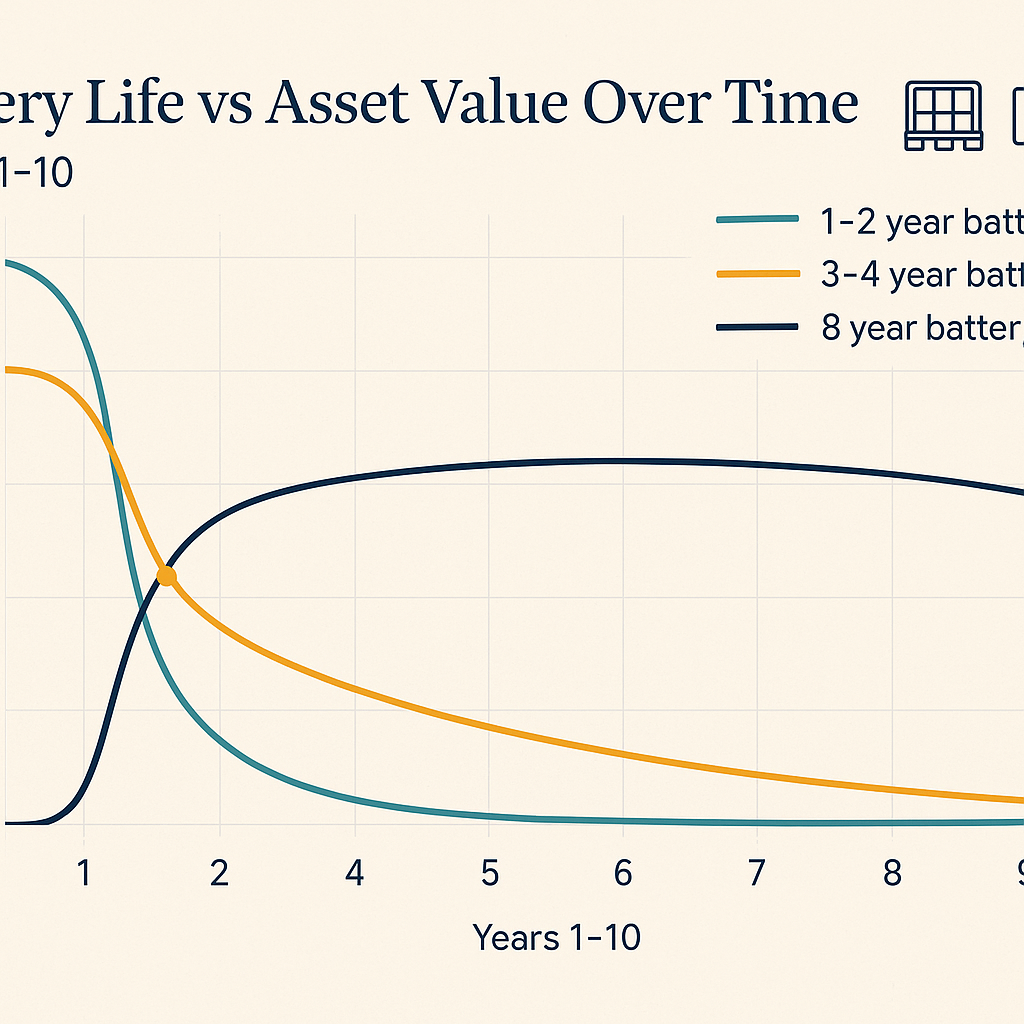
For most of the past two decades, pallet-level GPS tracking has existed mostly as a pitch deck, not a deployment plan. The math never worked. A 40-inch block pallet costs roughly €12–14 to replace, moves through a pool thousands of times over its life, and — crucially — is either idle for long stretches or handled roughly by forklift operators who don't care about your electronics. Strap a tracker to that pallet, and you've just spent more on the sensor than on the asset you're trying to watch. Then the battery dies 18 months in, and you're either retrieving hundreds of thousands of devices to recharge them, or writing them off.
That math has quietly changed. Not because anyone invented a new positioning technology, but because three boring curves — cellular power consumption, lithium chemistry energy density, and LTE Cat-1 module pricing — have finally crossed at a useful place. The result is that an 8-year standby tracker at a price point that survives a pooling-economics spreadsheet is now a real product category, not a wishlist item.
What Is Pallet-Level Tracking, and Why Did It Fail Before?
Pallet-level tracking is the practice of attaching a cellular IoT device to an individual pallet — not a trailer, not a container, the pallet itself — so that the shipper, the pallet pooler, or the receiver can verify its location, custody, and condition in near-real-time. It differs from container tracking (one device per 20 or 40 tons of goods) and from RFID tracking (which only tells you a pallet was seen at a specific gate). It's continuous, device-level visibility.
I've spent two decades working with IoT hardware manufacturers who ship trackers into roughly 100 countries, and pallet-level tracking has been the industry's most stubborn unsolved problem. The reason is straightforward. A wooden block pallet in the European EPAL pool has a duty cycle measured in years. A tracker's duty cycle was measured in months. Every deployment was a slow-motion retrieval project.
The Scale Problem Nobody Wanted to Solve
The pallet pooling industry is bigger than most people realize. Brambles' CHEP alone operates a pool estimated at more than 60 million wooden pallets, with a commanding share of the North American market, and PECO Pallet runs roughly 5 million. A recent Mordor Intelligence analysis puts the global pallet pooling and rentals market at around 6.77 billion units for 2026, growing at just under 5% annually. Across Europe and North America alone, somewhere in the range of 5.2 billion pallets are in circulation. Industry bodies like FEFPEB and NWPCA estimate roughly 1% annual loss — about 33 million pallets vanishing into the economy every year, representing more than €450 million in replacement material cost before you add administrative overhead and service disruption.
A 1% pool-level loss rate sounds acceptable. At the scale of modern pallet pooling, it quietly consumes hundreds of millions of euros a year — which is exactly the gap a multi-year tracker can finally close.
For years, the industry's answer was passive RFID. It works, in narrow circumstances: a pallet passes a read gate at a distribution center, the system logs the event. But RFID tells you nothing between gates. If a pallet gets diverted to a third-party warehouse and quietly absorbed into someone else's pool — which is exactly how most pallets are lost — RFID is silent. The only honest fix is an active cellular tracker on every asset. And until recently, that active tracker's battery outlived by a factor of five.
Why the Economics Finally Work
Three curves crossed.
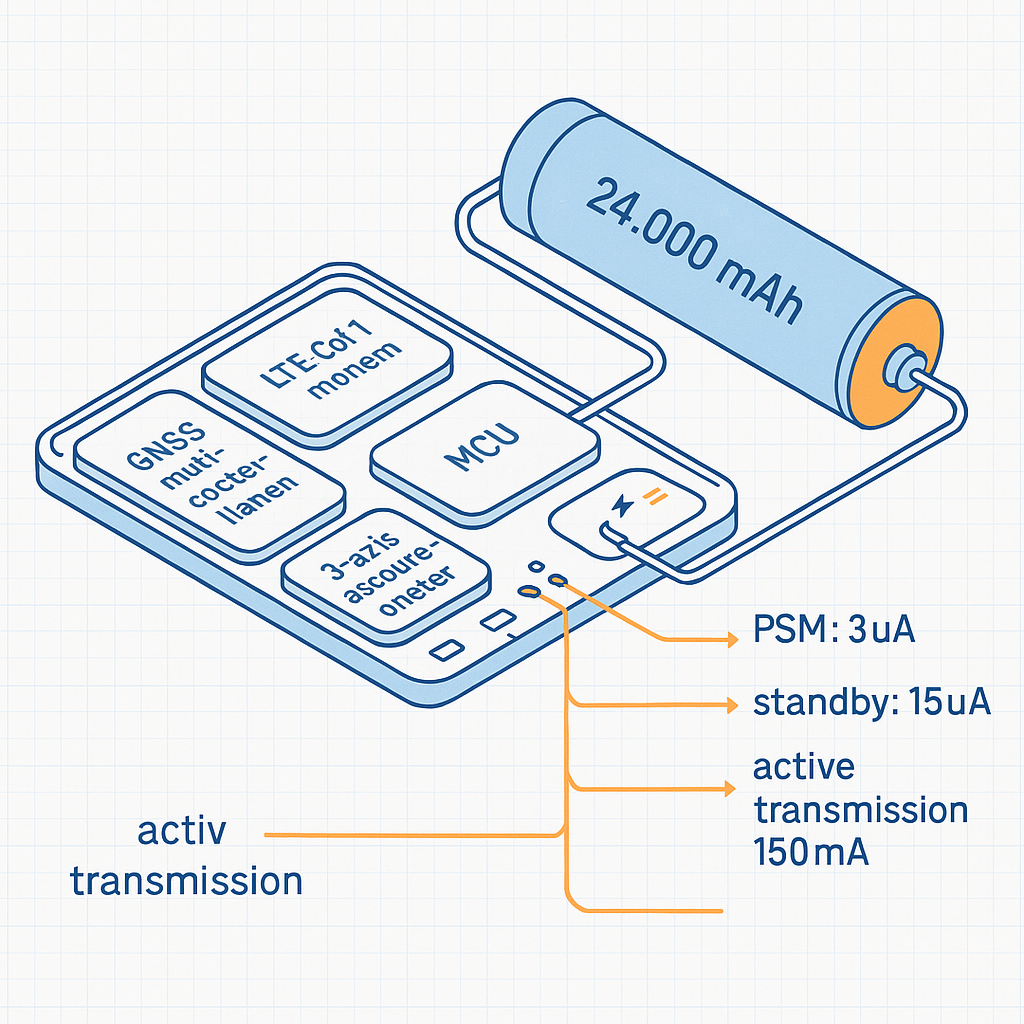
Cellular power consumption fell by an order of magnitude. 3GPP Release 13 and 14 introduced Power Saving Mode (PSM) and extended Discontinuous Reception (eDRX), which let a device stay attached to the network while drawing microamps between wake events. A 2G GPRS device from 2015 burned roughly 5 mA in idle listening. A modern LTE Cat-1 module using PSM sits at 3–15 µA. That's the difference between a tracker that lasts 18 months and one that lasts 8 years with the same battery.
Lithium chemistry matured for long-standby applications. 24,000 mAh lithium manganese primary cells are now available in compact form factors, with shelf lives that genuinely exceed a decade. Paired with a microamp-class duty cycle, an 8-year field life becomes an engineering calculation rather than a hope.
LTE Cat-1 module pricing collapsed. The move from 2G to LTE Cat-1 was supposed to make asset tracking more expensive. It did the opposite. A modern LTE Cat-1 module — the Quectel EG912 or its peers — now delivers global connectivity at a bill-of-materials cost that's competitive with what 2G modules cost five years ago, without the 2G sunset risk that's already rolling across North America and Australia.
What "8-Year Standby" Actually Means in Practice
Every datasheet claim deserves scrutiny. "8-year battery life" is a function of duty cycle assumptions, and vendors vary wildly in how honestly they disclose theirs. Here's how to read the spec sheet.
| Reporting Cadence | Use Case | Expected Field Life (24,000 mAh Class) |
|---|---|---|
| Once per day | Pallet pool audit, slow-moving assets | 5–8 years |
| Every 6 hours | In-transit containers, trailer yards | 2–3 years |
| Hourly | High-value in-transit cargo | 10–14 months |
| Emergency live mode | Theft recovery, anomaly response | Hours to days (then auto-revert) |
The deployment pattern that makes pallet-level tracking economically defensible is almost always the top row: infrequent scheduled heartbeat, with immediate wake-on-motion and wake-on-light-change for exceptions. The device sleeps 99.9% of its life, draws microamps when it does, and only burns serious power when something actually happens — a motion event, a container opening, a temperature threshold breach.
The Industry Use Cases That Cross the Threshold
Pallet pooling is the obvious beachhead, but it's not the only segment where 8-year standby changes the decision. Three use cases in particular flip from "can't be done profitably" to "should be done":
Returnable Transport Items (RTIs) in automotive. The automotive sector loses roughly 15–20% of its plastic containers and specialized racks annually, a figure widely cited from an AIAG survey at around $750 million per year in North America alone. These RTIs are expensive custom assets that cycle through tier-1 suppliers and OEM plants. A tracker that lasts the life of the container changes the economics dramatically.
Pharmaceutical shippers and reefer containers. Under EU Good Distribution Practice and FSMA 204, temperature excursion evidence is legally mandated. Here the 8-year standby tracker gets paired with a multi-sensor suite — temperature, humidity, light, shock — and the device effectively becomes an immutable custody record for the life of the reusable shipper.
Intermodal trailers and chassis. Trailer pools, particularly chassis for intermodal rail, sit idle for weeks and then move hard for days. A once-daily heartbeat for idle periods with motion-triggered rapid updates is the ideal power profile, and the asset itself lasts 10+ years. A tracker matched to that lifecycle is straightforward.
What to Actually Look For in a Spec Sheet
If you're evaluating trackers for a pallet-level deployment, four line items separate the serious products from the marketing.
The first is quiescent current in PSM, expressed in microamps, measured at a specific supply voltage, not the glossy "standby current" figure that conveniently omits the modem's idle draw. Anything above 20 µA at 3.6V is going to have trouble hitting a multi-year field life with a 24,000 mAh cell under real duty cycles.
The second is battery chemistry disclosure. Lithium manganese dioxide (Li-MnO₂) and lithium thionyl chloride (Li-SOCl₂) have genuinely different self-discharge profiles and temperature behaviors. "Large battery" is not a spec.
The third is emergency-mode auto-revert. A tracker that can be flipped to live tracking for a stolen shipment is useful; a tracker that stays in live mode after the event and drains itself in a week is a product defect. Reversion to deep standby must be automatic, not manual.
The fourth is 2G fallback behavior in the modem stack. LTE Cat-1 coverage is excellent in mature markets, but cross-border logistics still crosses dead zones. A clean fallback to 2G GSM where available — and a graceful timeout where it isn't — is the difference between a device that reports reliably and one that hangs on re-registration until the battery is flat.
The Honest Caveats
Multi-year pallet trackers are not a universal solution, and I want to be direct about where they break.
Indoor warehouse tracking is not their strong suit. GNSS signals are blocked by roofs, and Wi-Fi scanning assist helps only partially in environments that change frequently. For dense indoor visibility, RFID and BLE mesh still win. A cellular tracker's job is to hand off to those systems at facility boundaries, not to replace them.
Cross-region certification remains a logistics headache. FCC, CE, PTCRB, and the carrier certifications behind them are real costs and real calendar time. A tracker that's PTCRB-approved on Verizon doesn't automatically work on Telstra. For global pallet pools, this needs to be scoped from day one.
And the device's value proposition lives or dies on software. A tracker that reports reliably but feeds into a platform with no API, no webhook support, and no ability to integrate with the customer's existing TMS or WMS is a dead asset. Hardware is the smaller half of the problem.
Frequently Asked Questions
How long does an 8-year standby tracker actually last in real deployments?
Under a realistic once-per-day reporting cadence with motion-triggered alarms and occasional emergency-mode activations, 5–8 years is a credible field life for a 24,000 mAh class device. If you move to hourly reporting, expect 10–14 months. The spec sheet number is the ceiling, not the typical.
Can multi-year trackers do pharmaceutical cold chain compliance?
Yes, if they include calibrated temperature and humidity sensors and the platform retains data immutably. Under EU GDP and FSMA 204, auditors care about data integrity and traceability more than about reporting cadence, so a once-hourly cold-chain tracker with a multi-year battery is fully viable. The regulatory requirement is evidence, not real-time.
What's the right reporting cadence for a pooled pallet?
Once per day is the baseline for pool management. The tracker should additionally wake on motion start, motion stop, and — where instrumented — light sensor events that indicate container opening. This hybrid cadence gives you 99% of the operational value at 1% of the power cost of continuous tracking.
Why not use satellite IoT for pallets?
Satellite IoT networks (Iridium, Myriota, Swarm, Astrocast) are excellent for assets that genuinely leave cellular coverage — offshore containers, maritime cargo, remote mining equipment. For pallets, which mostly move through cellular-covered warehouses, highways, and ports, LTE Cat-1 with 2G fallback covers more than 95% of the journey at a fraction of the per-message cost. Satellite's place is hybrid devices for cross-ocean shipments.
Is 2G fallback still relevant in 2026?
Less every year, but still relevant in many emerging markets. North American and Australian carriers have largely completed 2G sunset, while parts of Africa, Southeast Asia, and Latin America continue to rely on 2G for fallback coverage. For a tracker intended to ship globally for 5–8 years, including 2G fallback remains a prudent design choice through at least 2028.
Key Takeaways
- Pallet-level tracking was uneconomical for two decades because tracker battery life was five times shorter than the asset it was watching.
- Three curves — LTE Cat-1 module pricing, PSM-enabled microamp standby current, and high-density lithium chemistry — have now crossed at a useful point.
- 8-year standby at a once-per-day cadence is a real field specification, not a marketing claim, for 24,000 mAh class devices with PSM-capable modems.
- The economics flip in three use cases first: pallet pooling, automotive RTIs, and pharmaceutical reusable shippers.
- When evaluating a tracker, inspect quiescent current, battery chemistry, auto-revert behavior, and 2G fallback handling — not just the hero battery-life number.
- Hardware is half the problem; the platform's API, data retention, and integration with existing TMS/WMS systems determines whether the deployment delivers ROI.
If you're scoping a pallet-level deployment and want a second opinion on the hardware choices, let's discuss your requirements. I'll share what I've seen work and what I've seen fail.