

Every year, the pharmaceutical industry loses roughly $35 billion to cold chain failures — temperature excursions, broken packaging, missed alerts, lost documentation. The number is large enough to feel abstract, which is exactly why most cold chain monitoring pitches fail in front of a CFO: the sales deck points at a big scary total addressable loss, the CFO asks “what’s my share of that, and how much of it do I actually recover?” — and the room goes quiet.
I’ve spent enough time on both sides of that table to know the conversation is fixable. The problem isn’t the technology. The problem is the framing. When you translate monitoring investment into five distinct categories of recoverable cost, the ratio that keeps showing up in honest post-deployment audits is roughly five dollars saved downstream for every one dollar spent — and unlike a vendor slogan, you can defend each of the five line items separately.
What is cold chain monitoring ROI?
Cold chain monitoring ROI is the quantifiable financial return a temperature-sensitive logistics operator earns by deploying continuous IoT monitoring across its shipments and storage. It is calculated by summing avoided and accelerated cost flows in five discrete categories — spoilage reduction, regulatory fine avoidance, insurance premium reduction, claim resolution speed, and audit labor savings — and comparing the total against the fully loaded cost of hardware, connectivity, platform subscription, and operational overhead. A properly scoped program typically returns between 4× and 6× the investment over a 24-month horizon, anchored on the two-thirds of that return that comes from the first two categories alone.
An engineering note from the author
I’ve spent close to two decades inside the IoT hardware industry — specifying radios, arguing with firmware teams about sampling rates, and visiting the reefer bays where our devices either survive or don’t. What follows is not a product pitch. It’s the framework I give to colleagues when their finance team needs the business case in a language Excel can parse. The numbers I cite are drawn from publicly available industry reports, regulator filings, and deployments I’ve either worked on directly or debriefed with operators who did.
The five-category framework
There are five levers a monitoring program pulls on, and they don’t contribute equally. I’ll present them in descending order of dollar impact, because that’s how you’ll want to sequence the business case — lead with spoilage and fines, because they alone typically cover the cost of the entire program.
1. Spoilage reduction: the largest single line item
According to industry estimates compiled by IQVIA, temperature-controlled logistics failures cost the biopharma industry roughly $35 billion per year, and the World Health Organization has estimated that up to half of all vaccines distributed globally are wasted, much of that attributable to temperature excursions during storage and transit. In high-value biologics, the per-shipment numbers turn vertiginous: Zolgensma and Kymriah therapies carry per-dose values in the hundreds of thousands to low millions of dollars, meaning a single lost pallet can erase a quarter’s marketing budget.
What continuous monitoring changes is not the probability of a temperature excursion — it’s the window between when an excursion begins and when a human can intervene. A 10-minute window, created by real-time alerts, routinely converts “total loss” shipments into “partial loss with salvage” — a 60–80% recovery of goods value. Over a rolling year, this is typically the single largest line item in a properly accounted ROI model, frequently in the 35–45% range of total savings.
2. Regulatory fine avoidance: the fastest-growing line item
Regulators are not slowing down. The FDA’s Food Safety Modernization Act (FSMA) Rule 204 on traceability has had its compliance deadline pushed to mid-2028, but that should not be read as relief. It should be read as more runway to build the event-level audit trail you’ll need when enforcement arrives. The EU’s Good Distribution Practice (GDP) framework has been issuing fines against distributors with incomplete temperature records for years, and the U.S. Drug Supply Chain Security Act layers on top.
The ROI contribution here is harder to see because it is the cost of a penalty that did not happen. But enforcement actions on the record, in both food and pharmaceutical distribution, show single-incident fines in the $50,000–$500,000 range, plus knock-on costs (lost licensing, retraining, remediation consulting) that often double the headline number. For a mid-sized distributor, one avoided fine per year typically equals the total cost of the monitoring program. That is where the second third of the 5:1 ratio comes from.
3. Insurance premium reduction: the line item insurance brokers won’t advertise
Cargo insurance underwriters have begun differentiating premiums based on monitoring posture. Operators who can demonstrate continuous, time-synchronized, tamper-evident temperature and handling records typically see 8–15% premium reductions on temperature-controlled cargo policies, and deductible reductions on top of that. This is a quiet but durable line item — it compounds year over year and is unusually defensible in front of a CFO because the savings appear on the same line of the P&L every month.
4. Claim resolution speed: the hidden working-capital line item
When a shipment is compromised, the question isn’t only “how much do we recover?” — it’s also “how fast?” An uncontested claim with clean multi-sensor evidence (temperature, light, shock, location) typically settles in weeks. A contested claim without that evidence often takes 6–18 months and settles at a discount. The working-capital impact — tied-up receivables, legal overhead, the cost of carrying inventory you can’t sell yet — is rarely on the first draft of an ROI model, and it should be. For operators with meaningful claim volume, this is a 10–15% contribution to total savings.
5. Audit labor savings: the line item operations teams will defend
Quality and compliance teams spend a surprising share of their capacity reconstructing what happened to a shipment — pulling manual logs, reconciling handoff times, writing narratives. A monitoring program with a clean, machine-readable audit trail converts that work from a 3-day scramble to a 30-minute query. For a QA team of ten, this is usually a quiet six-figure annual saving in fully loaded labor cost, and it tends to be the savings category operations teams cite first when they’re asked to defend the program two years in.
Before and after: a side-by-side comparison
| Category | Without monitoring | With continuous monitoring | Share of total savings |
|---|---|---|---|
| Spoilage reduction | 10–20% recovery on damaged shipments | 60–80% recovery via real-time intervention | 35–45% |
| Regulatory fine avoidance | $50K–$500K per incident exposure | Audit-ready event trail; fines typically avoided | 20–30% |
| Insurance premium reduction | Baseline premium and deductible | 8–15% premium reduction; lower deductible | 10–15% |
| Claim resolution speed | 6–18 months, ~60% settlement | 3–5 weeks, uncontested settlement | 10–15% |
| Audit labor savings | Multi-day manual reconstruction | Query-driven; 30-minute evidence export | 5–10% |
A practical scenario: pharma reefer with six-sensor evidence
Consider a specialty pharmaceutical distributor moving biologics from a central warehouse to hospital pharmacies across three states. The fleet of reefer trailers handles roughly 200 shipments per month, with an average shipment value of $180,000 and a long tail of higher-value specialty doses.
Before continuous monitoring: an average of 2.4 incidents per month of undetected temperature excursion, discovered on receipt. Recovery rate: 10–20% through backup stock and expedited re-shipment. Claim processing: 4–7 months per incident, settling at roughly 60% of claimed value. Annual lost value from this one line alone: approximately $2.1M.
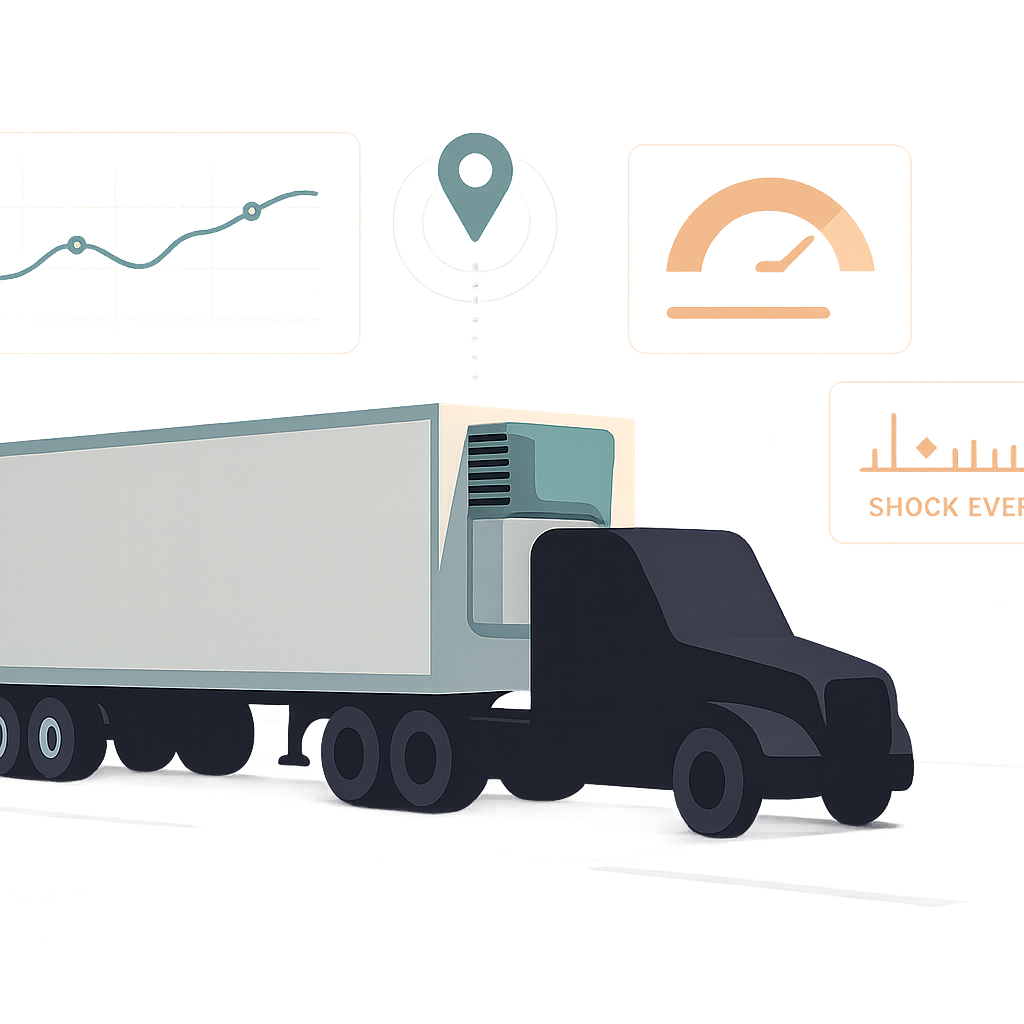
After deploying a multi-sensor monitoring program — temperature, humidity, light, shock, motion, and location logged at 1-minute intervals and alerted in real time: incidents detected at t+10 minutes, in-transit rerouting possible for 60% of them, partial loss for the rest with salvage rates above 75%. Claim evidence packages produce uncontested settlements in 3–5 weeks for the residual losses. Annual lost value drops to ~$380K. Net swing from this line alone: $1.7M.
Fully loaded annual monitoring cost for the same fleet, including hardware amortization, cellular connectivity across LTE-M and NB-IoT networks, platform subscription, integration, and QA overhead: roughly $340K. Direct ROI on spoilage alone: 5.0×. When the four remaining categories are added, the combined 24-month figure lands between 4.6× and 5.8× — the range I lead CFOs into when I’m asked to commit to a number.
Key takeaway. Treat cold chain monitoring not as a single investment but as five separate business cases stapled together. Lead with spoilage reduction and regulatory fine avoidance — they are the two-thirds of the 5:1 ratio that finance can verify independently in the first twelve months.
One more observation from watching this conversation unfold across dozens of deployments: the framing that wins is not “prevent losses.” It is evidence the auditor can read — an auditable chain of sensor events, configuration digests, and intervention logs. Finance will sign on for loss prevention. Audit, insurance, and legal will sign on for evidence. The device is the same; the vocabulary isn’t.
Frequently asked questions
How long does it typically take to recover the investment in a cold chain monitoring program?
For mid-sized operators in pharma or specialty food distribution, payback is usually achieved within 6–14 months. The first half of the payback is carried by spoilage reduction; the second half by avoided regulatory penalties and insurance premium reductions. Programs that fail to hit this window typically have either inadequate sensor coverage (location-only trackers without temperature, light, or shock) or poor alert workflows that prevent real-time intervention.
What sensors are actually required — can a temperature-only device do the job?
A temperature-only device covers the most visible excursion type but leaves the other evidence categories on the table. Insurance underwriters and regulators increasingly expect multi-modal evidence: temperature, humidity, light (indicating unauthorized opening), shock (indicating mishandling), and location (establishing chain of custody). For high-value biologics, a six-sensor profile is now the defensible minimum. For bulk perishables, four sensors (temperature, humidity, light, location) is usually sufficient.
How should the 5:1 ratio be adjusted for food logistics versus pharmaceutical logistics?
In pharmaceuticals, the ratio skews higher — often 5:1 to 7:1 — because product unit values are higher and regulatory penalties are heavier. In food logistics, the ratio tends to settle at 3:1 to 4:1, with a larger share of savings coming from insurance and audit labor, and a smaller share from spoilage reduction per incident. The methodology is the same; the relative weights shift.
What role does battery life play in the ROI calculation?
More than finance usually appreciates. A device that requires mid-shipment recharging or fails on multi-leg international routes creates gaps in the audit trail — which is exactly what regulators, insurers, and legal counterparties need when something goes wrong. Multi-year battery life (5–10 years, depending on duty cycle) shifts the device from consumable to durable asset and meaningfully improves the ROI because the amortization schedule stretches over more shipments.
How do FSMA 204 and EU GDP changes affect the business case in 2026 and beyond?
The regulatory trajectory is unambiguous: more traceability events required, tighter documentation standards, and a growing expectation that the evidence trail is machine-readable and tamper-resistant. FSMA 204’s 2028 compliance deadline should be treated as a planning horizon, not a pause. The operators building event-level monitoring infrastructure in 2026 will absorb the 2028 compliance load as a configuration change, not a retrofit.
Key takeaways
- The 5:1 ratio is a composite, not a single line item. Defend each of the five categories separately in front of finance.
- Spoilage reduction and regulatory fine avoidance together carry two-thirds of the return — lead the business case with these.
- Multi-sensor evidence is no longer optional — insurers and regulators now expect temperature, humidity, light, shock, and location at a minimum.
- The working-capital impact of faster claim resolution is typically missing from first-draft ROI models. Include it.
- Treat the regulatory runway (FSMA 204, EU GDP) as an infrastructure investment window, not a compliance deadline to chase.
If you’re building the business case for a monitoring deployment and want a second opinion on the line items above — or if you’d like to discuss hardware specifications for a specific product category — I’d be happy to have that conversation. Let’s discuss your requirements.