
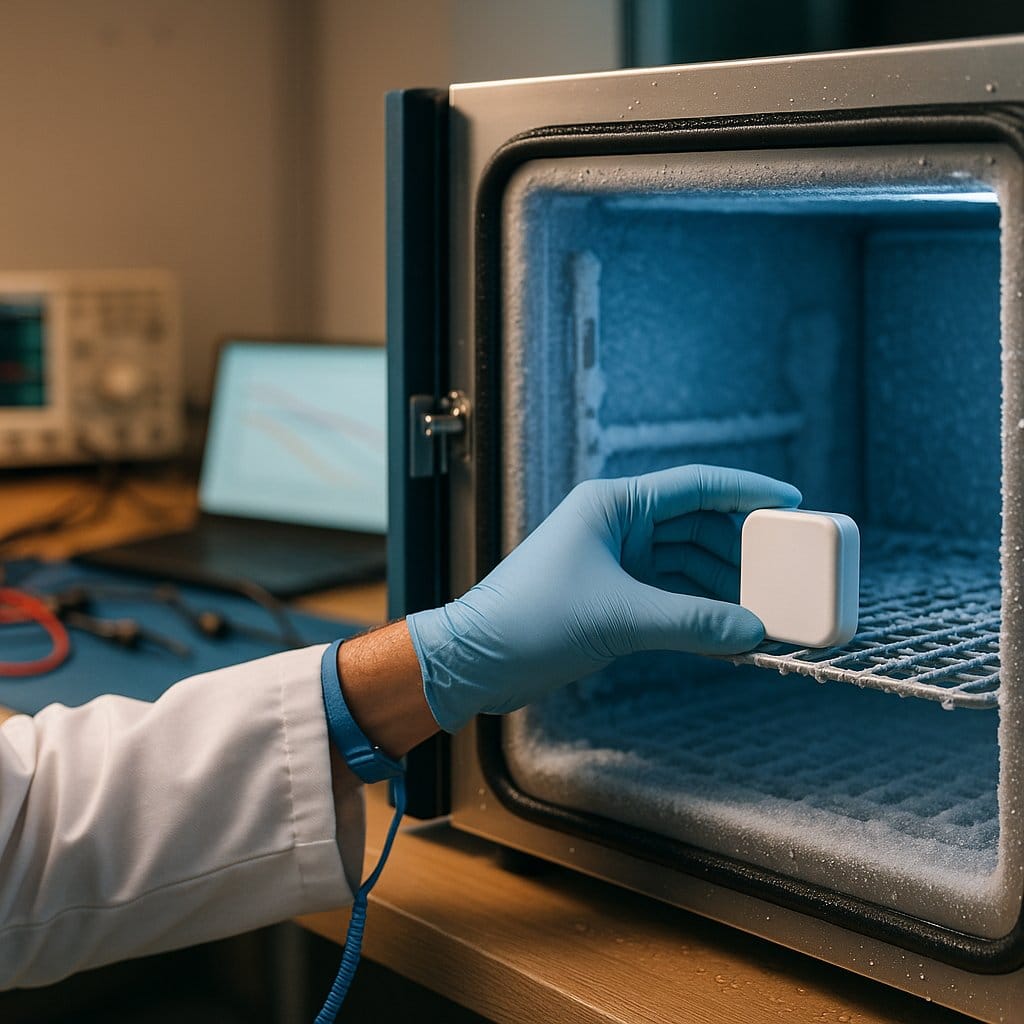
The first cold chain tracker I ever helped debug did not die of a software bug. It died of physics. The device left a packing house in perfect health, rode a reefer trailer into a -22 °C distribution cold store, and went silent the next day — with healthy battery percentage showing on its last report. The eventual diagnosis, confirmed when the unit woke up again after a few hours at room temperature, was not an empty battery. It was a cold one.
I have spent more than twenty years designing and shipping tracking hardware — devices that have ended up in over 100 countries, in lanes from Gulf summer heat to Nordic winter. Cold is the failure mode engineers underestimate most. This is my field-notes version of what actually happens to a tracker below zero, and why the fix is usually mechanical, not electrical.
What Happens to a Lithium Battery Below Zero?
Below 0 °C, lithium-based batteries suffer in two separate ways — and the two problems belong to different chemistries. Discharge gets harder for nearly all of them: the electrolyte thickens, ion diffusion slows, and internal resistance climbs, so usable capacity and deliverable current both drop. Charging is the second problem, and it is specific to rechargeable lithium-ion: charging a conventional Li-ion cell below freezing plates metallic lithium onto the anode, causing permanent capacity loss and a safety risk.
The discharge side is a performance problem. The charge side is a damage problem, and it is the one that surprises teams. Battery University's BU-410 puts it plainly: no charging is permitted at freezing temperatures, because lithium plating during a sub-freezing charge permanently degrades performance and safety. A plated cell also becomes more vulnerable to failure under vibration — which is exactly what a pallet on a truck experiences all day.
For a rechargeable tracker, the conservative rule is: no charging below the cell manufacturer's validated low-temperature limit — for conventional Li-ion, that limit is 0 °C — even when the device sits on a powered dock in a cold room. (Specialized low-temperature cells exist with their own qualified charge envelopes; they are the exception you design for deliberately, not the default.) Robust designs enforce that limit through the charger or battery-protection architecture, not application software alone. If a vendor cannot tell you their low-temperature charge cutoff, ask harder questions.
Why Do Cold Chain Trackers Die Mid-Lane With Battery Left?
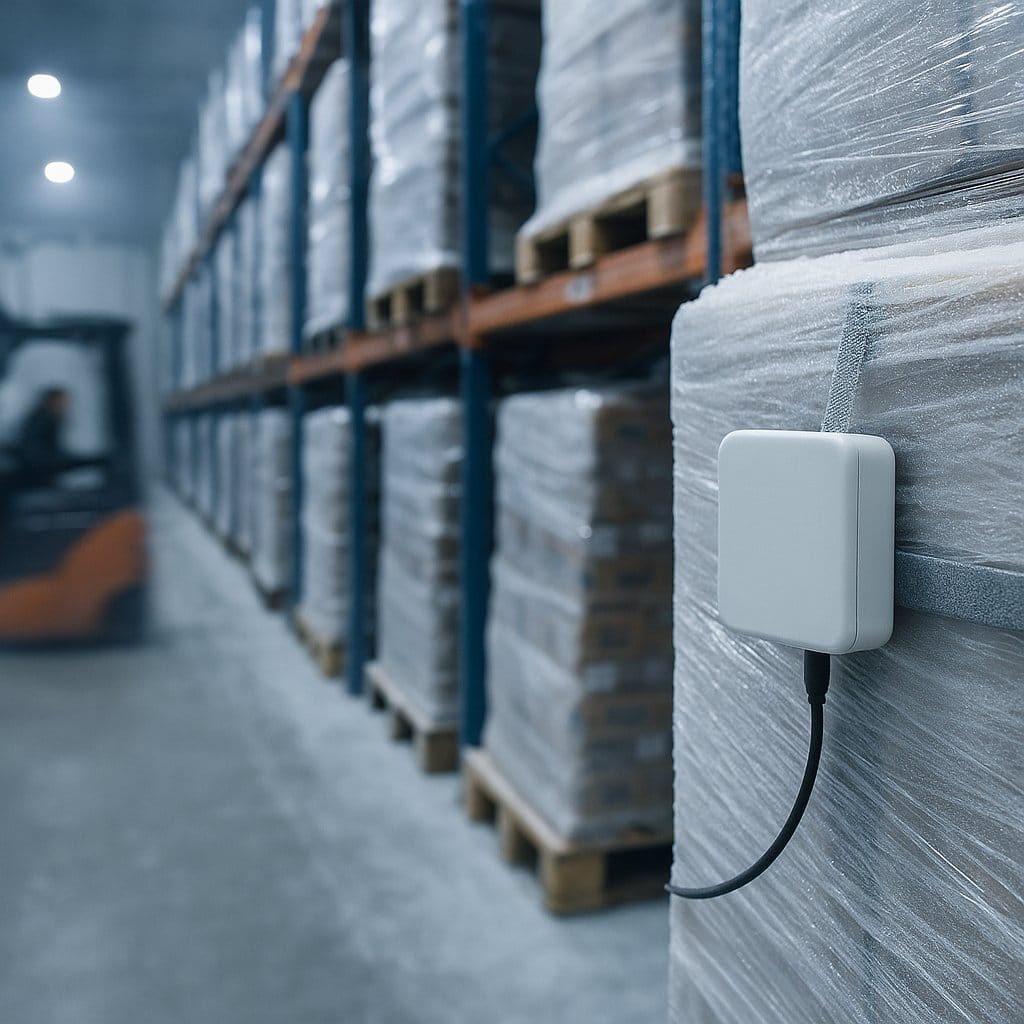
Trackers rarely drain to zero in the cold. They brown out. A cellular modem draws its highest current in short transmission bursts. A cold cell with elevated internal resistance cannot hold voltage under that burst load. The voltage sags below the electronics' cutoff, the device resets or shuts down, and the "remaining capacity" on paper never gets used.
Three design decisions determine whether that happens on your lane:
- Reporting interval. Every report is a burst-load event — and not only the transmission itself: network registration, retries in weak signal, and GNSS cold starts all add load. Why those cold starts fail inside a metal box at all is its own physics problem — covered in the companion piece on why GNSS dies inside a reefer container. A 5-minute profile stresses a cold cell hundreds of times per day. Interval should be engineered per lane, not set to "maximum visibility" by default.
- Chemistry choice. Around -20 °C and below, many commodity Li-ion cells can no longer support cellular pulse loads reliably — treat that as the trigger for checking the cell's low-temperature discharge curves against your actual load profile, not as a hard boundary (low-temperature-rated Li-ion exists). Primary chemistries such as lithium thionyl chloride carry much deeper operating ratings — datasheets commonly state around -55 °C — but an operating rating is not usable pulse capacity: these cells deliver low burst current, exhibit passivation and voltage delay after storage, and usually need a capacitor buffer that must itself be qualified at lane temperature.
- Thermal placement. Where the battery physically sits matters more than either of the above. More on that below, because it is the cheapest fix on this list.
| Battery approach | Cold behavior | Where it fits |
|---|---|---|
| Rechargeable Li-ion / Li-Po | Capacity and burst current drop in the cold; charging below 0 °C causes permanent lithium plating | Chilled lanes (0 to 8 °C), reusable multi-trip devices, with a hardware charge cutoff |
| Primary lithium (e.g. Li-SOCl2) | Deep operating ratings, but limited burst current, passivation after storage — needs cold-qualified capacitor support for cellular bursts | Deep-freeze lanes, long single-trip or multi-year deployments |
| Any chemistry + external probe, electronics outside the cold zone | Battery stays in a milder microclimate; only the sensor tip lives at product temperature | Deep-freeze and ultra-low lanes where the measurement must be cold but the device does not |
Why Put the Probe in the Load and the Electronics Outside?
One of the highest-leverage fixes in cold chain tracking is mechanical, not electrical: where the deployment offers a genuinely warmer mounting position, put the device body there and run a thin platinum RTD probe to the load. The battery then lives in a milder microclimate, while the probe tip records temperature at the load — a placement change that can buy more runtime than a bigger battery.
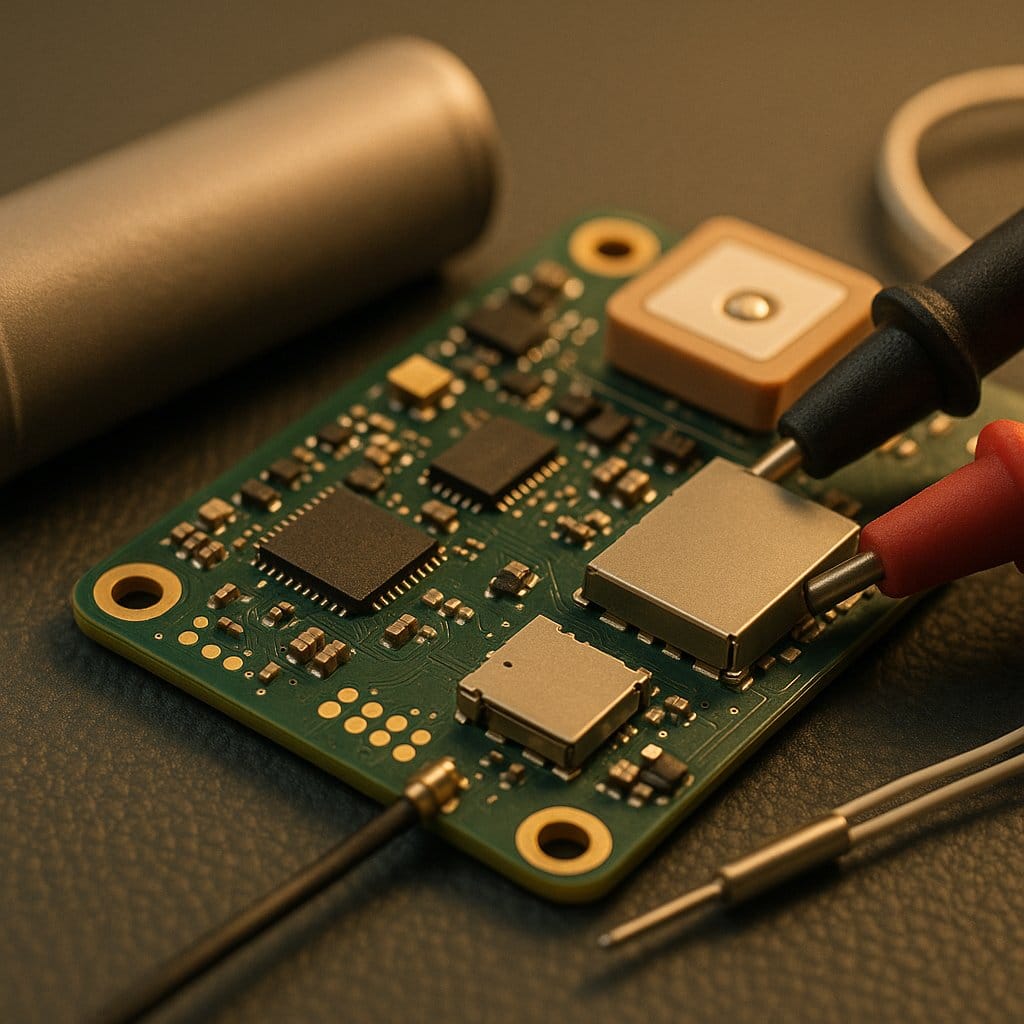
The condition attached to that sentence carries all the weight: the position must be genuinely warmer, and stay that way. A device that eventually equilibrates to ambient inside a sealed container gains nothing from clever mounting. A probe cable also brings its own failure modes — snag and crush points, connector wear, condensation at penetrations — so the mechanical routing deserves the same review as the electrical design. A tracker with a probe, thrown loose into the deep-freeze with its cable coiled on top, has all the same battery physics plus a connector to break.
The probe itself matters. Platinum RTDs (the PT100/PT1000 class whose characteristics and tolerance classes are standardized under IEC 60751) are the workhorse for wide-range measurement — though the standard defines the sensing element, not the accuracy of your whole chain, which still depends on wiring scheme, ADC, and calibration of the assembled logger-plus-probe. And measurement location is a specification question, not a default: some protocols are written against product temperature, others against ambient, supply air, or a validated representative position. A sensor sealed inside the device body reads the enclosure's own microclimate; a probe lets you place the measurement where your quality specification actually points. In a dispute, that difference is the difference.
Does Regulation Care About Any of This?
Not directly — and that is worth understanding clearly. The U.S. FDA's FSMA 204 traceability rule asks for shipment records, not temperature data. The EU's Good Distribution Practice guidelines do require demonstrable temperature control for medicinal transport. Neither text says a word about electrolyte viscosity.
But every record-keeping obligation quietly assumes the recording device survives the trip. A tracker that browns out on day two of a seven-day frozen lane produces a gap, and a gap in a monitoring record invites investigation — the question of what happened in the dark now has to be answered some other way. I wrote previously about visibility hardware as evidence; the battery is where that evidence chain physically begins. Regulators define what must be shown. Physics decides whether your device can show it.
Every battery-powered cold chain record rests on an unstated assumption: that the battery survived the lane. Below zero, that assumption is a design decision — chemistry, reporting interval, and where the device body physically sits.
How Do I Spec a Tracker for a Frozen Lane?
Speccing hardware for a frozen lane is a sequencing exercise: establish the lane's thermal profile, choose a chemistry that matches it, decide placement before capacity, engineer the reporting profile, and then verify the whole configuration in a chamber at lane temperature. This is the checklist I run with every deep-freeze deployment, in order:
- Lane thermal profile first. Coldest sustained temperature, duration, and how many door-opening warm spikes. This decides everything downstream.
- Chemistry to match. Chilled lanes: rechargeable is fine with a charge cutoff. Sustained below -20 °C: primary lithium, low-temperature-rated cells, or move the electronics out of the cold.
- Placement before capacity. A sheltered mounting position plus an external probe often buys more runtime than a bigger battery.
- Reporting profile per lane. Decide the minimum interval that still catches an excursion in time to act. Every extra report is cold-weather battery stress.
- Bench-test at temperature. Headline capacity figures are measured under benign conditions — use the temperature- and load-specific curves instead, then verify. Put the actual device, with the actual firmware profile, in a chamber at the actual lane temperature after a full cold soak, and watch the voltage under transmission load. This one test predicts more field failures than any spec review.
Frequently Asked Questions
Why does my cold chain tracker show battery remaining but still go offline?
Cold raises a lithium cell's internal resistance. During a cellular transmission burst, the voltage sags below the electronics' cutoff and the device resets or shuts down. The energy is still chemically present, but the cell cannot deliver it fast enough at that temperature. Fuel-gauge percentages are calibrated for room temperature and overstate what a cold cell can actually do.
Can I charge a lithium-ion tracker inside a cold room?
Not with a conventional lithium-ion cell below 0 °C. Charging below freezing plates metallic lithium onto the anode, permanently reducing capacity and creating a safety risk that vibration makes worse. Well-designed devices block charging below the cell's validated threshold in their charger or protection circuitry. Let the cell itself warm above the limit first, then charge.
What battery chemistry works best for deep-freeze tracking?
For sustained duty below about -20 °C, primary lithium chemistries such as lithium thionyl chloride are the common choice; operating ratings commonly reach around -55 °C, though usable pulse capacity shrinks with temperature. They deliver low burst current, so cellular designs pair them with cold-qualified capacitor buffers. Alternatives include low-temperature-rated Li-ion, or keeping the device body outside the coldest zone with an external probe.
Is an external temperature probe more accurate than the tracker's internal sensor?
It measures something different, which matters more than raw accuracy. An internal sensor reads the device's own enclosure microclimate. A platinum RTD probe (PT100/PT1000 class, standardized under IEC 60751) reads temperature at wherever you place the tip — which lets you match the measurement location your quality specification actually calls for. For disputes and audits, probe placement decides what your record proves.
How should reporting interval change in cold lanes?
Stretch it as far as your intervention window allows. Each cellular report is a high-current burst that a cold cell struggles to supply, so a 5-minute profile can brown out a device that would survive the same lane reporting hourly. Decide the slowest interval that still lets you act on an excursion, and bench-test that profile at lane temperature.
Key Takeaways
- Cold attacks lithium batteries twice: discharge performance drops with temperature, and charging a conventional Li-ion cell below 0 °C causes permanent lithium plating damage.
- Cold-lane trackers usually brown out under transmission load with charge remaining — fuel gauges calibrated at room temperature will not warn you.
- Chemistry must match the lane: rechargeable for chilled; primary lithium, low-temperature-rated cells, or relocated electronics for deep-freeze.
- One of the highest-leverage upgrades is mechanical: device body in a genuinely milder microclimate, external RTD probe placed where the specification points.
- Regulations define what a record must show; battery physics decides whether your device survives long enough to show it. Bench-test at lane temperature before you deploy.