
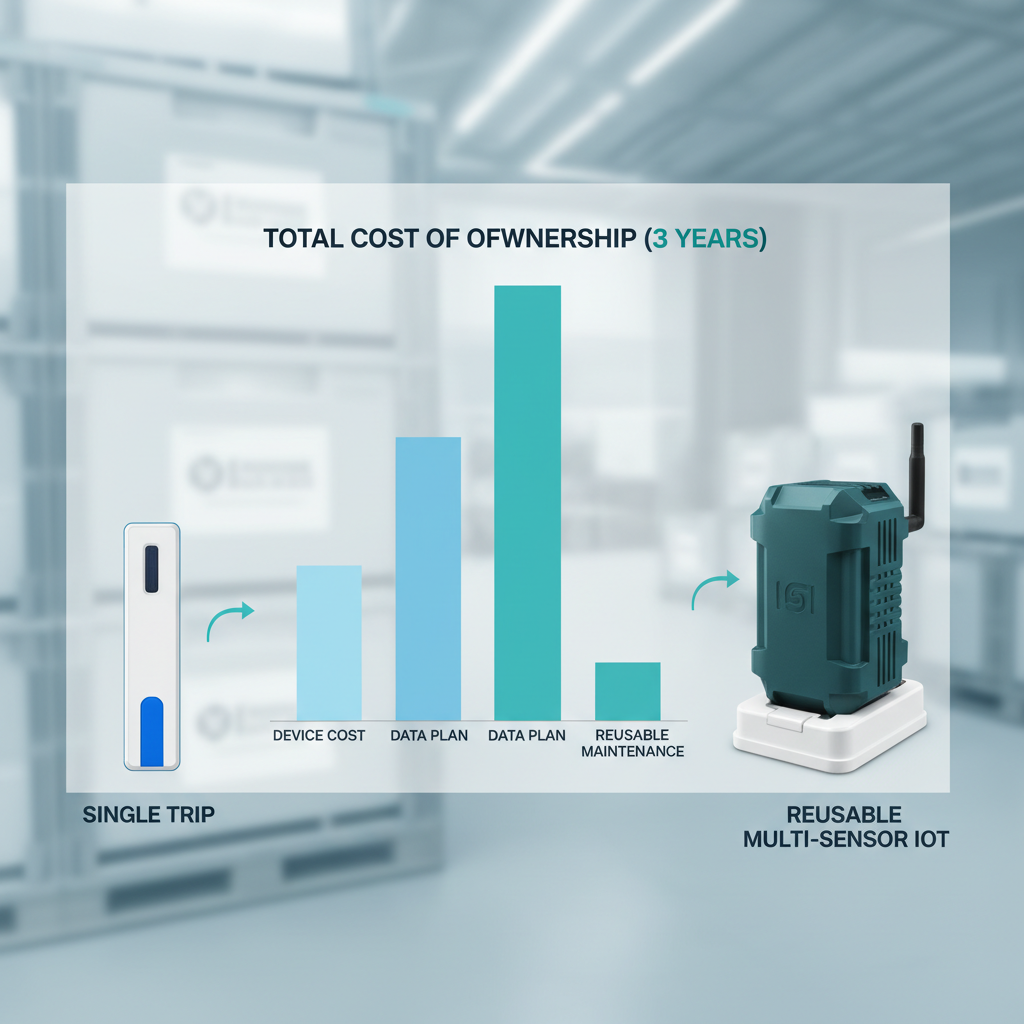
Total cost of ownership (TCO) in cold chain tracking is the complete financial picture of deploying a monitoring device over its useful life—including not just the purchase price, but also connectivity subscriptions, reverse logistics, maintenance, labor, disposal, and the cost of product losses that monitoring either prevents or fails to prevent.
This is the conversation that procurement teams across pharmaceutical logistics are having right now. The active tracking device market reached approximately 4.5 million units by end of 2024 and is forecast to hit 14.7 million by 2029, with device shipments growing from 6.5 million to over 33 million units per year. That explosive growth is being driven by a mix of disposable (single-use) and reusable trackers—and the choice between them is far more nuanced than comparing sticker prices.
I've been specifying and deploying tracking hardware across more than 100 countries for over two decades. Here's what the TCO numbers actually look like when you run them honestly.
Understanding the Two Categories
A disposable tracker is a single-use device designed to be attached to a shipment, activated (often by peeling a strip or scanning a barcode), and discarded or returned for recycling after delivery. These range from BLE smart labels costing $5–10 (which need gateway infrastructure) to cellular-connected trackers at $15–50 per unit with built-in GPS, temperature, humidity, and light sensors.
A reusable tracker is a multi-trip device with a rechargeable or long-life primary battery, designed to be retrieved after each shipment, recharged or maintained, and redeployed. Upfront costs range from $80 to $300+, with monthly subscription fees for connectivity and cloud platform access.
Key Takeaway: The real TCO question isn't "which device is cheaper?" It's "what does each shipment actually cost me over three to five years, including all the costs I'm not seeing on the invoice?"
The Hidden Cost Iceberg
The reason TCO analysis matters so much for tracking devices is that the purchase price represents only the visible tip of the cost iceberg. Below the waterline sit costs that can double or triple the effective per-shipment expense.
For disposable trackers, the hidden costs include: per-unit connectivity fees baked into the device price, environmental disposal compliance (lithium battery e-waste regulations vary by country), limited sensor capability that may miss excursions a more capable device would catch, and the cumulative cost of buying new units for every single shipment.
For reusable trackers, the hidden costs include: reverse logistics to retrieve devices from delivery destinations, cleaning and recalibration between deployments, battery charging or replacement labor, firmware update management, inventory management of the tracker pool, and lost or damaged devices that never return.
Industry experience suggests that these hidden costs can add 30–50% to the sticker price of reusable devices over a three-year lifecycle.
TCO Model: 200 Shipments Per Year Over 3 Years
Let's build a realistic TCO comparison. Assume a mid-size pharmaceutical distributor shipping 200 temperature-controlled loads per year, each requiring a tracker with GPS, temperature, and humidity monitoring.
| Cost Category | Disposable (per year) | Reusable (per year) |
|---|---|---|
| Device purchase | 200 × $35 = $7,000 | Year 1: 30 × $200 = $6,000 Year 2–3: $1,200 (replacements) |
| Connectivity + SaaS | Included in unit price | 30 × $8/mo × 12 = $2,880 |
| Reverse logistics | $0 | $2,400 (shipping + handling) |
| Charging + maintenance | $0 | $1,200 (labor) |
| Device loss (10% attrition) | N/A | $600 |
| Disposal / e-waste compliance | $400 | $100 |
| Annual total | $7,400 | Year 1: $13,080 Year 2–3: $8,280 |
| 3-Year TCO | $22,200 | $29,640 |
| Cost per shipment | $37.00 | $49.40 |
When the Numbers Flip
At first glance, disposable wins on pure cost. But this model doesn't account for the most important variable: what the tracking data actually prevents.
Reusable multi-sensor devices typically offer richer data, more accurate sensors, longer reporting windows, and more reliable connectivity—which translates to better excursion detection and faster corrective action. If a reusable tracker prevents even one temperature excursion per year that would have destroyed a $50,000 biologic shipment, the 3-year TCO flips dramatically in favor of reusable devices.
The crossover also depends heavily on shipment volume. At 500+ shipments per year, reusable trackers with proper reverse logistics achieve per-shipment costs below $25, while disposable costs remain fixed. At scale, the economics strongly favor reusable devices—which is why large pharmaceutical logistics operators overwhelmingly choose reusable fleets.
When Disposable Wins Clearly
Disposable trackers have a genuine economic advantage in specific scenarios: one-way international shipments where device retrieval is impractical or impossible, ad hoc shipments outside your regular lanes, low-volume operations (fewer than 50 tracked shipments per year), lanes where the receiver has no relationship with your organization and won't return devices, and proof-of-concept deployments where you're testing the value of tracking before committing to infrastructure.
The emergence of ultra-thin BLE smart labels at under $10 per unit is also expanding the disposable segment for lower-value shipments where per-unit economics have historically made tracking unviable.
The Hybrid Strategy Most Operators Actually Use
In practice, the most sophisticated cold chain operators don't choose one or the other—they deploy both strategically. A typical hybrid deployment looks like this: reusable multi-sensor trackers on the top 10–20 highest-frequency routes that account for 60–70% of shipment volume, disposable trackers for one-way international lanes, spot shipments, and routes where reverse logistics would cost more than a new device.
This approach captures the cost efficiency of reusable devices where it matters most while preserving the flexibility of disposable tracking for unpredictable logistics scenarios. Leading cold chain tracking providers now offer platform-level support for mixing both device types under a single dashboard.
Beyond Cost: Capability Differences That Matter
TCO analysis sometimes obscures the fact that disposable and reusable devices are not functionally equivalent. Most disposable trackers offer temperature, location, and perhaps light sensors. Reusable devices from leading manufacturers commonly add humidity, shock/vibration, tilt, barometric pressure, and door-open detection. For pharmaceutical compliance—particularly under FDA FSMA and EU GDP—multi-sensor data significantly strengthens your audit documentation.
Battery life also differs in meaningful ways. Disposable trackers are optimized for a single journey of days to weeks. Reusable devices designed on LTE-M or NB-IoT networks with power-saving modes can operate for months to years between charges, making them suitable for long-duration monitoring of containers, trailers, and warehouse cold storage.
How much does a disposable GPS tracker cost per shipment?
Single-use cellular trackers typically range from $15 to $50 per unit depending on sensor capability and connectivity technology. BLE-only smart labels can cost as little as $5–10, though they require gateway infrastructure to relay data. Since these devices are not recovered, the per-shipment cost equals the full unit price.
At what shipment volume do reusable trackers become more cost-effective?
For most pharmaceutical logistics operations, reusable trackers become more cost-effective at around 50–100 shipments per year per device. Below this threshold, the reverse logistics and maintenance costs erode the per-shipment savings. Above it, the amortized hardware cost drops rapidly while disposable costs remain linear.
What are the hidden costs of reusable trackers?
The most commonly underestimated costs include reverse logistics for device retrieval (especially cross-border), cleaning and recalibration between trips, battery charging or replacement labor, firmware update management, and inventory management of tracker pools. These can add 30–50% to the sticker price over a three-year lifecycle.
Are disposable trackers environmentally sustainable?
Most disposable cellular trackers contain lithium batteries and electronic components that require proper e-waste disposal. Some manufacturers offer return-and-recycle programs to mitigate this. BLE smart labels have smaller environmental footprints. Organizations with strong ESG commitments should factor disposal compliance costs and environmental impact into their TCO calculations.
Can I mix disposable and reusable trackers in the same operation?
Yes, and many leading logistics operators do exactly this. A common pattern is deploying reusable multi-sensor trackers on high-frequency predictable routes and using disposable trackers for ad hoc shipments, one-way international lanes, or when receiver-end retrieval is impractical. Most modern cloud platforms support both device types under a unified dashboard.
Key Takeaways
- TCO analysis must include reverse logistics, maintenance, connectivity fees, device attrition, and disposal costs—not just purchase price.
- Disposable trackers win on simplicity and flexibility for low-volume, one-way, and ad hoc shipments.
- Reusable trackers win at scale (50+ shipments/year) and when superior sensor data prevents even one high-value product loss.
- The most effective cold chain operations deploy a hybrid strategy—reusable for core routes, disposable for everything else.
- Smart labels under $10 per unit are expanding the addressable market for per-shipment tracking of lower-value goods.
The disposable-vs-reusable debate isn't really about which technology is better. It's about matching device economics to your specific logistics patterns—and having the discipline to calculate the real numbers, not just the purchase order.
Evaluating cold chain tracking options for your operation? Let's talk through the TCO model for your specific routes and volumes.