

The pharmaceutical cold chain is one of the most regulated logistics environments on the planet—and the monitoring device strapped to your shipment is, increasingly, the only piece of evidence that survives an audit. Yet many cold chain operators discover the hard way that their hardware meets the spec sheet but fails the regulator's checklist.
The reason isn't usually a missing sensor. It's a missing match between what auditors require and what the device was built to prove. In 2026, with FSMA 204 enforcement formally pushed to 2028 and EU GDP scrutiny intensifying after several high-profile vaccine excursion cases, the gap between "monitoring" and "evidence" is where compliance programs are breaking down.
This article walks through exactly what the FDA's FSMA 204 framework, the EU's GDP guidelines, and the WHO's TRS 957 Annex 5 actually demand from the hardware itself—not from the operator, not from the procedure, but from the device. By the end you'll have a 15-point capability checklist you can take into any vendor conversation.
What Is Cold Chain Compliance Monitoring?
Cold chain compliance monitoring is the continuous capture of environmental and location data from temperature-sensitive shipments using validated, calibrated devices that produce an audit-defensible record meeting FDA, EU GDP, WHO, and regional regulatory requirements. Unlike basic temperature logging, compliance monitoring is defined by what regulators can verify after the fact: traceable lot codes, time-synchronized events, threshold-and-duration excursion semantics, and an unbroken evidence chain from manufacturer to point of use.
The difference matters because most "temperature loggers" on the market produce data. Few produce evidence.
Which Three Regulatory Frameworks Govern Your Cold Chain Device in 2026?
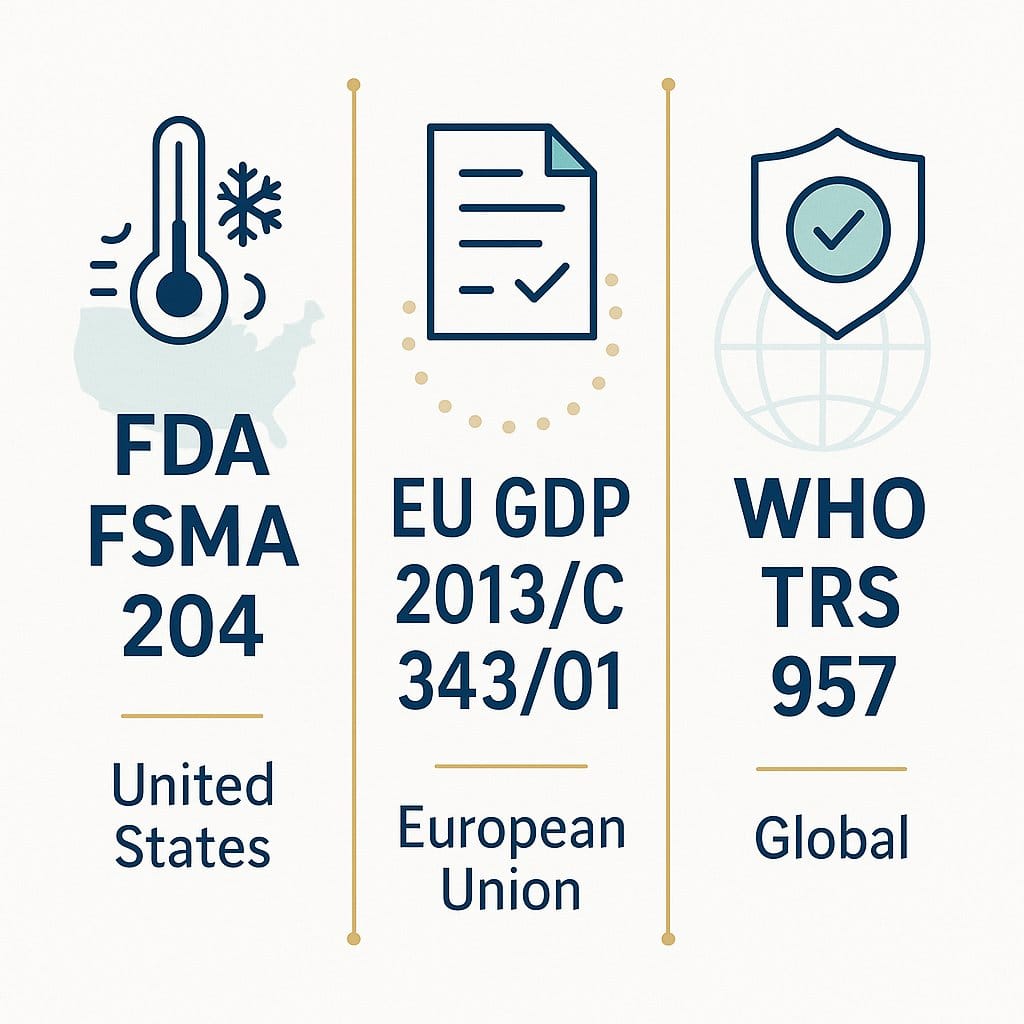
Three regulatory frameworks govern pharmaceutical and food cold chain monitoring across most major markets in 2026: the FDA's FSMA 204 rule in the United States, the European Union's Good Distribution Practice guidelines, and the World Health Organization's Technical Report Series 957 Annex 5. Knowing which one applies, where they overlap, and which is the most prescriptive for monitoring devices is the first step in any meaningful compliance evaluation.
FDA FSMA 204: Food Traceability with a Moved Deadline
The Food Safety Modernization Act's Section 204 rule originally required compliance by January 20, 2026. In March 2025 the FDA proposed a 30-month extension, and Congress codified the delay in November 2025—pushing enforcement to July 20, 2028. The substantive requirements remain unchanged: covered entities must capture Key Data Elements (KDEs) at Critical Tracking Events (CTEs) and provide a sortable electronic record within 24 hours of an FDA request. The delay is an engineering window, not a pause. For a deeper systems-architecture breakdown of how to build the underlying data model, see my earlier piece on FSMA 204 cold chain data architecture.
EU GDP 2013/C 343/01: Continuous Monitoring, No Shortcuts
The European Union's Good Distribution Practice guidelines are the most prescriptive of the three frameworks on the monitoring side. The guidance mandates continuous temperature recording at intervals typically between 15 and 30 minutes, calibrated equipment with documented maintenance, validated alarm thresholds, and tamper-evident records. Excursions trigger immediate quarantine and structured deviation management. Unlike FSMA 204, EU GDP applies during distribution itself, not just at handoff events—meaning the device must remain operational across the entire transport leg without gaps.
WHO TRS 957 Annex 5: The Global Reference
For multilateral aid distribution, low-and-middle-income market shipments, and any vaccine program with WHO involvement, the World Health Organization's Technical Report Series 957 Annex 5 sets the baseline. It is harmonized with both FDA and EU expectations and is the framework cited in most cross-border GDP audits. Devices that meet WHO TRS 957 typically clear both FDA and EU requirements with minor additions.
How Do the Three Frameworks Compare?
Where the three regulators agree, they agree firmly: continuous monitoring, calibration, excursion management, and an audit-defensible record. Where they differ, the differences are usually about evidence format and reporting cadence, not the underlying physics. The table below maps the most common compliance requirements across the three frameworks so you can see at a glance which constraint applies in which market.
| Requirement | FDA FSMA 204 | EU GDP 2013 | WHO TRS 957 |
|---|---|---|---|
| Continuous monitoring | Required at CTEs | 15–30 min interval | ≤ 30 min interval |
| Calibration documentation | Implied via 21 CFR 211 | Required, periodic | Required, traceable to NIST/ISO |
| Excursion definition | Per product specification | Threshold + duration | Threshold + duration + MKT |
| Audit data retrieval window | 24 hours, sortable electronic | On reasonable request | On request, retained 5 years |
| Multi-sensor context | Not mandated | Humidity for some products | Recommended for biologics |
| Compliance deadline | July 20, 2028 | In force | In force |
What Do Auditors Actually Look For at the Device Level?
I've spent more than 20 years in IoT hardware design and supply chain visibility, with deployments across more than 100 countries. The pattern is consistent: regulators don't audit your dashboard. They audit your evidence. Five capabilities at the device level determine whether that evidence holds up.
1. Continuous, Tamper-Evident Logging
Sampling cadence has to be consistent and uninterruptible. A 30-minute interval that drops out for 4 hours mid-transit is worse than no logging at all—it's now a documented gap. Devices need internal buffering for offline periods (no cellular coverage in remote depots, on tarmac, in metal-shielded warehouses) and idempotent resend logic when connectivity returns so the same reading isn't double-counted.
2. Calibrated, Traceable Sensors
EU GDP and WHO TRS 957 both require sensor calibration traceable to a recognized standard (NIST, ISO 17025, or a national metrology institute). The device should ship with a calibration certificate, support periodic re-calibration, and timestamp every reading against a synchronized clock source. Devices that drift more than ±0.5°C over a year on cold chain ranges (2–8°C) are functionally non-compliant for most pharma applications.
3. Excursion Semantics, Not Just Excursion Detection
Detecting that the temperature went out of range is the easy part. What matters for regulators is the excursion event model: when did it start, when did it end, what was the maximum deviation, what was the cumulative duration above threshold, and was Mean Kinetic Temperature (MKT) preserved? A device that emits raw point readings without forming bounded excursion events forces downstream systems to do reconstruction—and reconstruction is where claim disputes are won and lost.
4. Multi-Parameter Context
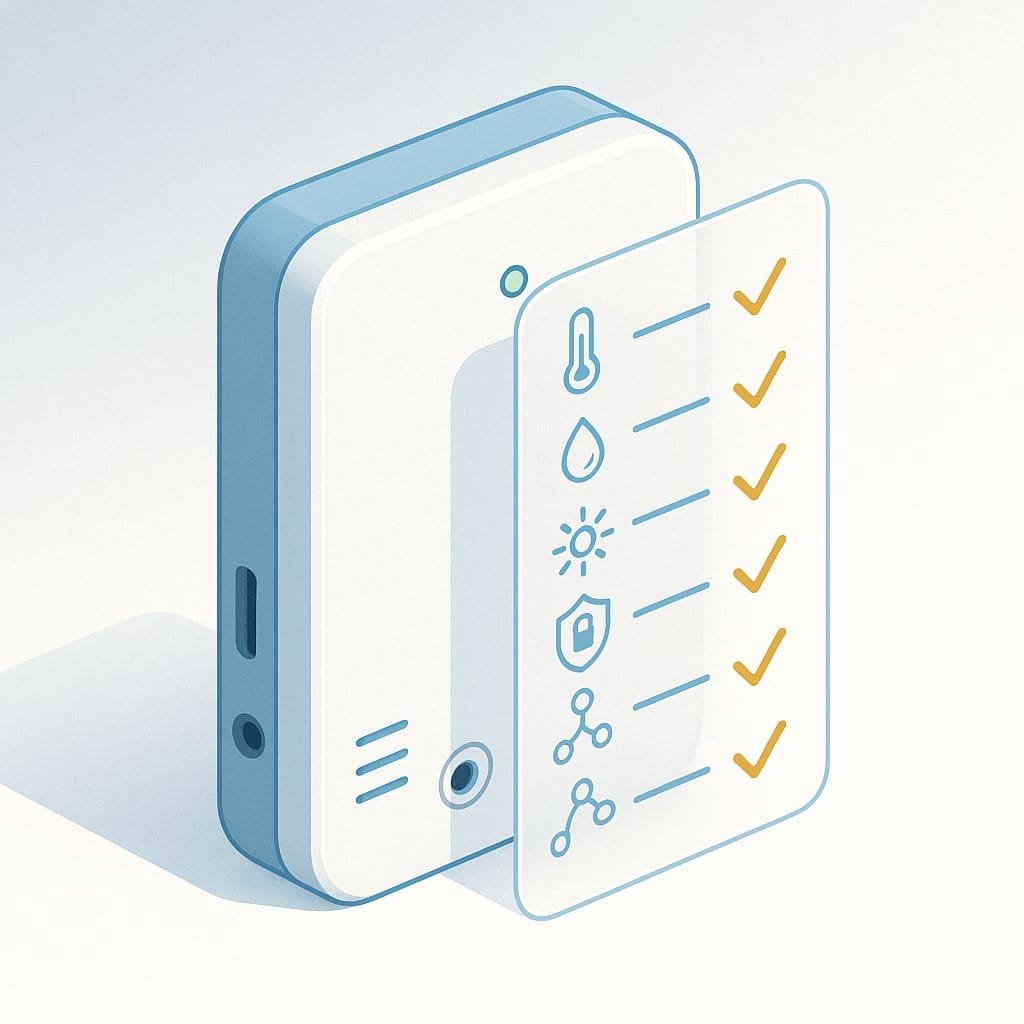
Temperature alone is rarely enough. Biologics degrade with humidity exposure. Photo-sensitive injectables fail under light. Vaccine vials crack with shock. A device with only a temperature sensor cannot causally link an excursion to a root cause when an insurer or auditor asks. The most defensible devices on the market today combine at least four sensors: temperature, humidity, light, and shock. Some add tilt and motion for biologic shipments. This is where Eelink's GPT29 cold chain device was specifically engineered—six sensors in a single compliance-grade enclosure, sampling cadences independently configurable per sensor stream.
5. Data Integrity by Design
The final pillar is the one that catches most teams off guard: data integrity has to be designed in, not bolted on. That means cryptographically-signed firmware, sequence numbers on every transmitted record, time synchronization against a verified source (typically the cellular network's NITZ or NTP fallback), and a tamper-evident record format. If your auditor can argue that timestamps could have been altered, your evidence is suspect regardless of how clean the chart looks. The underlying principle here mirrors the design principles for modern IoT devices I've written about previously: integrity at the source is cheaper than reconstruction downstream.
Key Takeaway: A cold chain monitoring device that captures temperature but cannot produce an excursion event with bounded start/end timestamps, multi-parameter context, and a tamper-evident chain of custody isn't a compliance device. It's an expensive thermometer.
What's on the 15-Point Cold Chain Device Compliance Checklist?
Use this when evaluating any monitoring device for pharma or regulated food cold chain. A vendor that can answer "yes, here's the documentation" to all 15 is rare. One that can answer "yes" to 12 is a viable choice; one that scores below 10 will create audit work later.
Hardware capability (1–5)
- Temperature accuracy ±0.3°C or better across the 2–8°C cold chain range, with documented uncertainty across –20°C and 25°C extremes
- At least one additional environmental sensor beyond temperature (humidity, light, shock, or tilt) with independent sampling
- Calibration certificate traceable to NIST, ISO 17025, or an EU national metrology institute, included at shipment
- Internal non-volatile buffering capable of storing 30+ days of readings during offline periods
- Battery autonomy that covers the longest expected shipment duration plus a 50% contingency margin, validated under representative thermal conditions
Data and evidence capability (6–10)
- Timestamp synchronization against an authoritative source (cellular NITZ, GNSS time, or NTP) with documented drift bounds
- Excursion event model: bounded start/end timestamps, threshold and duration parameters, and MKT calculation per shipment
- Sequence numbers on every transmitted reading, with idempotent resend logic on reconnection
- Tamper-evident record format—cryptographic signing, append-only logs, or equivalent
- Audit-ready export in a sortable electronic format (CSV, JSON, or industry-standard EDI) retrievable within FDA's 24-hour window
Operational capability (11–15)
- Configurable alarm thresholds with multi-channel notification (cellular, BLE handoff at warehouse, dashboard integration)
- Multi-region cellular coverage—LTE-M and NB-IoT support for global routes, plus a 2G/Cat-1 fallback where available
- IATF 16949, ISO 9001, or equivalent quality management certification at the manufacturer level
- Documented carrier approvals (PTCRB, FCC, CE, RED) for every market the device will operate in
- Vendor-provided audit support and excursion investigation services when claims arise
Where Do Most Cold Chain Devices Fail the Audit?
Three failure modes account for the vast majority of cold chain compliance findings I've seen in supplier audits and claim disputes: clock drift, single-parameter blindness, and silent connectivity gaps. None of these are exotic engineering problems. All three can be prevented at the firmware-design layer for a fraction of what they cost downstream when an auditor or insurer challenges the data. Here's how each one manifests and what to look for when evaluating a device.
The first is clock drift. A device that loses 30 seconds per day looks fine—until an auditor compares its excursion timestamps to a synchronized warehouse system and finds a 2-minute discrepancy. That discrepancy is enough to break the chain of custody narrative. Cellular-NITZ time synchronization or periodic GNSS time-fixing eliminates this category of finding entirely.
The second is single-parameter blindness. A vaccine arrives degraded. Temperature logs are clean. Without a humidity or light sensor, there's no evidence to support either a denied claim or an accepted one. The dispute drags on for months. Multi-parameter devices resolve the root cause inside an afternoon.
The third is silent connectivity gaps. Devices that quietly fail to upload during dead zones and then resume as if nothing happened produce data that looks continuous on the dashboard but contains hidden offline periods on closer inspection. The fix is on-device buffering with explicit gap-marking on resend—a small firmware concern that becomes a major audit concern if not designed in.
What Are the Most Common Cold Chain Compliance Questions?
These five questions come up in nearly every cold chain compliance conversation I have with operators, procurement teams, and quality directors. The answers reflect the current regulatory landscape as of mid-2026, including the recent FSMA 204 deadline extension and the most prescriptive elements of EU GDP and WHO TRS 957 guidance.
Is a temperature logger enough for pharma cold chain compliance?
For most regulated pharmaceutical products it is not. EU GDP, WHO TRS 957, and most pharmaceutical stability protocols require at minimum temperature plus environmental context (humidity, light, or shock) and a validated audit trail. A pure temperature logger satisfies storage monitoring for some over-the-counter products but rarely meets transport-phase requirements for biologics, vaccines, or photo-sensitive injectables.
Does the FSMA 204 delay to 2028 mean I can wait to upgrade my monitoring devices?
No. The regulatory deadline moved but the market deadline did not. Several major retailers and pharmaceutical distributors are already requiring traceability-ready KDEs as an RFP qualification criterion in 2026, and procurement teams are using the extension period to vet suppliers. Companies that wait until 2028 will face compressed integration timelines and reduced market access.
How often should cold chain monitoring devices be calibrated?
EU GDP and WHO TRS 957 both expect periodic calibration with documentation, typically annually for transport devices and at minimum every 12 months for stationary warehouse equipment. Some pharmaceutical sponsors require semi-annual calibration for biologic shipments. Devices that drift more than ±0.5°C between calibrations should be retired from compliance use.
What is the difference between excursion detection and excursion event semantics?
Excursion detection simply identifies that a reading crossed a threshold. Excursion event semantics define the bounded event—start timestamp, end timestamp, peak deviation, duration above threshold, and Mean Kinetic Temperature impact. Regulators and insurers evaluate evidence at the event level, not the raw reading level. Devices that emit raw points without event modeling shift the burden of reconstruction to downstream analytics, which is where most claim disputes originate.
Do I need a different device for FDA, EU, and WHO compliance?
Not usually. A well-designed multi-sensor device that meets EU GDP and WHO TRS 957 requirements typically clears FDA expectations with minor configuration changes—primarily in how data is exported and how lot codes are bound to readings. The hardware itself is rarely the constraint; the data format and integration layer is.
What Are the Key Takeaways?
The shift from temperature monitoring to evidence production is the single most important mental model for cold chain compliance in 2026. The five points below capture the practical implications for anyone evaluating, deploying, or auditing a cold chain monitoring program against FDA, EU, or WHO frameworks.
- Cold chain compliance monitoring requires devices that produce evidence, not just data—bounded excursion events with multi-parameter context, not raw point readings.
- FSMA 204's deadline moved to July 20, 2028, but the underlying requirements are unchanged and market-driven adoption is happening now.
- EU GDP and WHO TRS 957 govern the device-level monitoring layer most prescriptively, with continuous logging, calibration traceability, and excursion semantics as the core demands.
- A 15-point capability checklist covering hardware sensors, data integrity, and operational support should be the foundation of any device evaluation.
- The three most common audit failures—clock drift, single-parameter blindness, and silent connectivity gaps—are all preventable at the firmware-design layer.
How Do You Apply This to Your Cold Chain Program?
If you're evaluating new monitoring hardware or auditing an existing fleet against the framework above, I'd be glad to compare notes on what's working in 2026 deployments and where the regulatory ground is shifting.