
Every summer, the same pattern repeats across refrigerated freight. A shipment leaves the dock with a clean setpoint, the reefer runs the whole way, the paperwork looks perfect — and the load still arrives compromised. The data logger recorded nothing alarming. The claim gets denied anyway. The problem was never the cooling unit. The problem was where the temperature was measured, and where it wasn't.
Summer is when the physical weaknesses of a cold chain stop being theoretical. The rest of the year, a mediocre monitoring setup can coast on mild ambient conditions. Under a heatwave, the margins disappear, and the gaps in sensor coverage become the exact places where cargo spoils undetected.
What is a summer cold chain stress test?
A summer cold chain stress test is the real-world validation of whether a temperature monitoring program can detect and localize excursions when external heat pushes refrigeration equipment to its operational limit. It is not a lab procedure — it is what every reefer trailer, air cargo pallet, and container endures once ambient temperatures climb into the mid-30s Celsius and beyond. The test exposes a specific truth: a monitoring setup that produces defensible data in spring can produce blind spots in July.
The stakes are quantifiable. Industry analyses have long estimated that around 20% of temperature-sensitive healthcare products are damaged or degraded during distribution due to poor cold chain management, and the World Health Organization has stated that as much as 25% of vaccines reach their destination in a degraded state. These losses are not evenly distributed across the calendar — they concentrate in the windows where thermal stress is highest and monitoring is weakest.
Why does summer break cold chains that hold up the rest of the year?
The failure mechanism is straightforward physics. A refrigeration unit removes heat at a finite rate. When outside temperatures rise, the unit has to work against a larger thermal gradient, and any weakness — a marginal door seal, an aging compressor, poor airflow from an over-stacked load — gets amplified. What was a manageable inefficiency in April becomes an active excursion source in July.
Extreme heat is also becoming more frequent and more prolonged. The U.S. Environmental Protection Agency reports that the frequency of U.S. heat waves has risen from an average of two per year in the 1960s to six per year in the 2010s and 2020s, with the heat wave season also lengthening. For cold chain operators, that trend means the annual high-risk window is widening, and the assumption that "our routes are fine most of the year" carries less and less protection.
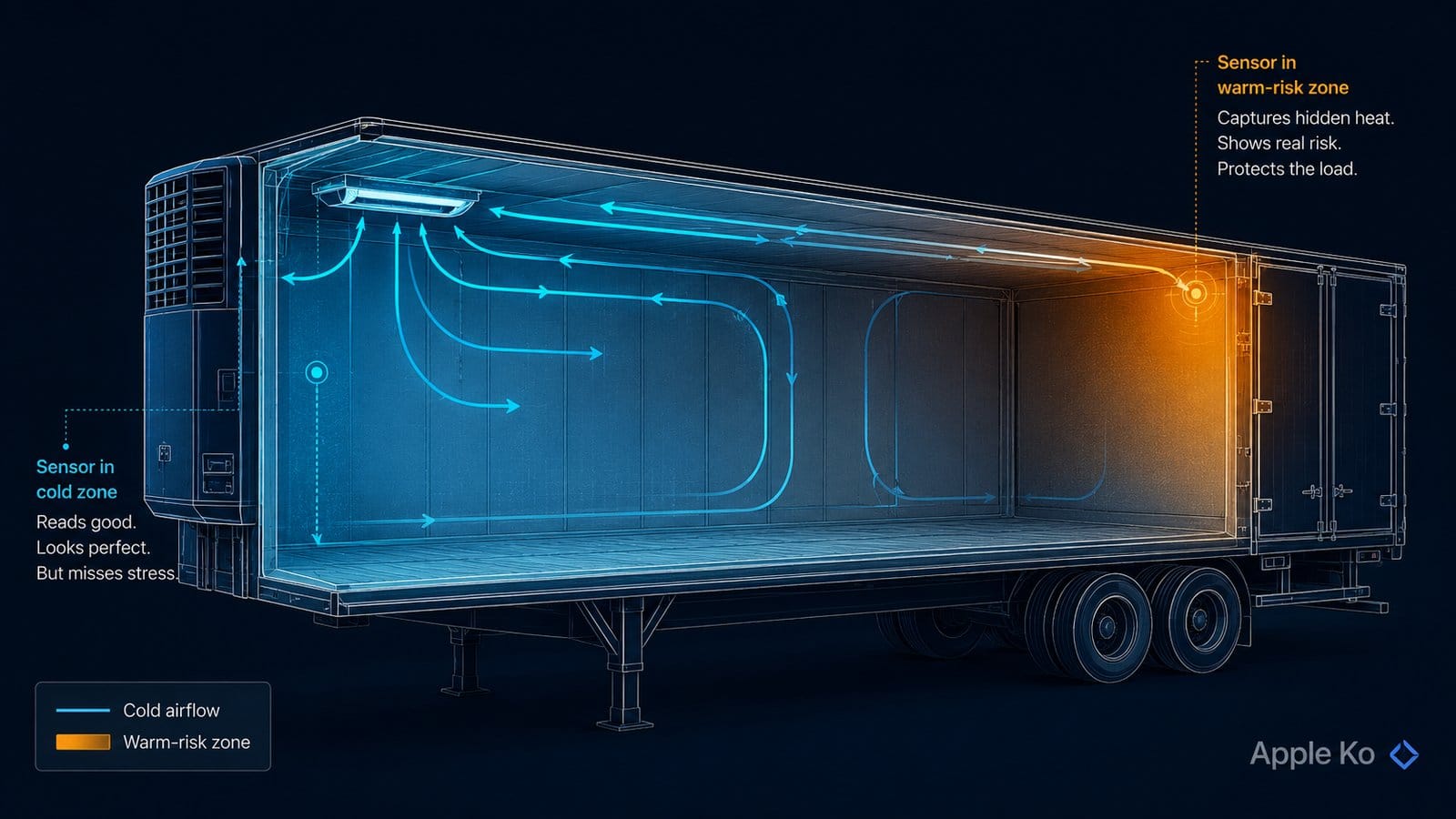
But here is the part most monitoring conversations skip: the heat does not raise the temperature uniformly inside the cargo space. It creates a temperature map — a predictable pattern of hot spots and cold spots that shifts depending on load configuration, airflow, and how long the doors have been open. And that map is exactly what a single-point sensor cannot see.
Where do temperature excursions actually happen inside a reefer?
Inside a refrigerated trailer, the refrigeration unit sits at the front. Cold air is pushed from the front and needs to circulate all the way to the rear doors and back. This geometry produces a consistent thermal reality: the air nearest the unit is coldest, and the air farthest from it — near the rear doors, near the roof — is warmest and most volatile. When cold chain sensor placement guidance recommends monitoring the rear of the trailer near the doors, it is because that is where airflow problems and door-opening events show up first.
Standard reefer validation practice reflects this. To characterize a loaded trailer, temperature is checked at nine points — front, center, and rear, each at top, middle, and bottom levels. The reason nine points exist is that a single reading, wherever it is taken, cannot represent the whole cargo space. In summer, the spread between the coldest and warmest of those nine points widens, because the refrigeration unit is fighting harder and airflow imperfections matter more.
Key takeaway: A summer excursion rarely happens everywhere in the load at once. It happens in one zone — usually the warmest, hardest-to-reach corner — while the rest of the cargo stays compliant. Whether that excursion is detected depends entirely on whether a sensor was placed in the zone that failed.
This is the fundamental gap between how monitoring is often sold and how heat actually behaves. Software platforms present a single trailer temperature as if the cargo space were one uniform box. The physics say otherwise. A monitoring program that reports "the trailer was 4°C" is answering the wrong question when the pallet against the rear-right wall spent three hours at 11°C.
Ambient vs product temperature: what is the monitor actually measuring?
There is a second measurement trap that summer makes worse. Most monitoring devices report ambient air temperature — the temperature of the air around the sensor. What actually determines whether cargo is safe is product temperature — the temperature of the goods themselves. These two values diverge, and they diverge most during rapid thermal events, which is precisely what summer produces.
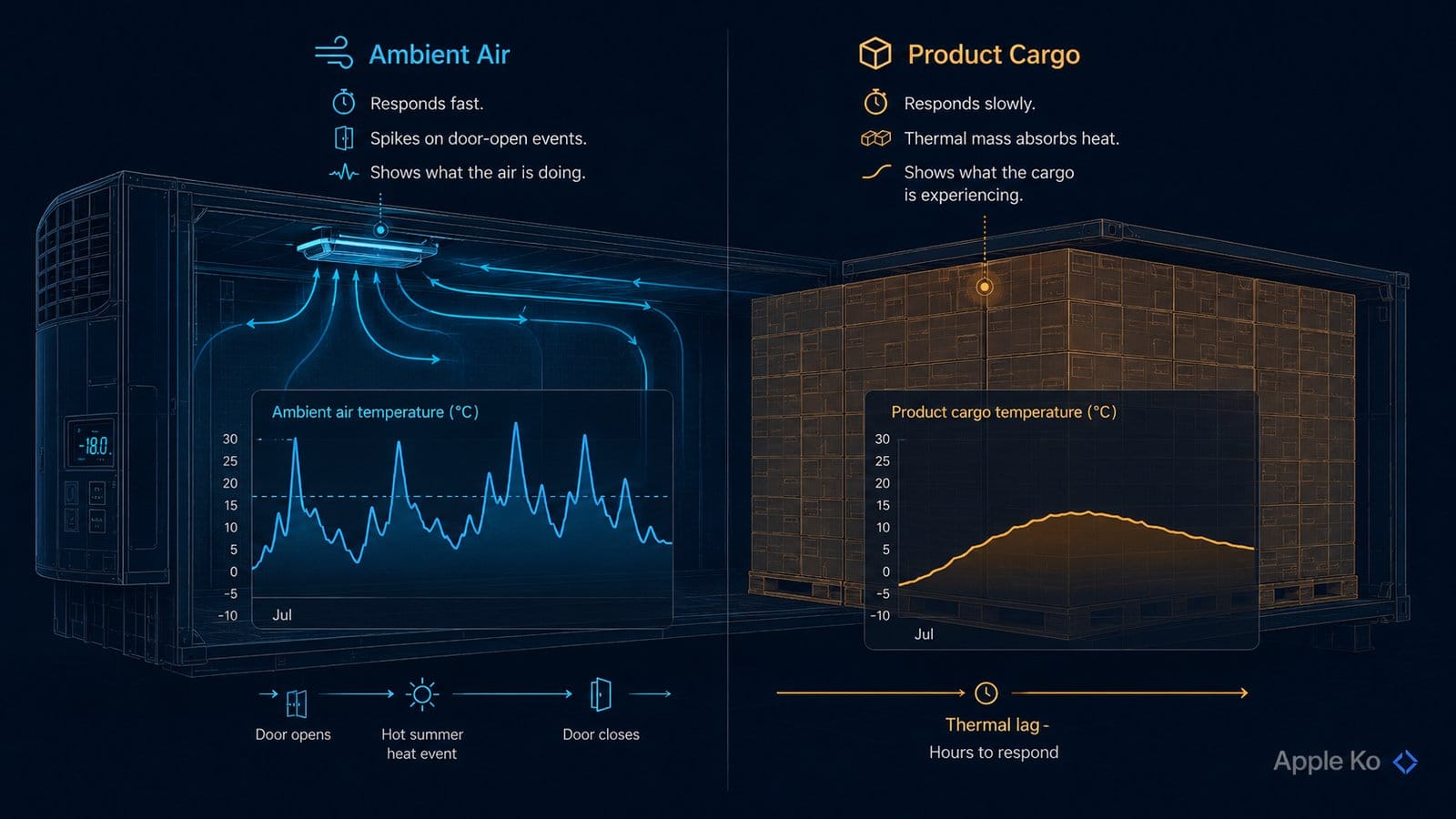
Air responds to a temperature change quickly. A dense pallet of frozen product responds slowly, thanks to its thermal mass. This lag cuts both ways. A brief spike in air temperature — a door opened at a loading dock in 38°C heat — may show up dramatically on an ambient sensor while the product core barely moves. Conversely, a slow, sustained rise can leave the air reading looking acceptable while heat gradually soaks into the outer layers of the load, where excursions actually begin.
Neither reading is wrong. But interpreting one as if it were the other is a common and expensive mistake. An audit-ready monitoring program documents which is being measured, where, and treats the difference as a design decision rather than an accident. The engineering question is not "what temperature was it" but "what temperature, of what, measured where, and how fast does that thing respond to heat."
Post-trip logger vs real-time monitor: what changes in summer?
The distinction between a passive logger and a real-time monitor is often framed as a cost trade-off. In summer, it becomes an intervention trade-off. A logger tells you, after the fact, that a zone failed. A real-time monitor tells you while the truck is still moving — when the driver can still lower the setpoint, when a load can still be rerouted to a closer facility, when the excursion is still preventable rather than merely documented.
| Dimension | Post-trip data logger | Real-time monitor |
|---|---|---|
| When you learn of an excursion | At delivery, on data retrieval | While the shipment is in transit |
| Summer intervention window | None — the loss is already realized | Minutes to hours to adjust or reroute |
| Spatial coverage | Only where the logger physically sits | Extensible to multiple zones if designed for it |
| Best fit | Lane qualification, low-value stable routes | High-value cargo, long hauls, heat-exposed lanes |
Neither device eliminates the placement problem. A real-time monitor in the wrong location is a fast alert about the wrong zone. The upgrade that actually reduces summer losses is not simply "add connectivity" — it is "cover the zones that fail, and know which reading each sensor produces."
How many sensors, and where? A placement framework
For teams reviewing their monitoring setup before peak heat season, the useful questions are structural, not brand-driven. A defensible summer placement strategy tends to follow these principles:
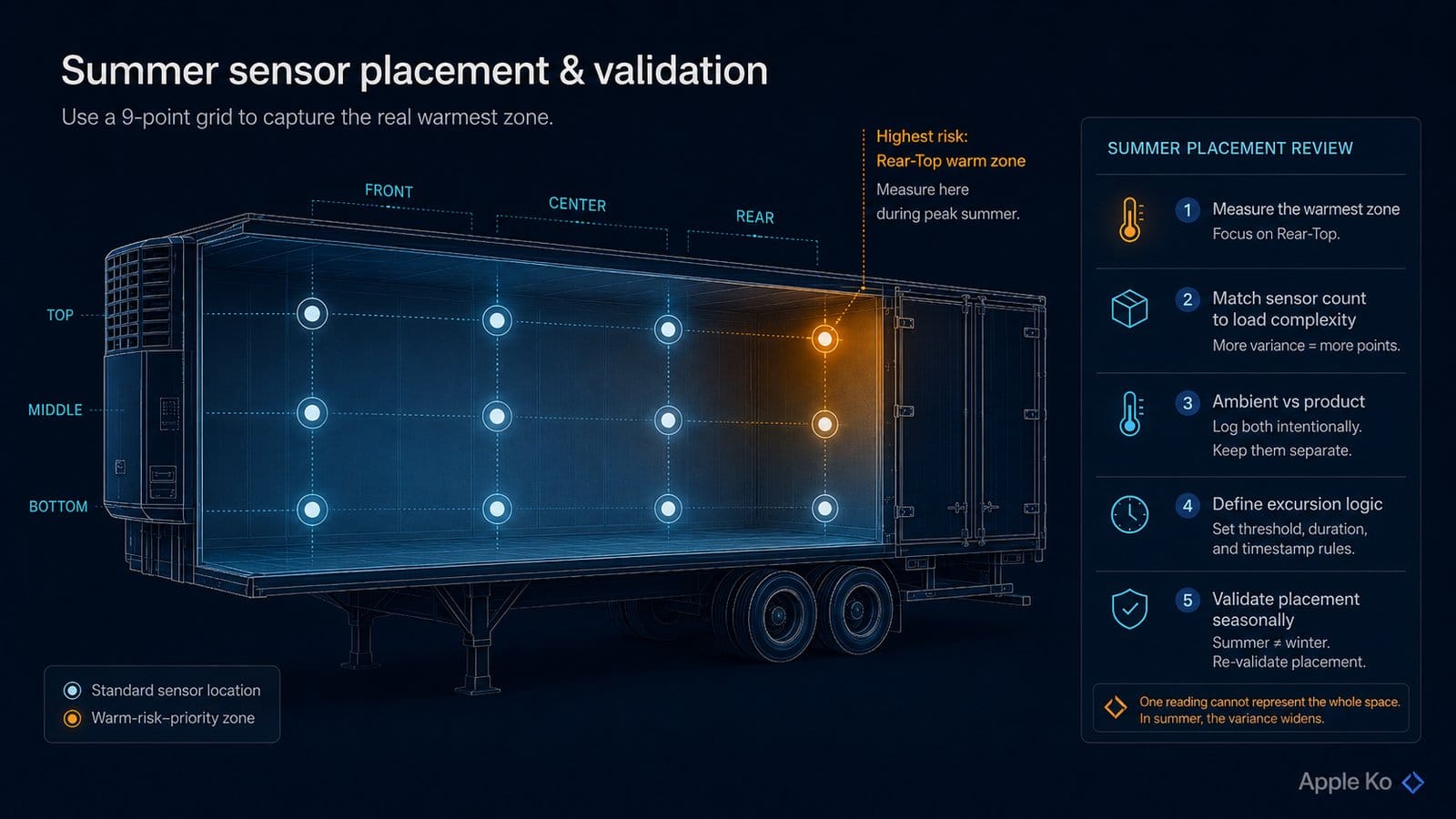
1. Instrument the warmest zone, not the most convenient one. The rear of the trailer near the doors, high up, is where airflow problems and door-opening excursions surface first. A sensor placed near the refrigeration unit reports good news while the failing corner goes unwatched.
2. Match sensor count to cargo heterogeneity. A single uniform frozen load tolerates fewer measurement points than a mixed load with different products, densities, and setpoints. The more varied the cargo, the more the temperature map fragments, and the more points are needed to represent it.
3. Decide ambient versus product deliberately. If the goal is to catch fast air-temperature events like door openings, ambient sensing responds quickly. If the goal is to protect the product core, a probe with appropriate thermal contact is more representative. Documenting the choice is what makes the resulting data defensible.
4. Define the excursion, don't just log the temperature. A meaningful excursion is a threshold plus a minimum duration plus timestamps, tuned to filter transient noise while catching genuine risk. A raw temperature stream without this logic produces either alarm fatigue or missed events. The same discipline underpins a defensible cold chain data architecture when the records later have to survive an audit.
5. Validate placement seasonally. A sensor position that was adequate in winter may sit in a false-comfort zone in summer. The temperature map shifts with ambient conditions, so placement assumptions deserve a seasonal review rather than a one-time setup.
None of this requires exotic hardware. It requires treating monitoring as a spatial and physical design problem rather than a dashboard feature. The companies that lose the least cargo in summer are usually not the ones with the flashiest platform — they are the ones who understood, before the heatwave, where their loads were going to fail.
Frequently asked questions
Why do cold chain failures spike in summer specifically?
Refrigeration units remove heat at a fixed rate, so higher ambient temperatures force them to work against a larger gradient. Marginal weaknesses — door seals, airflow, compressor age — that stay hidden in mild weather become active excursion sources under sustained heat. Longer, more frequent heat waves widen the annual high-risk window.
Is one temperature sensor enough for a refrigerated trailer?
Rarely, in summer. A single sensor reports one point in a cargo space that has a predictable temperature gradient — coldest near the refrigeration unit at the front, warmest near the rear doors and roof. Standard reefer validation checks nine points precisely because one reading cannot represent the whole load.
What is the difference between ambient and product temperature?
Ambient temperature is the air around the sensor; product temperature is the temperature of the goods. Air changes quickly, while dense cargo changes slowly due to thermal mass. During rapid summer events, the two readings can diverge significantly, so it matters which one a device is actually measuring.
Does real-time monitoring prevent summer losses better than data loggers?
Real-time monitoring creates an intervention window — a driver can lower the setpoint or reroute while the cargo is still savable. A post-trip logger only documents the loss after delivery. But a real-time monitor placed in the wrong zone still misses the excursion, so placement matters as much as connectivity.
How should sensor placement change for summer shipments?
Instrument the warmest, hardest-to-reach zones first, increase sensor count for mixed or heterogeneous loads, deliberately choose ambient versus product sensing, and revalidate placement seasonally. The temperature map inside a reefer shifts with outside conditions, so a winter-appropriate setup can leave summer blind spots.
Key takeaways
▸ Summer exposes monitoring weaknesses that mild weather hides — the annual high-risk window is widening as heat waves grow longer and more frequent.
▸ Excursions happen in specific zones, not uniformly; the warmest corner fails while the rest of the load stays compliant.
▸ Sensor placement determines whether that failing zone is detected — a sensor near the refrigeration unit reports good news while the rear corner spoils.
▸ Ambient and product temperature diverge most during rapid summer events; knowing which is measured is a design decision, not a detail.
▸ Real-time monitoring buys an intervention window, but only if the sensor covers the zone that actually fails.
Cold chain integrity in summer is ultimately a physics problem wearing a data problem's clothing. For teams designing or reviewing a temperature monitoring program before peak season, a technical discussion is always welcome at appleko.io/contact.