
What Is the FSMA 204 Hardware Gap?
The FSMA 204 hardware gap is the disconnect between a food company’s traceability software capability and the physical sensor infrastructure needed to generate the data that software consumes. Most compliance roadmaps treat FSMA 204 as a software procurement project. In practice, the rule requires capturing Key Data Elements (KDEs) at every Critical Tracking Event (CTE) — and that capture depends entirely on whether physical devices can survive the environment, maintain connectivity, and bind observations to specific lot codes. When the hardware layer fails silently, the software layer reports clean dashboards with missing data.
This analysis draws on two decades of IoT hardware engineering across 100+ countries and 42+ device architectures in cold chain, fleet, and asset tracking — the kind of deployment history that reveals how sensors actually fail in the field, not just how they perform on a spec sheet.
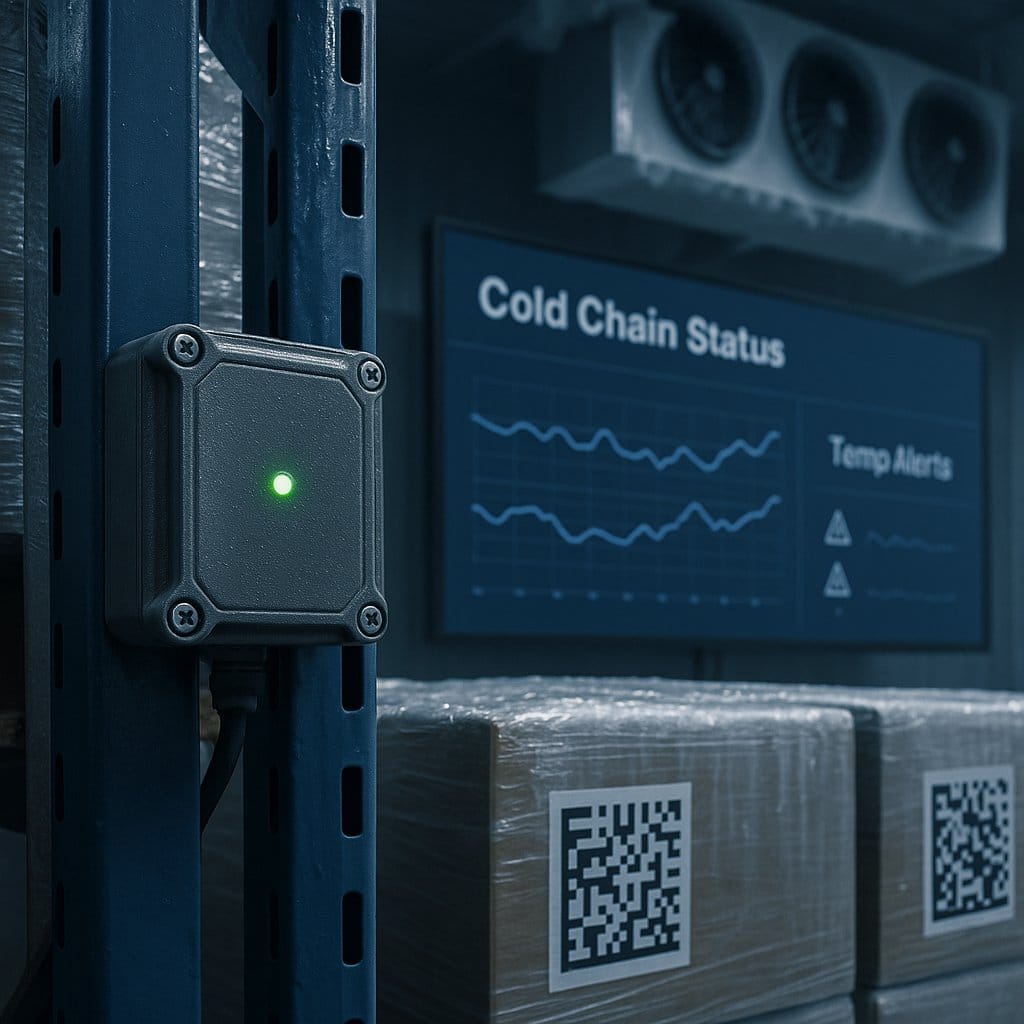
Why Does FSMA 204 Break at the Sensor Level?
The FDA’s Food Traceability Final Rule does not prescribe specific technology. It prescribes data outcomes: Traceability Lot Codes assigned at every CTE, KDEs captured in real time, and records producible to the FDA within 24 hours of request.
The enforcement deadline has moved to July 20, 2028, after the FDA extended the original January 2026 date by 30 months. As Food Logistics reported, that extension reflects an infrastructure readiness problem, not a softening of requirements. The rule itself is unchanged.
Compliance breaks at the sensor level because the five hardware failure modes below are silent. Unlike a software crash that generates error logs, a dead sensor in a cold room simply stops reporting — and the traceability platform cannot distinguish “no data” from “no event.”
Key Takeaway: Software platforms cannot compensate for hardware that fails to generate data. A traceability platform is only as reliable as the least robust sensor in the chain.
How Does Environmental Survival Determine Compliance?
Cold chain environments are among the harshest operating conditions for electronics. A sensor rated IP65 may survive dust and low-pressure water jets on a spec sheet, but food processing facilities routinely use high-pressure, high-temperature wash-down protocols that exceed IP65 thresholds.
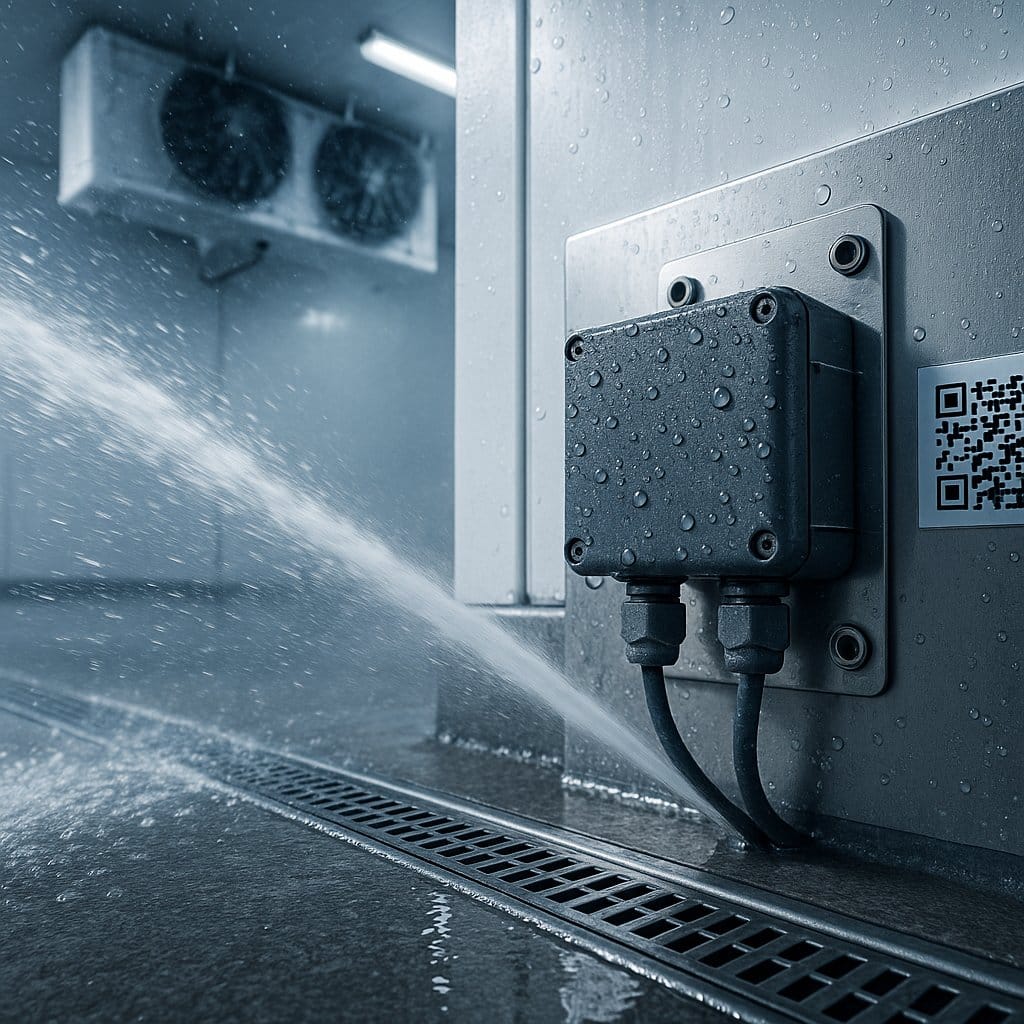
Temperature range compounds the problem. Deep-cold environments (-25°C to -40°C) fall outside the operating range of many commercial IoT sensors designed for ambient logistics.
| IP Rating | Protection Level | Cold Chain Suitability |
|---|---|---|
| IP54 | Partial dust, splash | ❌ Insufficient |
| IP65 | Dust-tight, low-pressure jets | ⚠️ Marginal |
| IP67 | Dust-tight, temporary immersion | ✅ Minimum for food processing |
| IP69K | High-pressure, high-temp wash | ✅ Gold standard |
What Battery Chemistry Survives Deep Cold?
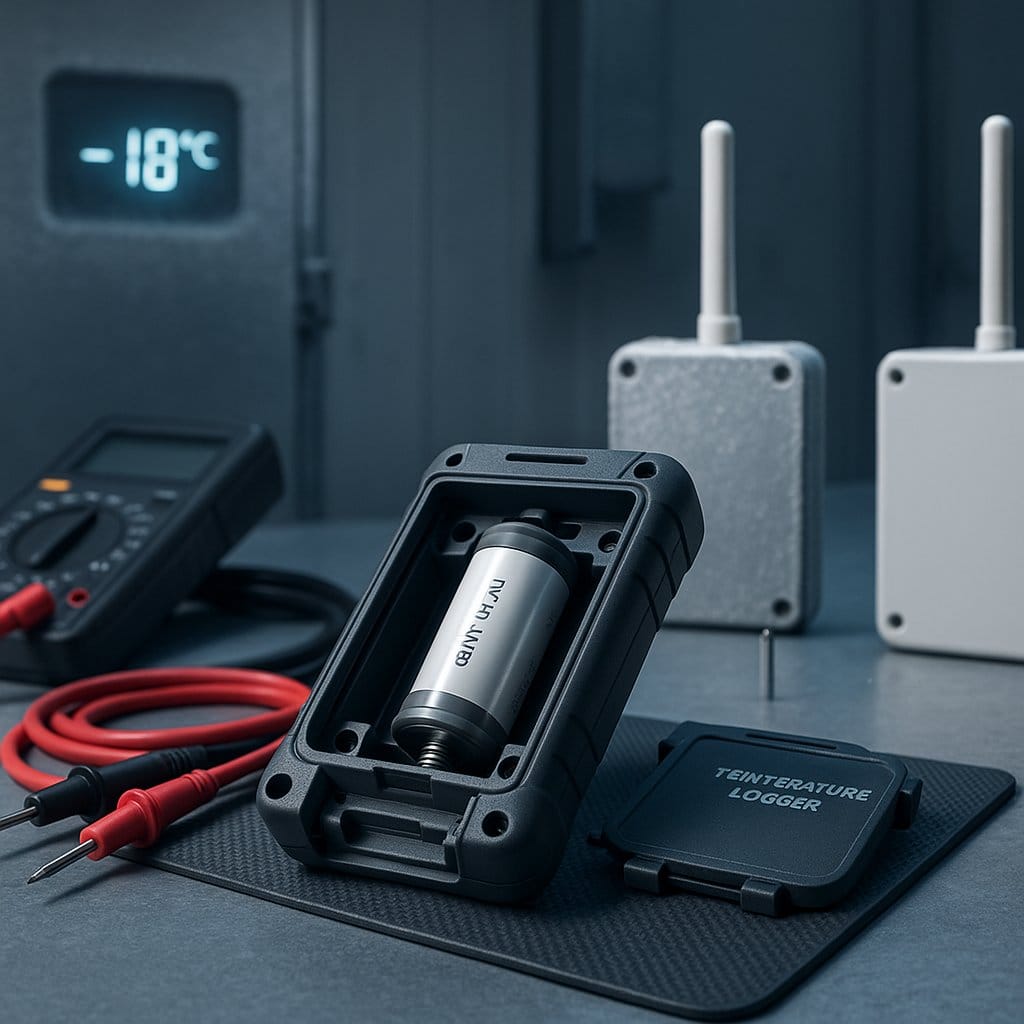
Battery selection is the single most consequential hardware decision in cold chain sensor design — and the one most frequently delegated to procurement rather than engineering.
| Chemistry | Temp Range | Self-Discharge | Cold Chain Fit |
|---|---|---|---|
| Li-ion | -20°C to +60°C | ~5%/month | ⚠️ Ambient only |
| LiSOCl₂ | -55°C to +85°C | <1%/year | ✅ Ideal — 5-10 year deep-cold |
| LiFePO₄ | -20°C to +60°C | ~3%/month | ⚠️ Limited cold range |
The critical distinction: lithium thionyl chloride (LiSOCl₂) primary cells maintain stable voltage output down to -55°C and exhibit less than 1% annual self-discharge. A sensor powered by LiSOCl₂ can operate in a -30°C frozen food warehouse for five to ten years without battery replacement.
Why Does Connectivity Architecture Matter for Compliance?
FSMA 204 requires that KDE records be producible within 24 hours. As specified in the Federal Register compliance date extension notice, that requirement assumes continuous or near-continuous data capture.
Cold storage warehouses, refrigerated trucks, and distribution center interiors present significant RF shielding. Metal racking, insulated walls, and Faraday-cage-like reefer containers attenuate cellular and Wi-Fi signals.
The engineering solution is store-and-forward capability: sensors that buffer data locally during connectivity outages and transmit automatically when signal is restored. This requires sufficient onboard memory (minimum 30 days of readings) and firmware that timestamps readings at the moment of capture, not at the moment of upload.
How Should Lot-Code Binding Work at the Physical Layer?
FSMA 204 requires Traceability Lot Codes (TLCs) to be assigned at specific CTEs. In most implementations, this binding happens in software: a warehouse management system associates a sensor reading with a lot code after the fact. The problem is temporal — if the sensor captures temperature at 14:32 and the WMS assigns the lot code at 15:15, there is a 43-minute window of ambiguity.
Hardware-level lot-code binding eliminates this gap. A sensor equipped with a barcode or QR scanner — or physically attached to a lot-code-bearing tag via BLE beacon pairing — creates an immutable association at the moment of the CTE, not retrospectively.
What Does Three-Year Total Cost of Ownership Actually Look Like?
The purchase price of a cold chain sensor is typically 15–25% of its three-year total cost of ownership (TCO). The remaining 75–85% is installation, connectivity fees, battery replacement, calibration, and the labor cost of managing sensor health across hundreds of monitoring points.
Organizations that select sensors based on unit price routinely discover that the cheapest devices carry the highest TCO. A $45 sensor that needs replacement every 18 months costs more over three years than a $120 sensor with a five-year battery and store-and-forward capability.
Frequently Asked Questions
What foods are covered under FSMA 204?
The FDA’s Food Traceability List covers high-risk categories including fresh-cut fruits and vegetables, shell eggs, certain cheeses, nut butters, fresh herbs, specific seafood, and ready-to-eat deli salads.
Does the July 2028 deadline mean organizations can wait to start hardware pilots?
The opposite. Sensor pilots in real operating conditions take 90–180 days to reveal battery, connectivity, and environmental survival issues. Waiting until 2027 compresses the discovery period and forces deployment of untested hardware under deadline pressure.
Why do traceability platforms not detect sensor failures?
Most traceability platforms are designed to process data that arrives, not to detect data that does not. A dead sensor and a sensor in a zone with no events look identical to the platform: no data.
What is store-and-forward and why does FSMA 204 require it?
Store-and-forward is an IoT sensor capability where the device buffers readings in onboard memory during connectivity outages and transmits them when signal is restored. FSMA 204 does not explicitly mandate it, but the KDE capture requirement makes it operationally necessary in RF-shielded environments.
How does lot-code binding differ from lot-code association?
Lot-code binding creates an immutable link between a sensor reading and a lot code at the exact moment of the CTE through physical mechanisms like BLE pairing or barcode scanning. Association is a software-layer process that matches data retrospectively.
Key Takeaways
- FSMA 204 compliance breaks at the hardware layer — sensor failure is silent and produces data gaps invisible to the traceability platform.
- Battery chemistry selection (LiSOCl₂ vs Li-ion) determines whether sensors survive deep-cold environments for their planned deployment life.
- IP67/IP69K environmental ratings are the minimum for food processing facilities with wash-down protocols.
- Store-and-forward capability prevents data loss during connectivity outages in shielded environments.
- Lot-code binding at the physical layer produces audit-grade data that software-layer association cannot replicate.
- Three-year TCO per monitoring point is typically 3–5× the initial sensor purchase price.
The hardware layer does not demo well. It is not a dashboard feature or a software release. But it is where traceability data is born — and where most compliance failures quietly begin.
→ Open to a conversation about how hardware architecture decisions shape traceability outcomes.