
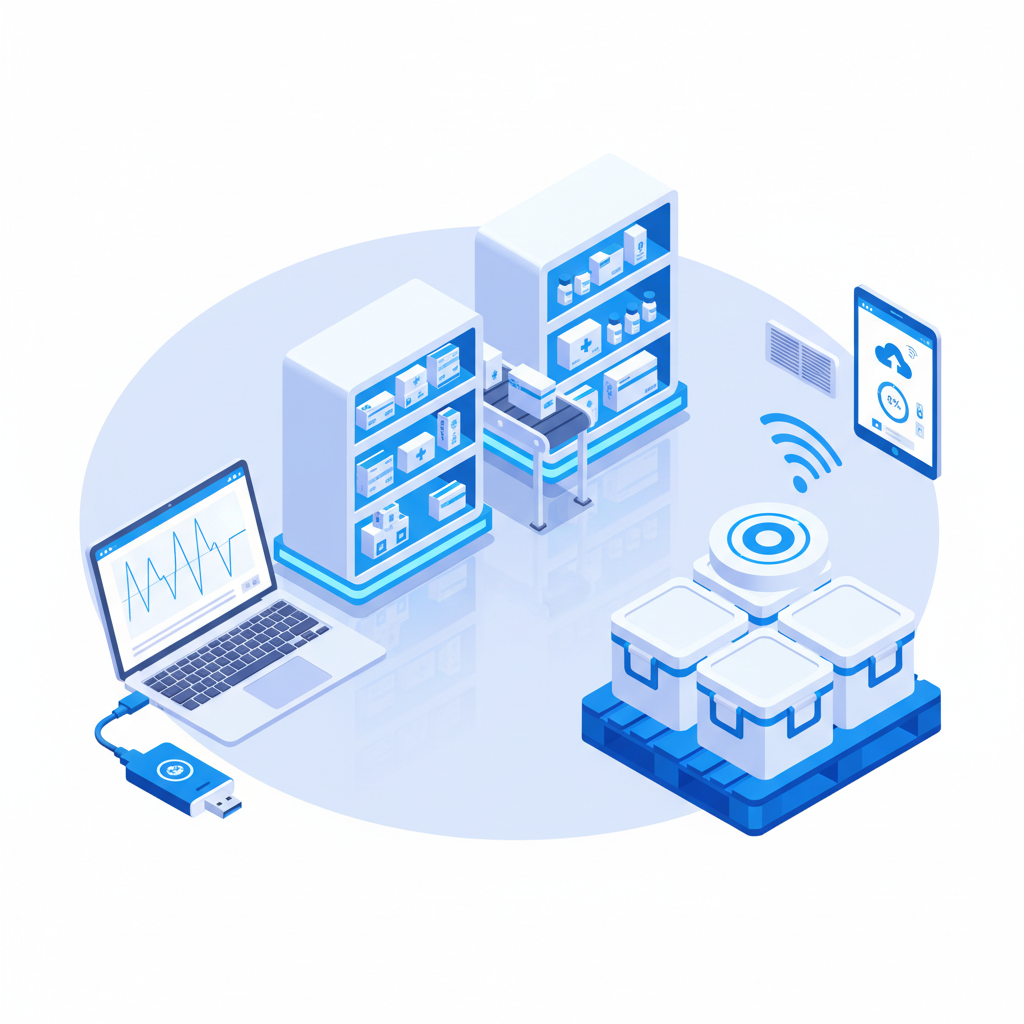
A USB data logger is a battery-powered device that records temperature readings at set intervals and stores them in internal memory. After a shipment arrives, someone physically retrieves the device, plugs it into a computer, and downloads the data. A real-time IoT monitor, by contrast, is a connected sensor that transmits temperature, humidity, location, and other environmental data over cellular or LPWAN networks to a cloud dashboard—continuously, while the shipment is still in transit.
That one-sentence distinction drives a $15 billion market shift. The cold chain monitoring industry is projected to grow from roughly USD 8.3 billion in 2025 to over USD 15 billion by 2030, and much of that growth is fueled by the migration from passive logging to active, real-time monitoring. But the transition is not as simple as swapping one device for another. I've spent over twenty years in IoT hardware development across 100+ countries, and I've watched customers struggle with this exact decision. Here's the engineering and operational reality behind each approach.
How USB Data Loggers Actually Work
USB data loggers—devices like the Testo 184 series, Elitech RC-5, or LogTag TRIX-8—have been the workhorse of pharmaceutical temperature monitoring for decades. They are compact, affordable (typically $20–$80 per unit), and require no network infrastructure. You activate the device, place it alongside your cargo, and forget about it until the shipment arrives.
The appeal is simplicity. There's no SIM card, no subscription, no cloud platform to configure. For short domestic shipments with stable supply chains, they can be perfectly adequate.
But there's a fundamental problem: USB loggers are retrospective. They tell you what happened after it already happened. If a refrigerated truck lost cooling at hour three of a twelve-hour journey, you won't know until hour thirteen—when a technician downloads the data and sees the temperature spike. By then, a $200,000 biologic shipment may already be compromised.
Key Takeaway: USB data loggers document failures; they don't prevent them. In pharmaceutical cold chains where a single temperature excursion can destroy an entire shipment of biologics, the difference between documentation and prevention is measured in hundreds of thousands of dollars.
How Real-Time IoT Monitors Change the Equation
Real-time IoT monitors use cellular connectivity (LTE-M, NB-IoT, Cat-1, or Cat-4) to push environmental data to the cloud at regular intervals—typically every 5 to 15 minutes. When a reading crosses a predefined threshold, the system triggers automated alerts via SMS, email, or platform notification.
This turns cold chain monitoring from reactive to proactive. Instead of discovering a temperature excursion after delivery, a logistics coordinator receives an alert within minutes of the event. They can then contact the driver, reroute the shipment, or activate backup refrigeration—potentially saving the entire load.
Modern IoT monitors also add sensors that USB loggers simply don't have: humidity, light exposure (detecting unauthorized container openings), shock and vibration (revealing rough handling), tilt, and GPS location. This multi-sensor data creates a complete chain-of-custody record that satisfies increasingly stringent regulatory frameworks.
The Regulatory Landscape Is Shifting Toward Real-Time
The FDA's FSMA Rule 204 and the EU's Good Distribution Practice (GDP) guidelines both emphasize continuous monitoring, traceability, and the ability to take corrective action during transit—not after. While neither regulation explicitly bans USB loggers, the direction of travel is clear: regulators want documented evidence that excursions were detected and responded to in real time.
FDA 21 CFR Part 11 compliance, which governs electronic records, also favors systems that produce tamper-proof, time-stamped data streams over manually downloaded CSV files from a USB stick. Auditors increasingly look for cloud-based audit trails with automated alerting as evidence of due diligence.
Head-to-Head Comparison
| Criteria | USB Data Logger | Real-Time IoT Monitor |
|---|---|---|
| Data access | Post-transit download only | Continuous cloud-based access |
| Alert capability | None during transit | Automated real-time alerts |
| Sensors | Temperature only (most models) | Temp, humidity, light, shock, GPS |
| Unit cost | $20–$80 | $50–$300+ (with subscription) |
| Ongoing cost | None (replacement batteries) | $3–$15/month SaaS + connectivity |
| GPS location tracking | No | Yes |
| Regulatory fit (FDA/EU GDP) | Adequate for basic compliance | Strong fit for modern audit standards |
| Battery life | 30–90 days (single use) | Months to years (depending on design) |
| Infrastructure needed | USB port + software | Cloud platform + cellular coverage |
Where USB Loggers Still Make Sense
I'm not suggesting USB data loggers are obsolete. They still serve a role in specific scenarios: short-haul domestic routes with well-established handling procedures, low-value shipments where the cost of IoT monitoring exceeds the product value, and supplementary compliance documentation where regulators accept post-transit data.
Some organizations also use loggers as a secondary validation layer alongside IoT monitors—a belt-and-suspenders approach for ultra-high-value biologics or cell-and-gene therapy shipments where redundancy is non-negotiable.
Where IoT Monitors Are Non-Negotiable
For international pharmaceutical shipments, high-value biologics, temperature-sensitive vaccines, and any route involving multiple handoffs between carriers, IoT monitoring has become the de facto standard. The reasons are straightforward: you need to know what's happening while you can still do something about it.
Research indicates that over 75% of temperature-excursion incidents in pharmaceutical logistics could be avoided with real-time Industry 4.0 monitoring tools. That's not a marginal improvement—it's a category shift in how the logistics industry approaches asset visibility.
The Hybrid Transition Path
Most pharmaceutical logistics operations won't flip a switch overnight. The practical migration path looks like this: start by deploying IoT monitors on your highest-value routes and most complex supply chains, retain USB loggers on stable domestic routes as a cost-effective baseline, and use the data from IoT deployments to build the business case for wider rollout. The economics almost always justify expansion once stakeholders see the first prevented excursion.
As modern LTE-M and NB-IoT networks continue to expand, the connectivity barrier that once limited IoT deployment is rapidly disappearing. Devices built on low-power wide-area networks can now operate for years on a single battery while maintaining reliable cloud connectivity across most global shipping lanes.
What to Look for in an IoT Monitor
If you're evaluating real-time monitors for pharmaceutical cold chain use, here are the engineering criteria that matter most: multi-sensor capability (temperature, humidity, light, shock, tilt—not just temperature), global cellular coverage with multi-band LTE-M or NB-IoT support, compliance-ready data output compatible with FDA 21 CFR Part 11 and EU GDP requirements, battery life that matches your longest shipping route with safety margin, and a cloud platform with API integration for your existing logistics software.
What is the accuracy requirement for pharma cold chain sensors?
Pharmaceutical regulatory guidelines typically require temperature accuracy of ±0.5°C or better. For cryogenic shipments such as mRNA vaccines, sensors must handle ranges down to −80°C with calibration certificates traceable to national standards like NIST or ISO 17025.
Can USB data loggers meet EU GDP compliance?
USB loggers can satisfy basic EU GDP requirements for temperature documentation, but they lack the real-time alerting and corrective-action evidence that auditors increasingly expect. Organizations relying solely on USB loggers may face more scrutiny during GDP inspections.
How long do IoT monitor batteries last in cold chain applications?
Battery life depends on reporting frequency, sensor configuration, and ambient temperature. Devices using LTE-M with aggressive power-saving modes like PSM and eDRX can achieve one to five years at typical cold chain reporting intervals of 10–15 minutes. Extreme cold temperatures below −20°C can reduce battery life by 20–40%.
What connectivity technology is best for pharma shipments?
LTE-M is generally the best fit for pharmaceutical logistics because it supports mobility, handovers between cell towers during transit, and firmware-over-the-air updates. NB-IoT works well for stationary cold storage monitoring. Some advanced devices support dual-mode operation, automatically selecting the best available network.
Is the transition from USB loggers to IoT monitors difficult?
The hardware transition is straightforward—IoT monitors are typically attach-and-activate devices. The organizational transition is harder: it requires training logistics teams to respond to real-time alerts, configuring escalation workflows, and integrating the cloud platform with existing quality management systems. Most companies achieve full deployment within 3–6 months.
Key Takeaways
- USB data loggers are retrospective; IoT monitors are proactive. The fundamental difference is whether you discover problems after they happen or while you can still prevent them.
- Regulatory momentum from FDA FSMA and EU GDP increasingly favors real-time monitoring with documented corrective actions.
- The cold chain monitoring market is projected to exceed $15 billion by 2030, driven primarily by IoT adoption.
- A hybrid transition—deploying IoT on high-value routes first—is the most practical path for most organizations.
- Evaluate IoT monitors on multi-sensor capability, global connectivity, battery life, and compliance-ready data output.
The shift from USB loggers to IoT monitoring isn't about replacing a good-enough tool with an expensive one. It's about matching your monitoring capability to the actual risk profile of pharmaceutical cold chains—where a single undetected excursion can destroy more value than a year of monitoring subscriptions.
Need help evaluating cold chain monitoring options for your pharmaceutical logistics operation? Let's discuss your requirements.