
Correction notice, 17 August 2026. This article was published in September 2025 with figures that have since been superseded, and with an evaluation section that presented modelled values as measured test results. It has been rewritten against the controlled specification. Where anything here differs from the Eelink GPT48-X product page, the product page is the controlled value.
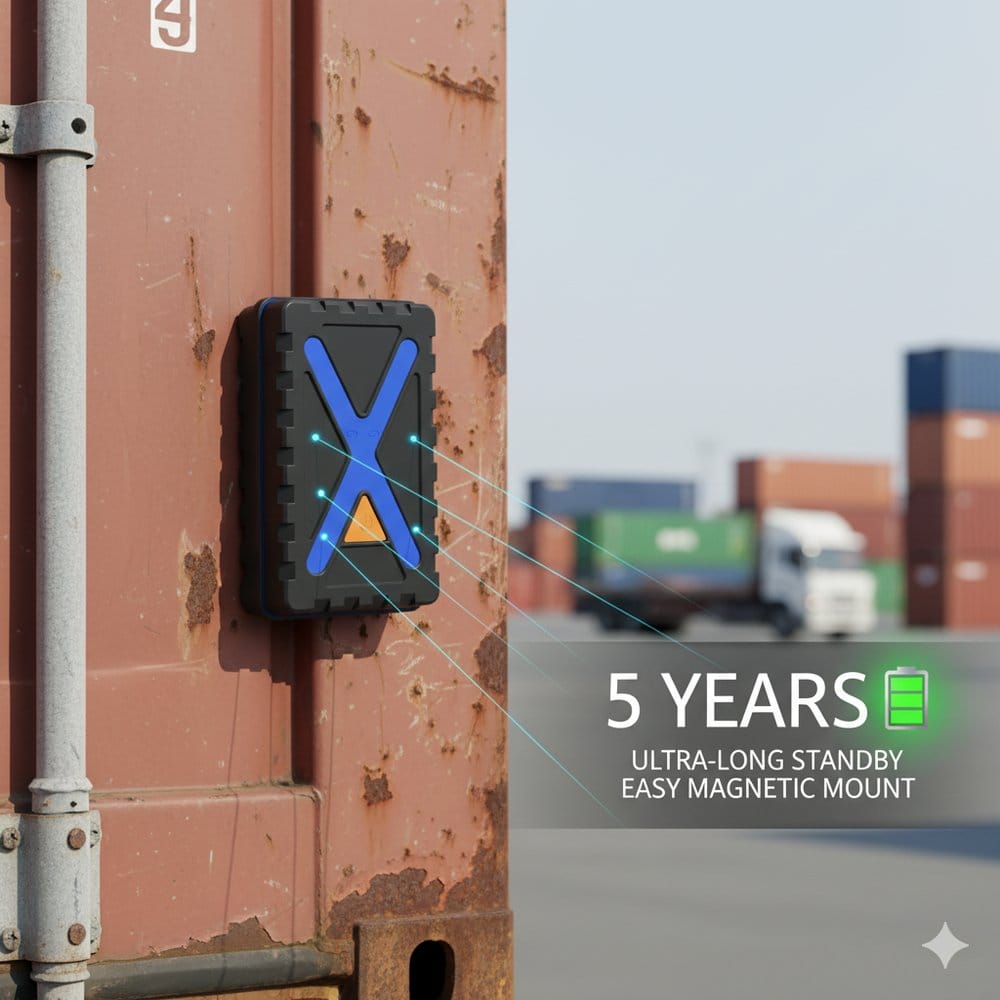
The Eelink GPT48-X is a magnetic asset GPS tracker built for assets that supply no power of their own. It runs on LTE-M and NB-IoT, carries a sealed 8000 mAh lithium-manganese primary cell rated for up to four years of standby at one report per day, and fits to bare steel in about sixty seconds with no tools and no wiring. This article covers the architecture, the controlled specification, and — in the last section — an explicit account of which numbers are modelled, which are specified, and which have no test report behind them yet.
Product Overview
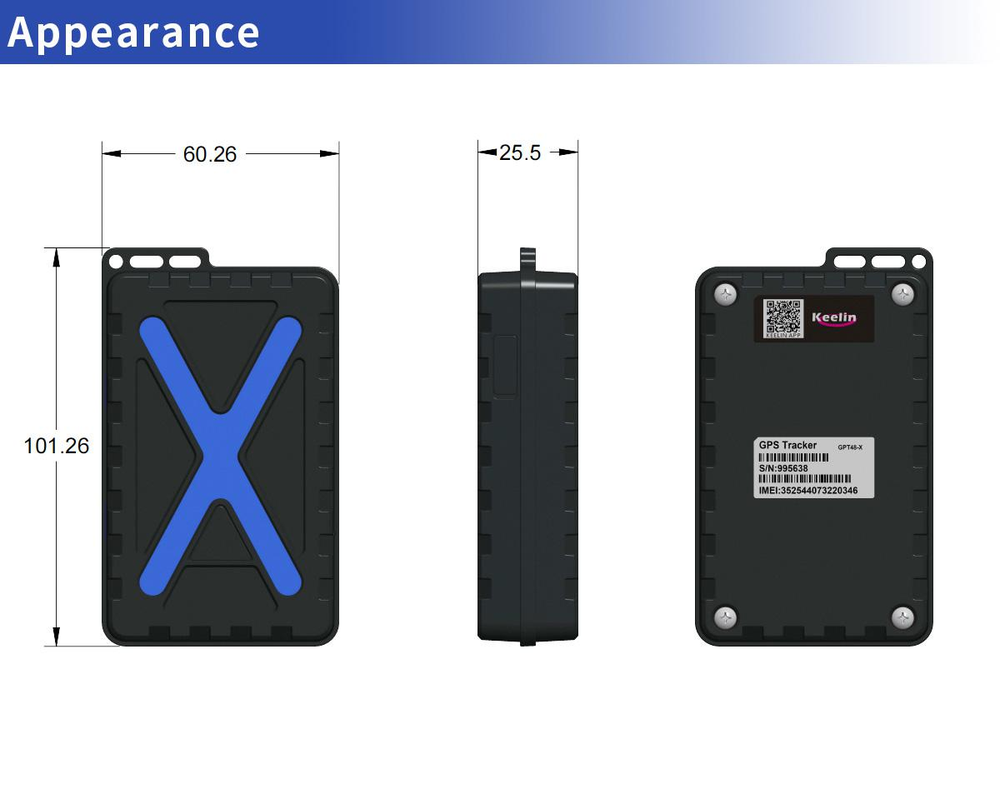
The Eelink GPT48-X measures 101.26 × 60.26 × 25.5 mm and weighs 130 g including the magnetic base. It is completely wire-free and mounts magnetically on ferrous steel, with four screw bosses for a bolted fixing where the mount has to be permanent. Its purpose is to give containers, trailers, chassis, gensets and site plant a custody and utilisation record of their own over multi-year deployments.
Key Features
- Four-year standby on one primary cell – A non-rechargeable 8000 mAh lithium-manganese dioxide (Li-MnO₂) cell at 3.0 VDC. There is no charge circuit; the USB-C port is for firmware upgrade and debug only, not charging.
- LTE-M and NB-IoT, no 2G fallback – 17 bands on LTE-M and 15 on NB-IoT from one part number. 2G is deliberately not supported: it is being retired across North America and much of Europe, and a device specified for four years has to outlive its bearer.
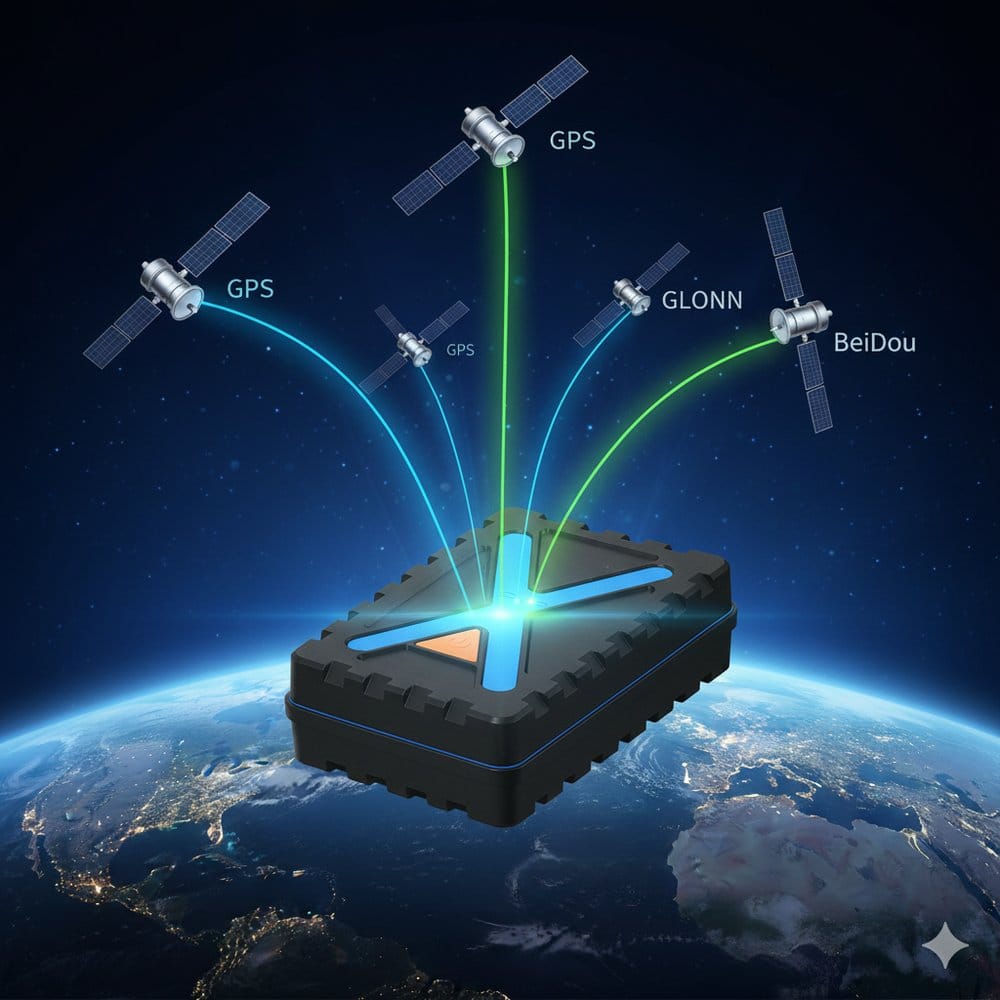
- GPS L1 C/A positioning – The Nordic nRF9160 receives a single 1575 MHz band: GPS L1 C/A, with QZSS L1 C/A where available. Accuracy is 2 m under open sky at −155 dBm sensitivity. Where the sky is gone, the device falls back to cell-tower positioning and labels it as such, so a coarse fix never silently satisfies or clears a geofence.
- Four operating modes on one part number – Long Standby, Emergency, Trip and Activity, changed over the air rather than by sending someone out to the asset.
- Motion sensing – A three-axis accelerometer arms wake-on-motion in every mode and drives vibration, fall and crash detection in Emergency mode. A tamper light sensor is scheduled for a future firmware revision and is not shipping today.
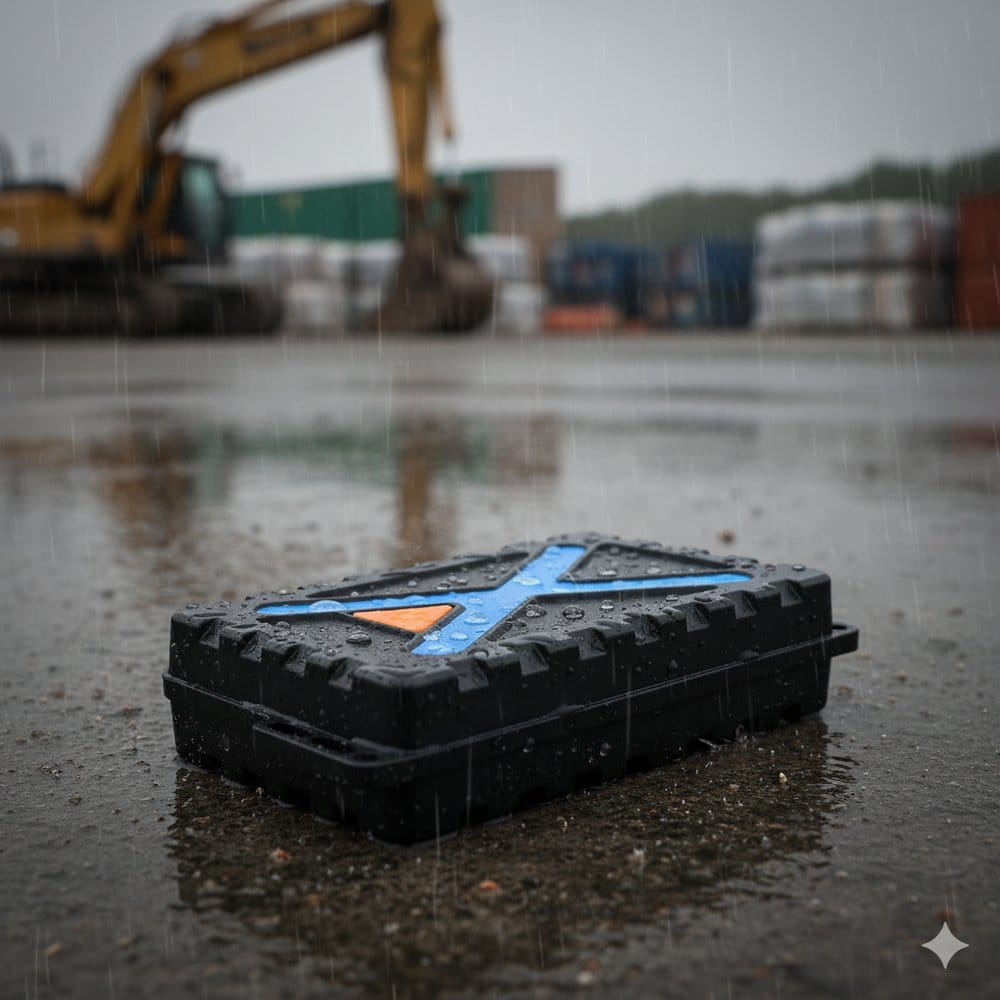
- IP65, −20 °C to +65 °C – One sealed shell with no serviceable opening, rated dust-tight and against water jets from any direction. Specified for outdoor yards, open decks and unheated storage; not for immersion or wash-down.
Technical Architecture and Power Management
The GPT48-X is built on the Nordic Semiconductor nRF9160, a certified system-in-package that carries the LTE-M / NB-IoT modem, the Arm Cortex-M33 core and the power management in one part. Fewer components between antenna and battery means fewer places for current to leak. A dedicated GPS ceramic patch antenna and an internal LTE bracket antenna keep the device fully sealed.
Firmware behaviour across the four modes:
- Long Standby – One report a day, radio off in between. This is where the four-year figure lives, and where containers and trailers sit.
- Emergency – Continuous short-interval reporting until it is switched back. This is the week an asset is missing, when every fix outranks the cell.
- Trip – Silent while parked, reporting through the journey, then a final position once the asset has been still for about four minutes.
- Activity – Wakes on the accelerometer and reports only while the asset moves. For most yard assets that is most of the year.
Remaining capacity rides on every report as a percentage, so replacement is scheduled from a dashboard rather than discovered when an asset goes quiet. Firmware updates are delivered over the air.
Hardware Specifications
- Dimensions: 101.26 × 60.26 × 25.5 mm (3.99 × 2.37 × 1.00 in). Weight: 130 g (4.6 oz).
- Power source: 8000 mAh Li-MnO₂ primary cell, non-rechargeable, 3.0 VDC, 24 Wh.
- Module: Nordic Semiconductor nRF9160 SiP. Bands B1/B2/B3/B4/B5/B8/B12/B13/B14/B17/B18/B19/B20/B25/B26/B28/B66 — 17 on LTE-M; B14 and B19 are LTE-M only, so NB-IoT presents 15.
- Positioning: GPS L1 C/A with QZSS L1 C/A, single 1575 MHz band; 2 m open sky; sensitivity −155 dBm; TTFF hot 5 s / warm 10 s / cold 32 s (published open-sky values, not guaranteed). Cell-tower positioning is a fallback measured in hundreds of metres, and is flagged as such.
- Sensors: Three-axis accelerometer for motion, vibration and shock. Tamper light sensor scheduled for a future revision, not shipping.
- Interfaces: Nano-SIM (4FF, not supplied); one key for power-on and manual wake; blue LED for GNSS, red LED for cellular; USB Type-C for firmware and debug only.
- Protocol: EELINK Device Protocol 2.0 family, document revision V2.0.3, with OTA firmware update.
- Certifications: Module-level GCF, PTCRB, FCC and CE approvals belong to the Nordic nRF9160 SiP. Module-level approval does not transfer to a finished device, so no device-level grant is claimed here; the current certificate set is issued per market on request.
Network and Positioning
LTE-M and NB-IoT are both low-power wide-area technologies, and the difference between them matters more than the band count. LTE-M holds the link in connected mode while the asset moves; NB-IoT reselects in idle mode only. Seventeen bands on LTE-M and fifteen on NB-IoT means one part number for most markets — but PSM and eDRX are 3GPP features the visited network has to implement, not device features Eelink can guarantee. Where a network attaches but withholds them, the standby estimate does not hold, so this is confirmed per country before order rather than claimed globally.
Where satellite signal is unavailable — inside a container, under a stacked pallet, in an urban canyon — the device falls back to a position derived from nearby cell towers. Size that expectation honestly: peer-reviewed measurement puts median cellular positioning error near 600 m against 8 m for assisted GPS (Zandbergen, Transactions in GIS, 2009). It answers which yard, not which bay, and it is flagged as a cell-derived position so it never silently triggers or clears a geofence.
Where It Fits
The GPT48-X is a deploy-and-redeploy device rather than a permanent installation. Typical deployments:
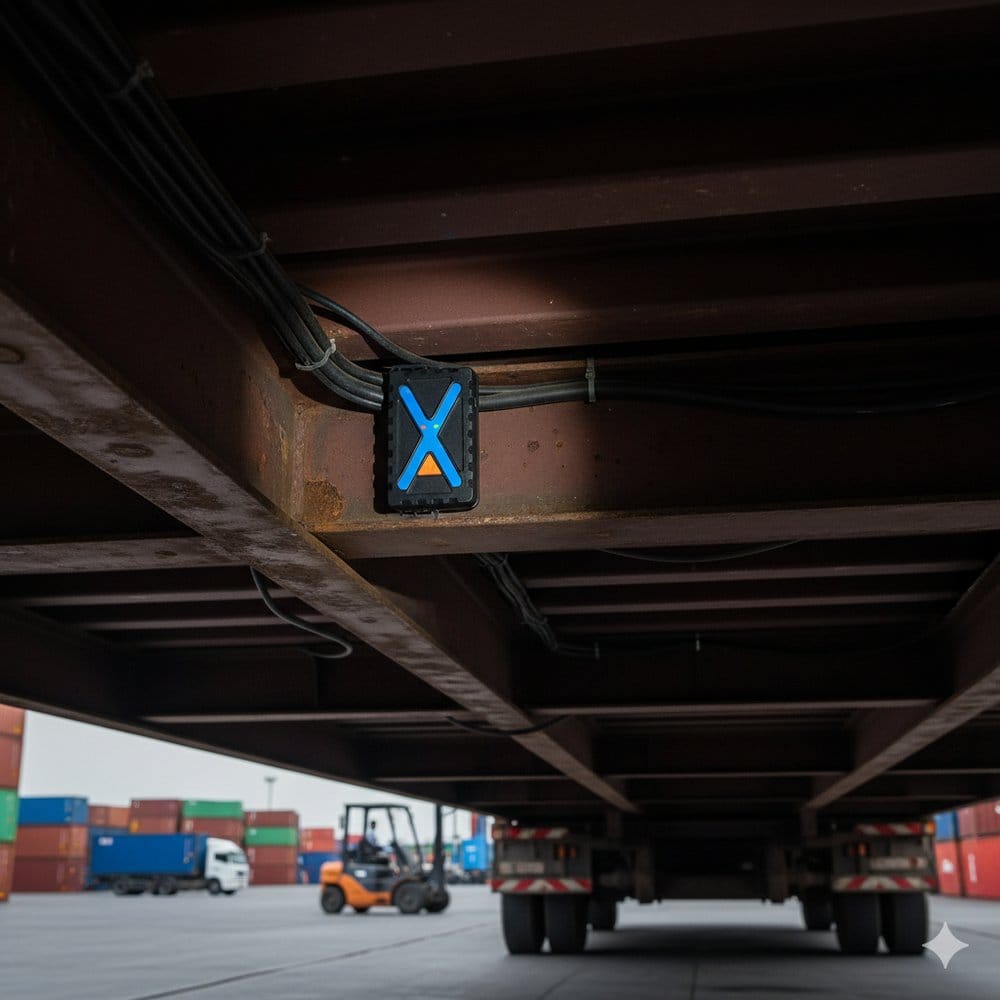
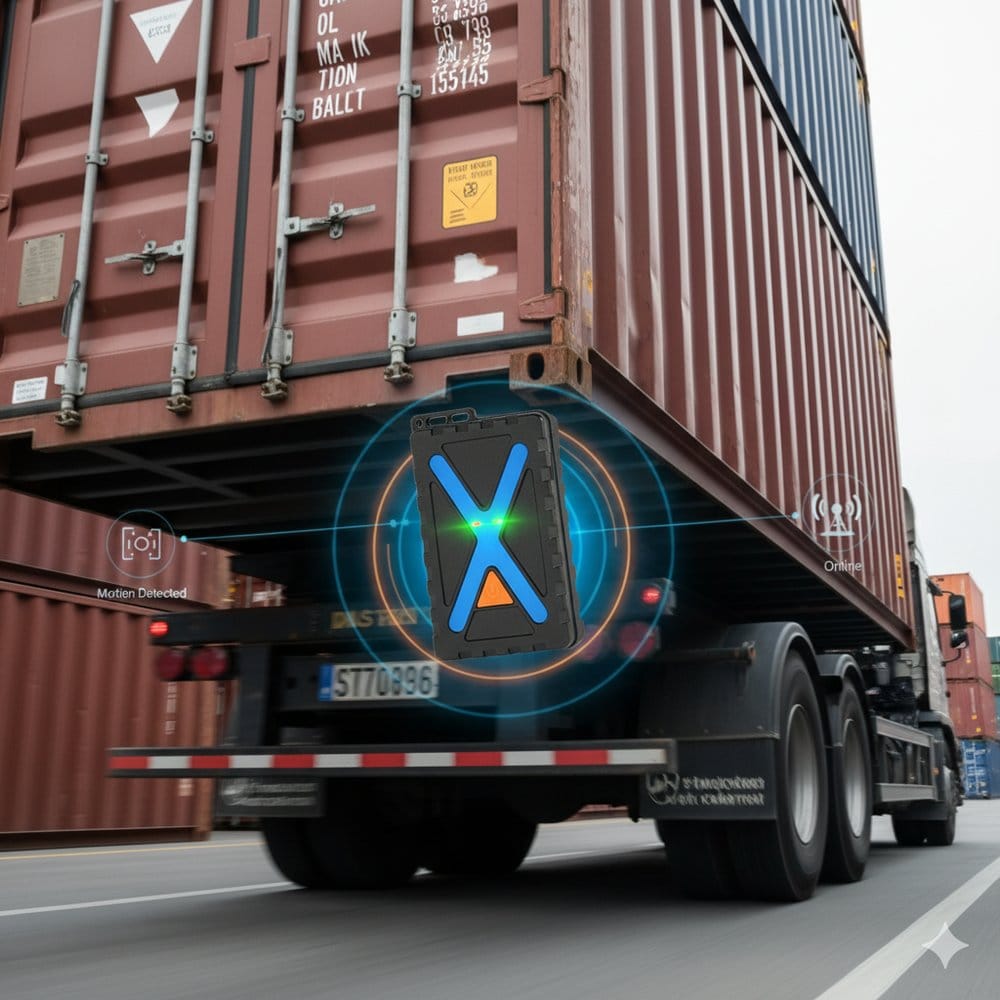
- Trailers, containers and chassis: assets that sit for months with nothing to plug into.
- Gensets and site plant: high-value equipment that moves between sites and is worth recovering.
- Long-term rental and leasing: multi-year contracts without a battery swap in the middle.
- Returnable steel assets: where the question is utilisation and custody, not cargo condition.
It is the wrong device when the asset has a permanent 12/24 V feed, when you need continuous second-by-second tracking, when the device will be immersed or pressure-washed, or when the asset lives below −20 °C. If the question is the condition of the cargo rather than the custody of the asset, the multi-sensor Eelink GPT45-M is the counterpart device.

What Is Modelled, What Is Specified, and What Is Not Yet Measured
This section previously reported endurance, accuracy, connectivity and drop-test figures as measured results from laboratory and field testing. Those measurements did not exist and have been removed. A device released this recently cannot have a multi-year continuous discharge record behind it, and publishing one was wrong. What follows is the distinction we should have drawn in the first place.
Modelled — the published energy ledger. The four-year figure is arithmetic, and the arithmetic is public. Idle draw between reports is 0.144 mAh per day. One wake, GNSS fix and LTE-M report is approximately 4.42 mAh. At one report per day that is 4.56 mAh per day, so 8000 mAh ÷ 4.56 gives about 1,754 days, or 4.8 years. Eelink derates that to four years and four years is the only standby number that goes into a quotation. The derate exists because the transmit term is modelled from the 265 mA upper bound of the LTE-M working current at attach and fix times typical of good coverage; a device attaching at the cell edge holds its transmit current longer on every wake, and that term dominates the budget. Coverage moves this number more than temperature does.
Modelled — other reporting cadences. Run the same ledger faster and the life roughly halves with each doubling of cadence: one report every twelve hours lands near two years, every six hours near twelve months, hourly near nine weeks. These are outputs of the same published arithmetic, not bench results. Trip and Activity mode life is set by motion rather than by a timer, so those are quoted against a customer’s real movement profile rather than modelled here.
Specified — not measured by us. IP65, the −20 °C to +65 °C operating range, 2 m open-sky accuracy, −155 dBm sensitivity and the TTFF set (5 / 10 / 32 s) are datasheet values. The TTFF figures in particular are published open-sky values and not guaranteed: under steel, in a stack, or against a wall, real fix times will be longer.
Not yet measured — no report exists. There is no device-level ingress, drop, vibration or thermal-cycling report available today, and no device-level FCC, CE or PTCRB grant. There is no measured discharge curve, no measured false-alarm rate and no measured magnet-retention figure. Rated magnet pull, where it is quoted at all, is measured perpendicular on bare flat thick steel at zero gap — none of which describes a painted chassis rail, so retention should be validated on your own asset before a fleet order.
Where the GPT48-X is weaker than the alternatives. Three places, better heard from us than found on a pilot. Ingress protection is IP65, sealed against weather and water jets but not immersion or wash-down, where several competitors are IP67. The operating floor is −20 °C where some units reach −30 °C. And the lithium-manganese cell carries roughly half the energy density of the bobbin lithium-thionyl-chloride most of this industry fits — capacity traded away deliberately to keep the transmit burst intact in year four.
Conclusion
The Eelink GPT48-X pairs a four-year primary cell with LTE-M / NB-IoT connectivity, GPS L1 C/A positioning and a sealed IP65 housing in a device that fits to bare steel in about sixty seconds and can be lifted off and redeployed onto the next asset. Four operating modes on one part number, changed over the air, let the same hardware run a four-year yard census and a live recovery.
The figures above are stated as what they are: a published energy model, a datasheet, and an explicit list of what has not been measured yet. The controlled specification lives on the Eelink GPT48-X product page, which carries the full footnote set naming every figure where an older Eelink document disagrees.